
Portable Network Cable: The Field Kit Cord
Quick answer / TL;DR: Short answer: carry one 5 m flat or retractable cord and one 10 m standard cord; both stranded, both with moulded snagless plugs. Category Cat6 is enough for any field task. Check the strain relief and avoid cords that coil into a fixed cassette – the cassette is the part that breaks.
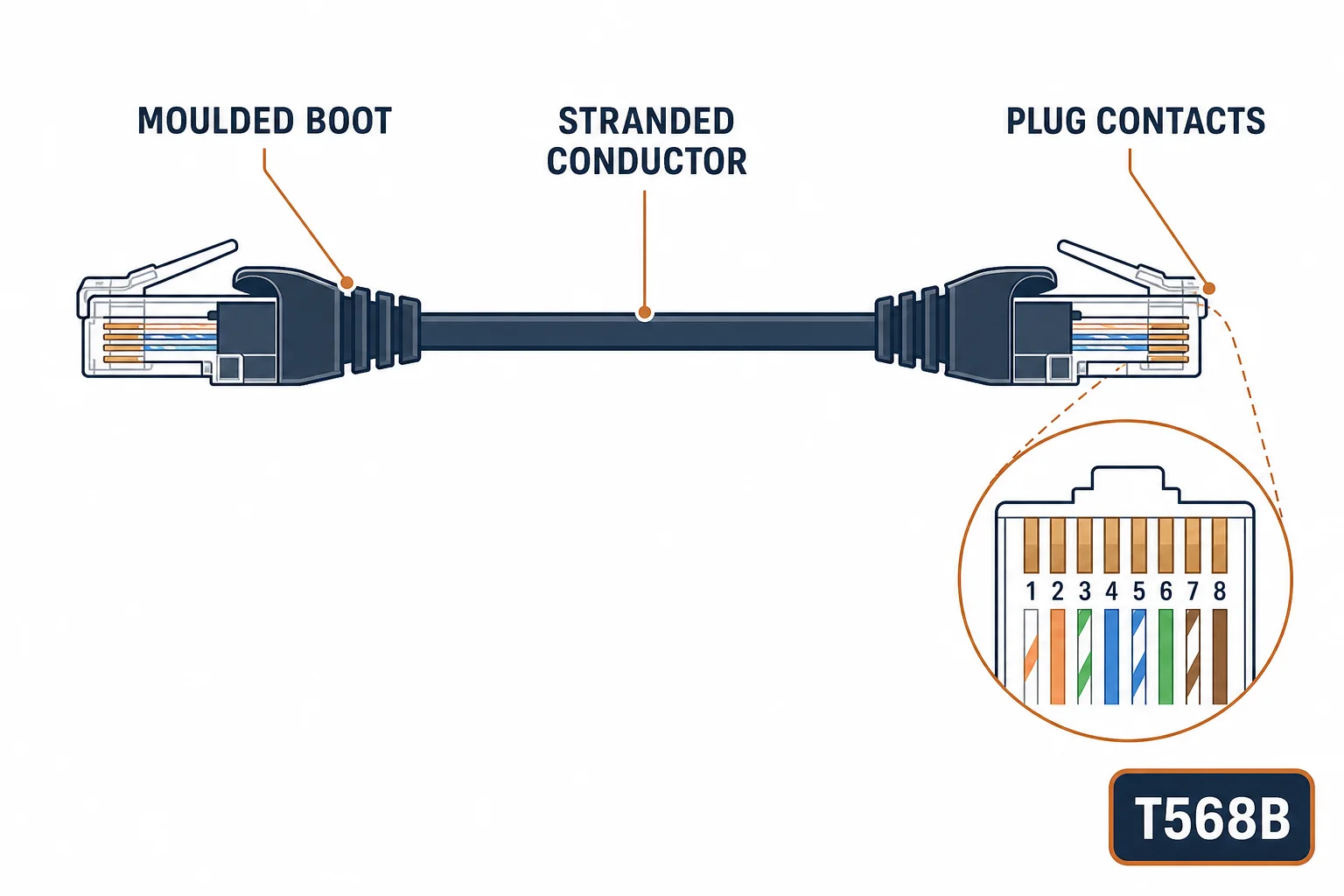
A portable network cable is bought for a bag, not a building: a site visit, a conference room, a temporary link where the cable will be coiled, stuffed and uncoiled again. In that life the category matters less than the jacket and the plugs, because the cable fails from handling long before it fails from bandwidth.
This is the field-kit guide: the forms that travel well, the length that covers most visits, and the durability markers worth paying for.
The Forms That Travel
| The form | The advantage | The weakness |
|---|---|---|
| Flat | Packs flat, no coil memory | Thin conductors, shorter life |
| Retractable cassette | Tidy, fixed length | The mechanism fails first |
| Standard round | Durable, repairable | Bulky in a bag |
| Slim round | Light, small coil | Less strain relief |
The trade is always the same: the more the cable is optimised for packing, the less material it has to survive handling.
The Length That Covers Visits
- 5 m: desk to wall in most meeting rooms
- 10 m: across a room to a projector or a switch
- 20 m: rare, and usually a permanent installation instead
- Two cords beat one long one for flexibility
The pair of lengths covers almost every field scenario without forcing a long cord into a short job.
Durability Markers
| The marker | The reason |
|---|---|
| Moulded plugs | Field-crimped plugs fail in a bag |
| Stranded conductor | Flex life at the plug |
| Snagless boot | Latches survive packing |
| Jacket thickness | Abrasion in a laptop bag |
These are the four things to look at in the product photograph; the category is on the label and rarely the issue.
Standards and Verification
| The reference | The relevance |
|---|---|
| TIA-568.2-D | Cord requirements |
| IEC 60603-7 | The plug interface |
| Continuity test | After a season in a bag |
Per-SKU construction is not provided in the knowledge base. The cord rules are standard; test a travelling cord periodically rather than trusting it.
Real-World Applications
The site visit
An engineer visiting three sites in a day: one 5 m and one 10 m cord in the bag, both Cat6 stranded – every link made without borrowing from the customer.
The cassette failure
A retractable cord used daily for a year: the spring failed and the cable would not retract. Replaced with a flat cord – fewer parts, longer life.
The borrowed cable
A visit where no cord was carried: a cable borrowed from the site and forgotten. The kit rule afterwards – two cords, always in the bag, checked at packing.
Related reading: The cord construction that survives handling — blogs/news/patch-cord-buying
Related reading: The stock lengths for a kit — blogs/news/short-ethernet-cable
Frequently Asked Questions
What makes a network cable portable?
Stranded construction, moulded plugs and a jacket that survives packing – not the category.
Flat or round for a bag?
Flat packs better but has thinner conductors; round is more durable.
What length should I carry?
A 5 m and a 10 m cord cover nearly every field situation.
Do retractable cables last?
The cassette mechanism usually fails before the cable does.
Sourcing cables for a project, a store, or a private-label line? Contact our B2B sales team for specifications, certification evidence, and volume terms – FOB and CIF options available. Request a quote or sample.