
Patch Cords: The Assembly Behind Every Port
Quick answer / TL;DR: Short answer: a patch cord is a stranded-conductor assembly with a plug at each end, rated to the same category as the cabling it joins. Specify category, boot type, length and colour; buy them as a managed stock by length, and never use a cord where permanent cabling is required.
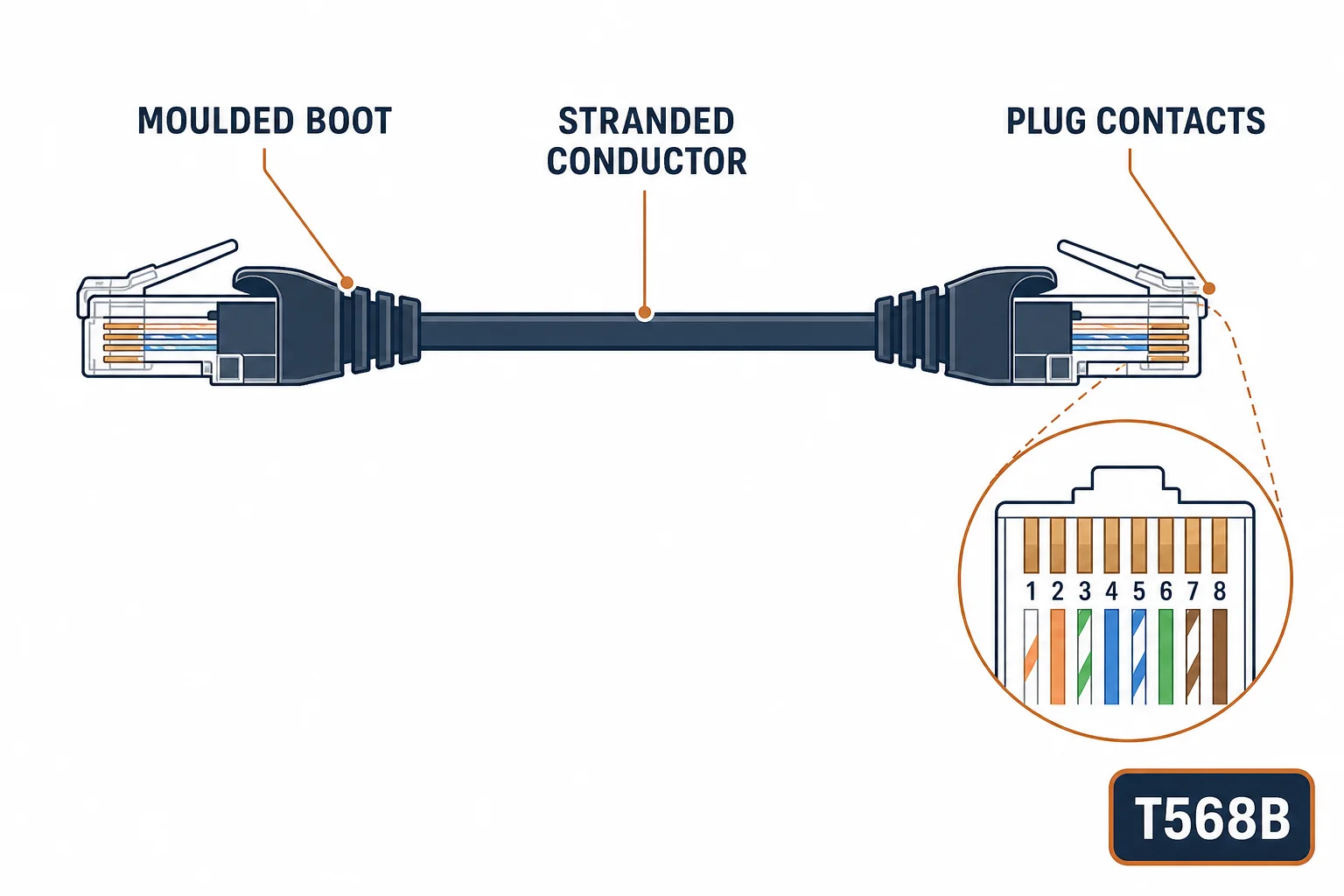
Every port in a rack or at a desk is completed by a patch cord, and the cord is the part most often bought by habit rather than specification. The category is only the first decision; the conductor form, boot and length decide how the cord survives and how the cabinet reads.
This is the patch cord guide: what the assembly contains, the four decisions, and the stock policy that stops a drawer of unknown cords.
What the Assembly Contains
| The part | The function |
|---|---|
| Stranded conductors | Flex life at the plug |
| Moulded boot | Strain relief and latch protection |
| Plug contacts | Eight positions, category-rated |
| Jacket | Flexible compound for handling |
The assembly is designed for movement: each part trades a little electrical margin for mechanical survival.
The Four Decisions
- Category: match the permanent cabling, or the channel is limited by the cord
- Boot: snagless for dense racks, standard elsewhere, slim where ports are close
- Length: the shortest that reaches without strain
- Colour: one per function for legibility
The decisions are cheap to make at order time and expensive to correct after a cabinet is built.
The Stock Policy
| The length | The stock level |
|---|---|
| 0.5 m | High – cabinet patching |
| 1 m | High |
| 2 m | Medium |
| 3 m | Medium |
| 5 m | Low |
Standards and Verification
| The reference | The relevance |
|---|---|
| TIA-568.2-D | Cord requirements within a channel |
| ISO/IEC 11801-1 | Category definitions |
| Field test | Channel test with cords in place |
Per-SKU cord construction is not provided in the knowledge base. The construction rules are standard; check category and stranded construction on delivery.
Real-World Applications
The cabinet build
A 48-port panel patched with 0.5 m and 1 m cords in two colours: the patching legible, the spare lengths stocked in the same colours.
The break-fix call
An intermittent link traced to a cord with a cracked latch: replaced from managed stock in a minute – the labelling making the swap obvious.
The cord as permanent cabling
Cords run through a ceiling void instead of cable: no rating, no support, no test. Replaced with Cat6 CMR – the shortcut reversed.
Related reading: The naming and boots in detail? Read the patch leads guide — blogs/news/ethernet-patch-leads
Related reading: The category that matches the cord? Read the Cat5e patch cable guide — blogs/news/cat5e-patch-cable-buying
Frequently Asked Questions
What is a patch cord?
A short stranded-conductor cable with plugs at both ends, used to connect equipment to outlets or patch panels.
Patch cord or patch cable – is there a difference?
In practice no; both describe the same assembly. 'Patch cable' is sometimes used loosely for bulk cable too.
Can patch cords be any length?
Up to a few metres for normal use. Beyond that the run should be permanent cabling with outlets.
Why do patch cords fail?
Mostly at the plug: latch breakage, strain at the boot, or conductor fatigue from repeated flexing.
Sourcing cables for a project, a store, or a private-label line? Contact our B2B sales team for specifications, certification evidence, and volume terms – FOB and CIF options available. Request a quote or sample.