
Outdoor Ethernet 100 Ft: The Practical Length
Quick answer / TL;DR: Short answer: buy cable rated for outdoor use – UV-stable, and gel-filled if it will be buried or in wet conditions – at 100 ft for a typical garden run. Seal both connectors, add a drip loop at each end, and keep the run out of standing water. 30 m leaves ample channel margin; the failure mode is water, not distance.
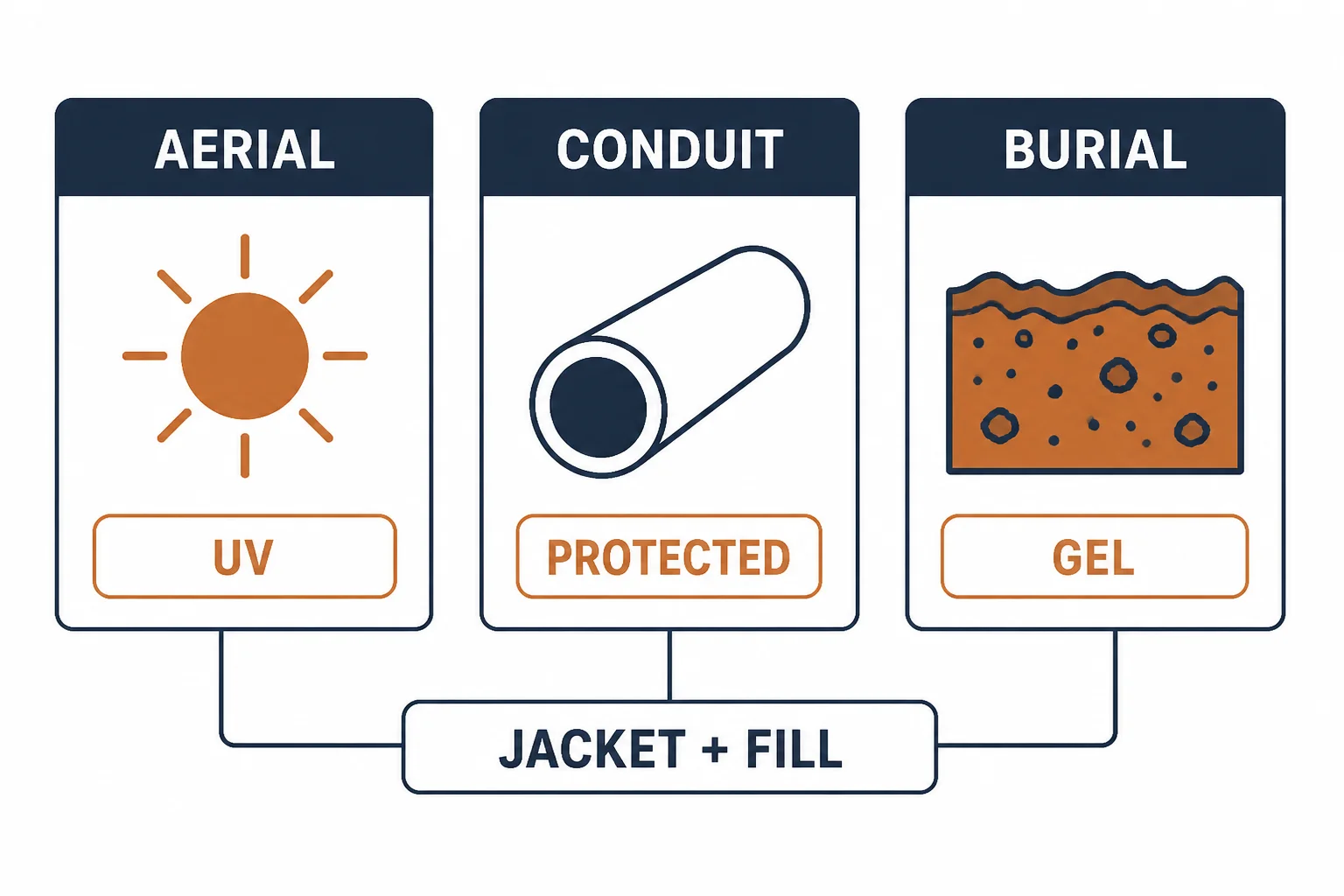
Outdoor ethernet cable in a 100 ft length covers the common domestic exterior run: house to shed, house to gate camera, house to a garden office. At 30 metres it is well inside the channel limit, which means the jacket and the connectors decide whether it lasts, not the bandwidth.
This is the 100 ft outdoor guide: what the rating must include, the connector protection that keeps water out, and the routes where this length is the right purchase.
What the Rating Must Include
| The feature | The reason | The omission |
|---|---|---|
| UV-stable jacket | Sunlight degrades PVC | Cracking within a season |
| Water blocking | Moisture travels inside | Corrosion at the far end |
| Abrasion resistance | Soil and stone contact | Jacket breach |
| Temperature range | Winter flexibility | Jacket splits when moved |
The rating is about the environment; a cable rated only for indoor use will fail on exposure even if it is electrically identical.
The Route Decisions
- Aerial: needs UV stability and support
- Conduit: protects against mechanical damage
- Direct burial: needs gel fill and depth
- Along a fence: protected from strimmers and animals
The route determines which of the rating features matters most, so the route should be settled before the cable is bought.
The Connector Protection
| The method | The use |
|---|---|
| Sealed enclosure | The most reliable |
| Gel-filled connector | Where access is impossible |
| Self-amalgamating tape | With a drip loop |
| Drip loop | Always |
The connector is where water enters, and the enclosure is the only method that stays inspectable.
Standards and Verification
| The reference | The relevance |
|---|---|
| TIA-568.2-D | Exterior cabling practice |
| IEC 60529 | IP ratings for enclosures |
| UL 444 | Jacket ratings |
| Field test | Link test plus a visual seal check |
Per-market exterior requirements are not provided in the knowledge base. The sealing principles are standard; confirm the local rule for burial depth if the route leaves the surface.
Real-World Applications
The garden office
A studio 28 m from the house: 100 ft outdoor cable in conduit along the fence, sealed enclosures at both ends – gigabit and no water ingress after two winters.
The drip that was missing
A camera fed by an outdoor cable entering the housing upward: water tracked in and corroded the plug. A drip loop formed below the gland – the fault removed without changing cable.
The indoor cable outside
An indoor Cat6 run along a wall for a year: the jacket chalked and cracked where the sun hit it. Replaced with an outdoor-rated cable – the rating had been the missing line.
Related reading: The outdoor installation methods — blogs/news/outdoor-install-methods
Related reading: The weatherproofing detail at the connector — blogs/news/weatherproof-ethernet-cable
Frequently Asked Questions
Is 100 ft enough for a garden run?
For most domestic runs, yes – 30 m is well inside the 100 m channel.
Do I need gel-filled cable?
For burial or permanently wet conditions, yes; for a sheltered surface run, UV-stable may suffice.
How do I stop water entering?
Seal the connectors and form a drip loop before the cable enters a device.
Can I use indoor cable outdoors?
It will degrade in sunlight and is not rated for wet conditions.
Sourcing cables for a project, a store, or a private-label line? Contact our B2B sales team for specifications, certification evidence, and volume terms – FOB and CIF options available. Request a quote or sample.