
Is Cat8 Backwards Compatible: The Matrix
Quick answer / TL;DR: Short answer: yes, Cat8 is backwards compatible at the connector level – RJ45 is RJ45. The link then runs at the lowest common capability: Cat8 cable on a 1G port gives 1G; Cat5e cable on a 25G port gives Cat5e's ceiling. Compatibility is physical; performance is negotiated and limited by the weakest component.
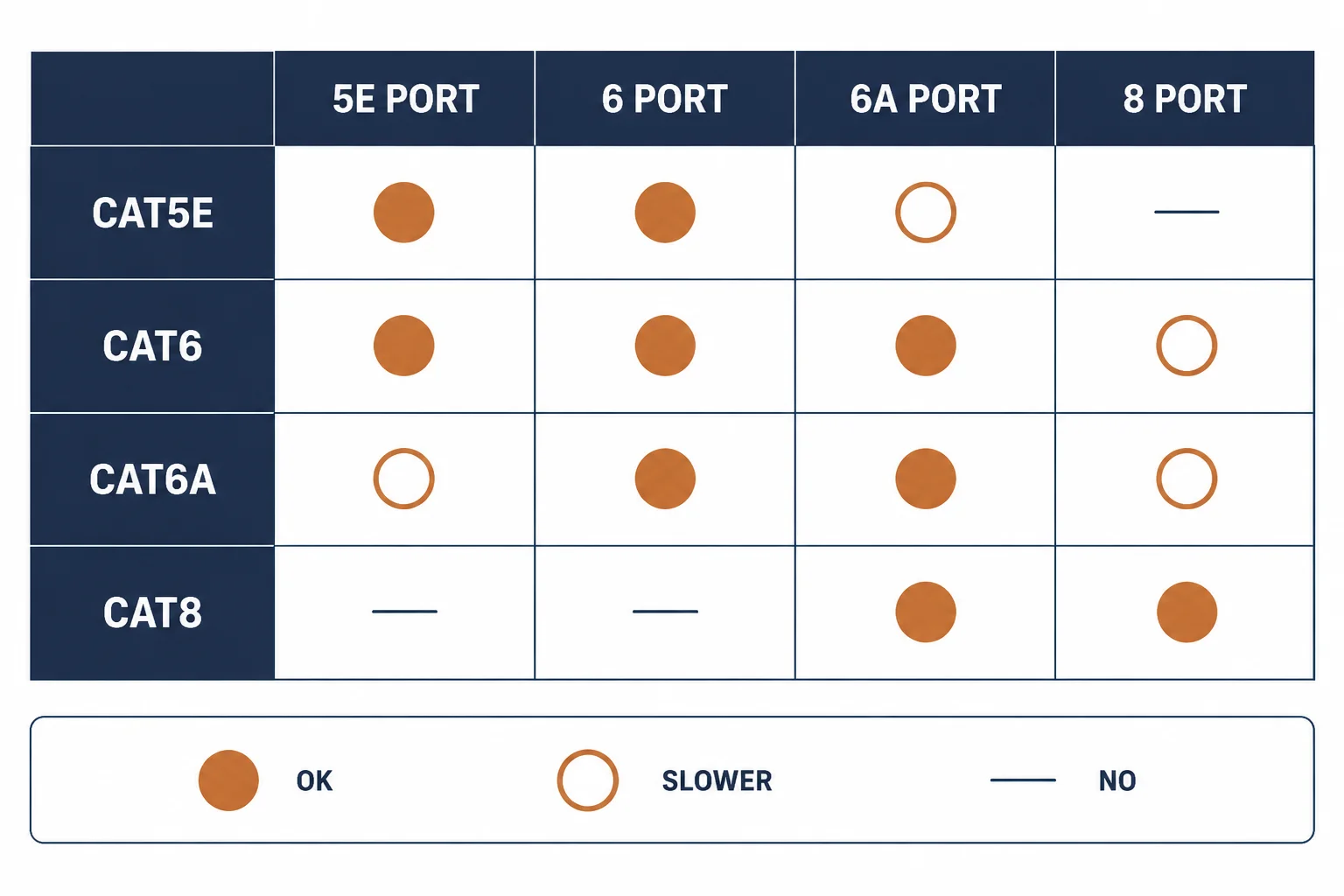
Cat8's RJ45 plug fits older ports – that is the short answer, and it hides the useful one: compatibility is about negotiation, not connectors. A Cat8 cable in a 1G port runs at 1G; an old cable in a 25G port leaves the link at the old category's ceiling. The matrix makes the combinations explicit.
This is the compatibility guide: the plug, the negotiation, and the combinations that surprise buyers.
The Matrix
| Cable \ Port | 1G | 2.5G/5G | 10G | 25G/40G |
|---|---|---|---|---|
| Cat5e | Works | Short only | No | No |
| Cat6 | Works | Works | To ~55 m | No |
| Cat6a | Works | Works | To 100 m | No |
| Cat8 | Works | Works | Works | To ~30 m |
The table reads down the columns: each port speed is available only where the cable's category supports it at the run's length.
What Actually Happens
- Auto-negotiation: both ends advertise their best common speed
- The cable's category caps what the negotiation can reach
- Length caps the category – a 60 m Cat6 run cannot do 10G
- Diagnostics: link speed reported by the switch is the ground truth
The mechanism is negotiation with a physical ceiling: the ports agree on a speed the cable can carry. The switch's link report is the honest witness.
The Combinations That Surprise
| The situation | The expectation vs reality |
|---|---|
| Cat8 in a 1G switch | Expectation: faster. Reality: 1G – the port's limit |
| Cat5e in a 10G switch | Expectation: 10G. Reality: Cat5e's ceiling or link refusal |
| Cat8 at 45 m | Expectation: 25G. Reality: beyond the 30 m rating |
Standards and Verification
| The reference | The relevance |
|---|---|
| TIA-568.2-D | Category and channel requirements |
| IEEE 802.3 (various) | The speed standards and their media assumptions |
| The switch's link report | The practical verification of negotiated speed |
Per-SKU compatibility is not provided in the knowledge base. The matrix reflects the standards' distance limits; verify the negotiated link speed on the actual equipment.
Real-World Applications
The leftover Cat8 patch
A data-center spare used on an office desk: the link negotiating 1G – the cable excess harmless, the expectation corrected.
The old-cable surprise
A new 10G switch reporting 1G on a legacy run: the cable's category found as the ceiling – the run replaced, the speed arriving.
The length check
A 40-meter Cat8 run planned for 25G: the distance ceiling caught at design – the run shortened or the speed plan adjusted.
Related reading: The Cat8 vs Cat6 case? Read the comparison — blogs/news/cat8-vs-cat6-buyer
Related reading: The 10G distance limits? Read the Cat6 10G guide — blogs/news/cat6-10gb-distance
Frequently Asked Questions
Is Cat8 backwards compatible with Cat5e and Cat6?
Physically yes – the RJ45 connector fits. The link runs at the lowest common capability, so a Cat8 cable on a Cat5e port gives Cat5e speeds.
Can I use Cat5e cable with a 10G switch?
The link will negotiate to what the cable supports – typically 1G, or 2.5G on short runs. 10G needs Cat6 or better within its distance limits.
Does a higher-category cable slow anything down?
No – it simply does not add speed beyond the ports. The cable is a ceiling, never a brake.
How do I verify the actual link speed?
Check the switch's port status or the device's link report. That figure reflects the negotiated speed the cable supports.
Sourcing Cat6 or Cat6a for a project, a store, or a private-label line? Contact our B2B sales team for datasheets, category test reports, and volume terms – FOB and CIF options available. Request a quote or sample.