
Is Cat6a Shielded: The Construction Answer
Quick answer / TL;DR: Short answer: Cat6a is normally shielded – the common constructions are F/UTP (overall foil) and S/FTP (braid plus per-pair foil). The shield is what supports the category's 500 MHz performance over 100 m. Verify on the datasheet: the code F/UTP or S/FTP, the drain wire, and the grounding instructions.
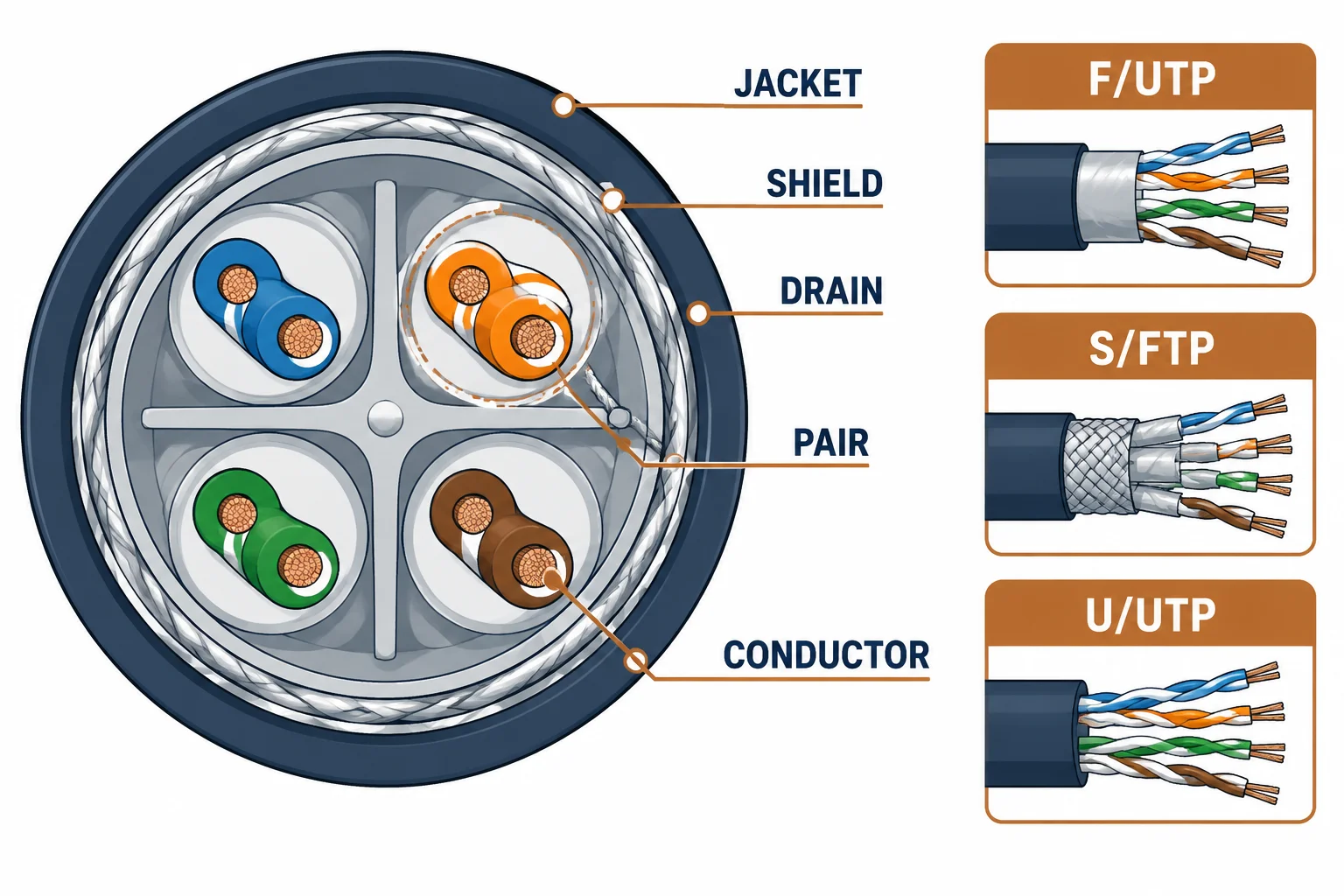
Cat6a is the category that mainstreamed shielding in office cabling: its construction is defined around shielded builds (F/UTP, S/FTP), and the shield is part of how it reaches 500 MHz over the full 100 meters. That does not mean every 'Cat6a' product is identical – it means the buyer should read the construction code, not assume it.
This article answers the shielding question with the cross-section, the construction codes, and the datasheet check.
The Construction Codes
| The code | The build | The typical use |
|---|---|---|
| F/UTP | Overall foil shield around four unshielded pairs | Office and campus Cat6a |
| S/FTP | Braid overall plus foil per pair | Industrial and high-interference paths |
| U/UTP | No shield – not the typical Cat6a construction | Rare in true Cat6a builds |
The codes are the datasheet's shorthand: the first letters describe the outer shield, the second pair the pair-level shield. The code is verifiable; the word 'shielded' on its own is not.
What the Shield Does
- Rejects external interference before it reaches the pairs
- Supports the higher frequency range with controlled crosstalk
- Requires grounding practice – the drain wire connects at the patch panel end per the installation standard
- Adds stiffness and diameter – the bend radius grows
The shield is an engineering feature with obligations: performance on one side, grounding discipline on the other. An ungrounded shield is a floating conductor, not a benefit.
The Datasheet Check
| The line | The expected entry |
|---|---|
| Construction | F/UTP or S/FTP |
| Shield material | Aluminum foil, braid where specified |
| Drain wire | Present, with grounding instructions |
| Category test | 500 MHz, channel test to 100 m |
Standards and Verification
| The reference | The relevance |
|---|---|
| TIA-568.2-D | Cat6a construction and field-test requirements |
| ISO/IEC 11801-1 | The Cat6a channel definition |
| IEC 61156 | Pair construction and shielding definitions |
Per-SKU constructions and shielding materials are not provided in the knowledge base. The construction codes are standard; confirm the exact build on the supplier's datasheet and follow the grounding instructions.
Real-World Applications
The campus backbone
A building-to-building Cat6a run: F/UTP with the drain grounded at the panel – the shield doing its job along the path that needed it.
The machine hall
A production hall with VFD drives: S/FTP Cat6a for the control network – the braid and pair foils answering the noise the environment generates.
The ungrounded mistake
A shielded installation with the drain left floating: intermittent errors traced to the shield's potential. The grounding fixed, the errors gone.
Related reading: The Cat6a upgrade case? Read Cat6a vs Cat6 — blogs/news/cat6a-vs-cat6-buyer
Related reading: The shielding decision in general? Read the shielded cable test — blogs/news/shielded-ethernet-cable-need
Frequently Asked Questions
Is Cat6a always shielded?
In practice yes – the common Cat6a constructions are F/UTP and S/FTP. Confirm the code on the datasheet rather than assuming the word 'shielded'.
Does shielded Cat6a need grounding?
Yes – the drain wire must be bonded per the installation standard, typically at the patch panel. An ungrounded shield does not deliver its benefit.
What is the difference between F/UTP and S/FTP?
F/UTP has one overall foil shield; S/FTP adds a braid and shields each pair. S/FTP suits harsher interference environments.
Is shielded Cat6a harder to install?
Somewhat – larger diameter, stiffer jacket, tighter bend radius, and grounding discipline. The installer's technique matters more than with U/UTP.
Sourcing Cat6 or Cat6a for a project, a store, or a private-label line? Contact our B2B sales team for datasheets, category test reports, and volume terms – FOB and CIF options available. Request a quote or sample.