
Is Cat6 Better Than Cat5e: The Arithmetic
Quick answer / TL;DR: Short answer: Cat6 doubles Cat5e's bandwidth (250 vs 100 MHz) and adds 10G capability to about 55 m, with tighter construction. Upgrade when installing new cable, when runs approach 100 m, or when 2.5G/5G/10G is on the roadmap. Keep Cat5e when the channel tests clean and the network is 1G at short distances – the cable is not the bottleneck.
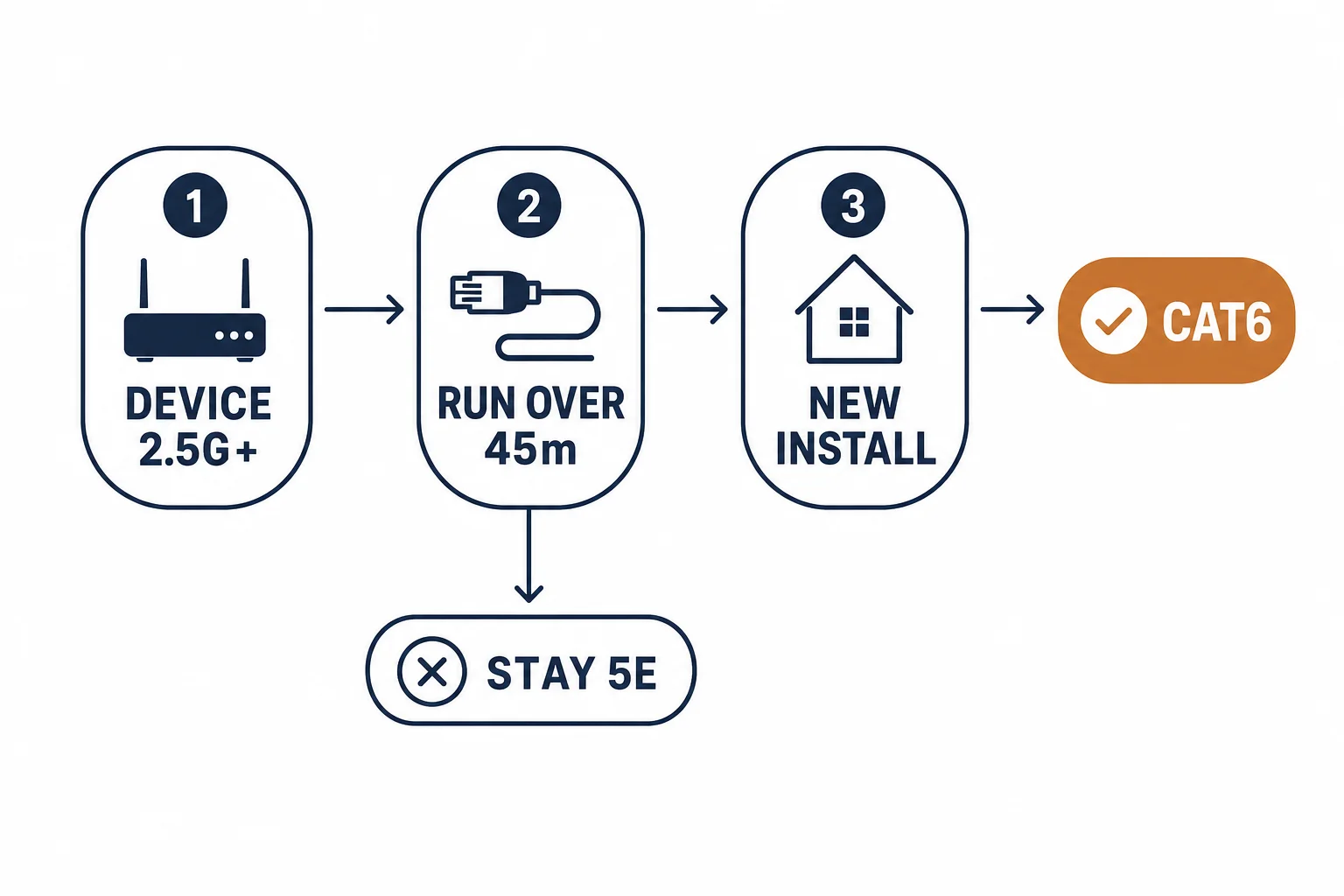
Cat6 is faster on paper and better built in practice – and Cat5e is still adequate for most existing 1G networks. The decision is an arithmetic of three variables: the speed the devices will use, the length of the runs, and whether the cable is being installed new or kept.
This is the upgrade arithmetic: the measured differences, the cost of changing, and the cases where staying is correct.
The Measured Differences
| The attribute | Cat5e | Cat6 |
|---|---|---|
| Bandwidth | 100 MHz | 250 MHz |
| 1G distance | 100 m | 100 m |
| 2.5G/5G | Limited or short | Supported on typical runs |
| 10G | Not supported | About 55 m |
| Construction | Looser pair geometry | Tighter geometry, often a spline |
The bandwidth row is the one that matters for the future: it buys headroom for 2.5G and 5G, which Cat5e cannot guarantee on long runs.
The Cost of Changing
- Cable and connectors: modest premium over Cat5e for new installs
- Labor: the dominant cost in any re-cable – the reason to decide once
- Panels and keystones: replaced with the cable if the category changes
- Downtime: the real cost in occupied buildings
The labor logic drives the decision: if the wall is open, install the better category once. If the wall is closed and the channel tests clean, the labor math usually says stay.
When Staying Is Correct
| The situation | The call |
|---|---|
| 1G switching, runs under 60 m, clean test results | Keep Cat5e |
| Long runs near 100 m | Cat6 for margin |
| Planned 2.5G/5G access points | Cat6 to the AP |
| New construction | Cat6 – the labor is already being spent |
Standards and Verification
| The reference | The relevance |
|---|---|
| TIA-568.2-D | Both categories and their test methods |
| IEEE 802.3bz | 2.5GBASE-T and 5GBASE-T, the headroom Cat6 protects |
| ISO/IEC 11801-1 | The international category table |
Per-SKU performance is not provided in the knowledge base. The category limits are standard; test the existing channel before deciding to keep it.
Real-World Applications
The open-wall moment
A renovation with the ceilings down: Cat6 installed throughout – the labor already committed, the headroom bought once.
The clean-test decision
A 15-year-old Cat5e install testing clean at 1G: kept, with the test report filed – the upgrade deferred on evidence rather than assumption.
The access-point upgrade
New 2.5G access points on 80-meter runs: Cat6 pulled to the AP locations only – the upgrade targeted where the bandwidth will be used.
Related reading: The buying criteria in full? Read the best ethernet cable guide — blogs/news/best-ethernet-cable-criteria
Related reading: The Cat6a step beyond Cat6? Read Cat6a vs Cat6 — blogs/news/cat6a-vs-cat6-buyer
Frequently Asked Questions
Is Cat6 much better than Cat5e?
It doubles the bandwidth (250 vs 100 MHz) and supports 10G to about 55 m. For 1G at short distances, the difference is headroom rather than current performance.
Should I replace Cat5e with Cat6?
Only when the channel fails or the network needs more than 1G. If it tests clean at 1G, the labor cost of replacement rarely pays back.
Does Cat6 need different connectors?
RJ45 is the same interface; Cat6 termination is less forgiving of untwisting. Use Cat6-rated keystones and panels for the category's benefit.
Will Cat6 improve my internet speed?
Only if the cable was the bottleneck. Internet speed is set by the service and the equipment; the cable prevents the bottleneck.
Sourcing Cat6 or Cat6a for a project, a store, or a private-label line? Contact our B2B sales team for datasheets, category test reports, and volume terms – FOB and CIF options available. Request a quote or sample.