
In-Wall Ethernet Cable: Rated or Not
Quick answer / TL;DR: Short answer: use solid-conductor cable with a jacket rated for the space – CM for general walls, CMR for risers, CMP for plenums – and terminate at outlets. Never run a patch cord inside a wall. Leave a service loop, support the cable, and test the link before the wall is closed.
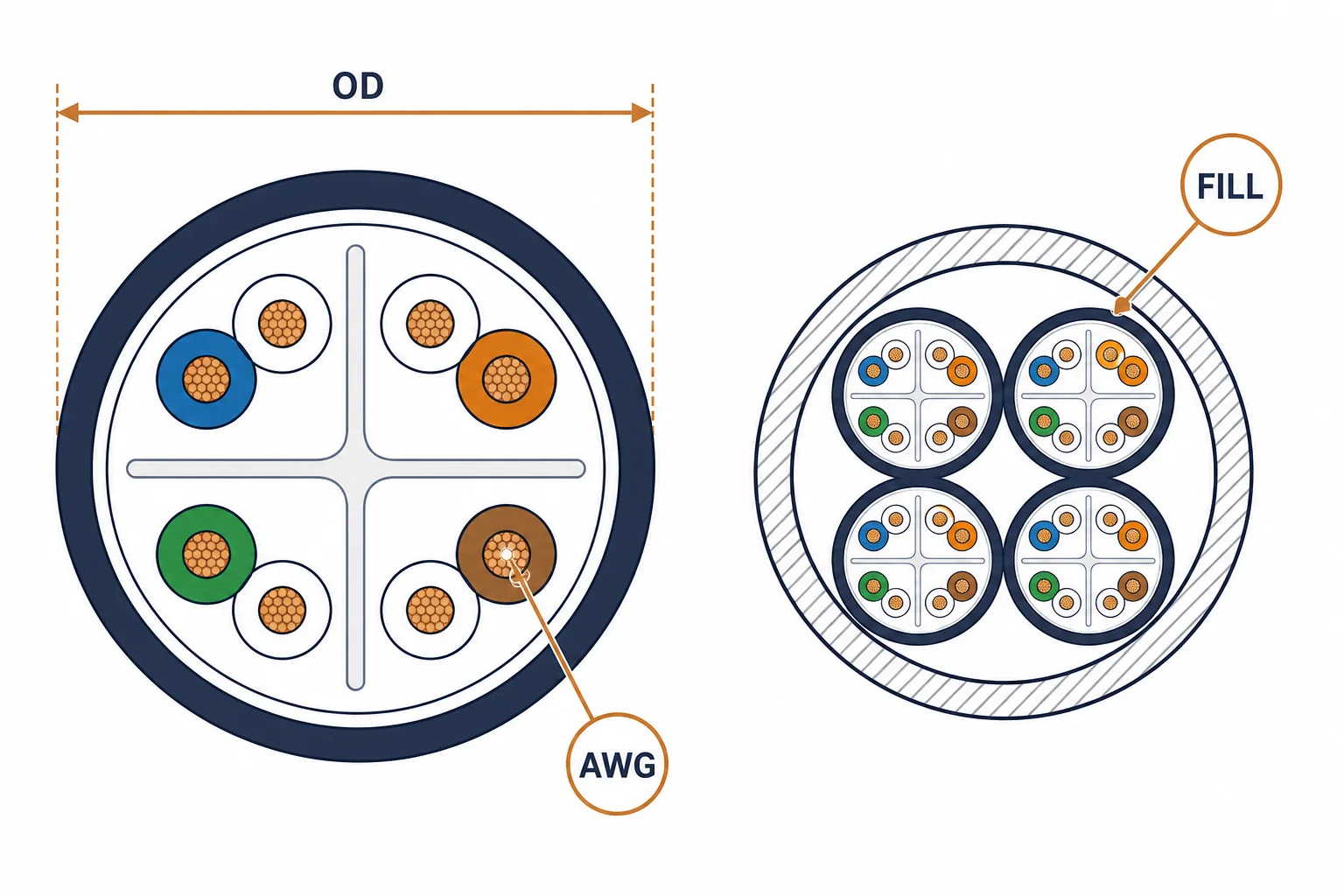
In-wall ethernet cable is defined by one thing a patch cord lacks: a jacket rating that permits it inside a building's fabric. The distinction is not cosmetic – an unrated cord in a wall fails inspection, may void insurance, and is unreachable when it fails.
This is the in-wall guide: what the rating covers, the routes that need which jacket, and the installation details that make a wall run last.
What the Rating Covers
| The jacket | The permitted space | The note |
|---|---|---|
| CM | General-purpose walls | Not risers or plenums |
| CMR | Vertical shafts | Between floors |
| CMP | Plenums and air paths | Highest flame and smoke performance |
The rating is about fire behaviour in the space the cable passes through, not about the cable's data performance.
Why a Cord Cannot Go in a Wall
- The jacket is not rated for the space
- Stranded conductors are not designed for permanent installation
- No support or strain relief inside the cavity
- Failure means opening the wall
The four reasons are independent, and any one of them is enough to reject the practice.
Installation Details
| The detail | The practice |
|---|---|
| Support | Clips or conduit, not hanging |
| Bend radius | Respected at both ends |
| Service loop | About a metre at each outlet |
| Test | Before the wall is closed |
| Firestop | At rated penetrations |
The test before closing is the only cheap moment in the project; after that, a fault is a demolition.
Standards and Verification
| The reference | The relevance |
|---|---|
| UL 444 / NEC | Jacket ratings and routes |
| TIA-568.2-D | Installation practice |
| IEC 61156 | Cable construction |
| Field test | Permanent link test |
Per-market code requirements are not provided in the knowledge base. The rating ladder is standard; confirm the local requirement for the specific wall or shaft.
Practical Notes
Conduit is worth the extra cost in any wall that might change: it turns a re-pull into a fifteen-minute job and protects the cable from the plasterer's trowel. Where conduit is impossible, photograph the route before closing the wall.
Real-World Applications
The stud wall install
Six drops in a new stud wall: solid Cat6 in conduit, outlets fitted, every link tested before boarding – no rework after decoration.
The cord in the wall
A patch cord stapled inside a wall to reach a TV: the inspector rejected it and the insurer was notified. Replaced with rated cable and an outlet – the shortcut cost more than the correct job.
The missing service loop
A cable cut exactly to length: when the outlet was re-terminated there was no slack, and the cable had to be extended. The next run left a loop – the mistake not repeated.
Related reading: The jacket ratings compared — blogs/news/cable-jacket-ratings
Related reading: The riser variant for shafts — blogs/news/cat6-riser-cable
Frequently Asked Questions
Can I run a patch cord in a wall?
No – the jacket is not rated for the space and the conductors are not for permanent installation.
What jacket rating do I need?
CM for general walls, CMR for risers, CMP for plenums.
Solid or stranded in a wall?
Solid – it is the construction for permanent runs and punch-down termination.
Should I use conduit?
Yes where the wall may change; it makes a future re-pull trivial.
Sourcing cables for a project, a store, or a private-label line? Contact our B2B sales team for specifications, certification evidence, and volume terms – FOB and CIF options available. Request a quote or sample.