
How to Tell If Ethernet Cable Is Shielded
Quick answer / TL;DR: Short answer: check the jacket print first – U/UTP means unshielded; F/UTP, FTP, or S/FTP means shielded. At a cut end, a foil layer and a bare drain wire confirm the shield. At the panel, shielded jacks and a bonded bar confirm the installation was designed for shielding. Any one check is enough; two make it certain.
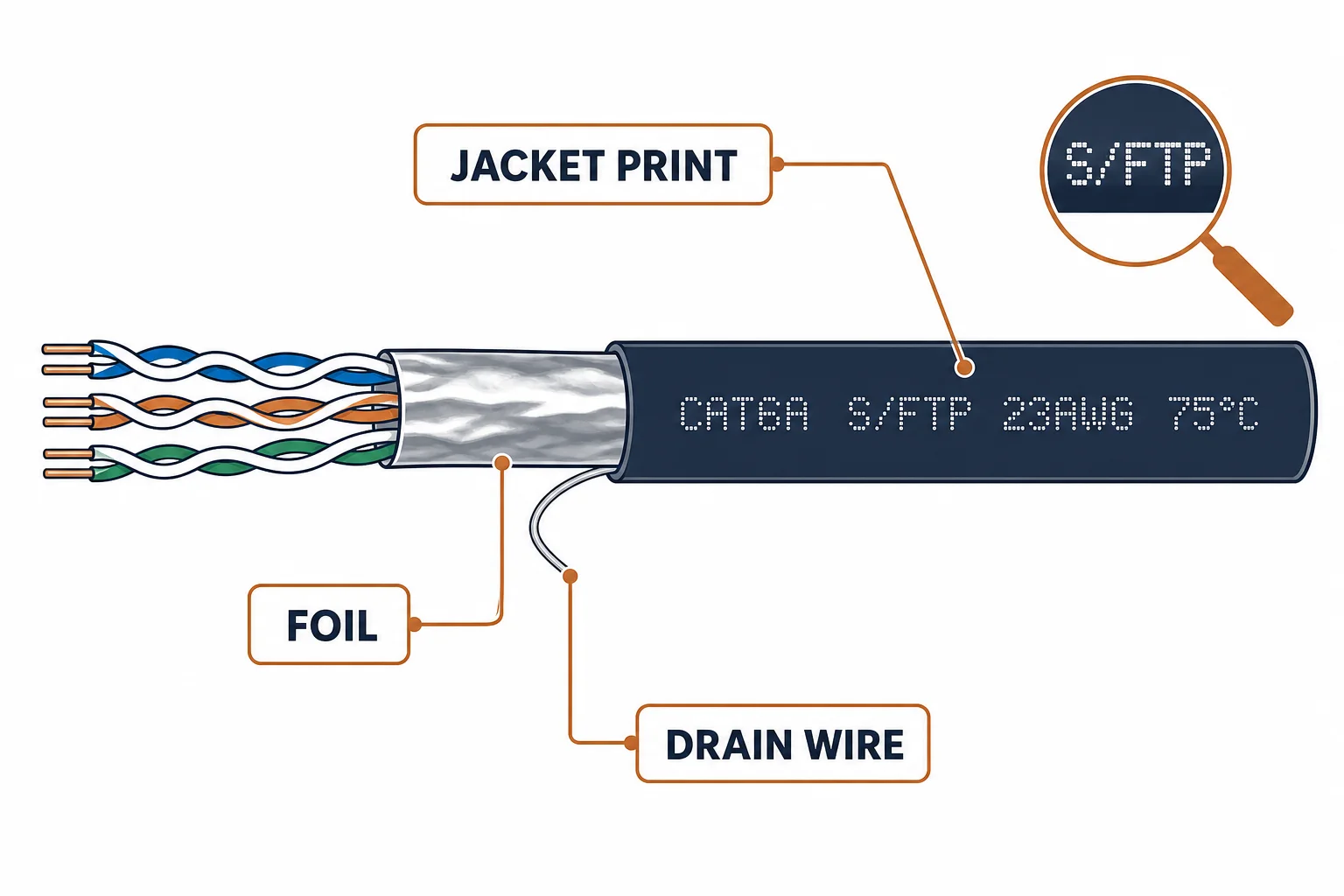
Shielded or not is a construction fact that the cable will tell you – if you know where to look. Three checks settle it in a minute: the print on the jacket, the layer under the jacket at a cut end, and the construction of the panel it terminates into. This guide runs them in order.
This is the field identification guide: the three checks, what each proves, and the purchase decisions that follow.
The Three Checks
| The check | What it proves | The limit |
|---|---|---|
| Jacket print | The manufacturer's declared construction | Faded or absent on old cable |
| Cut end | The physical layers – foil, braid, drain | Requires access to a termination |
| Panel build | The installation's intent | A shielded cable can land on an unshielded panel |
The checks are ordered by access: the print is visible along any exposed run, the cut end needs a jack, the panel needs the cabinet.
Reading the Print
- U/UTP or UTP: unshielded twisted pair
- F/UTP or FTP: overall foil with a drain
- S/FTP or STP: braid and/or per-pair foils
- The category follows: Cat6 F/UTP is a shielded Cat6
The print is the manufacturer's claim; the cut end is the physical evidence. When they disagree, the physical evidence wins.
The Purchase Decisions That Follow
| The finding | The action |
|---|---|
| Unshielded cable in a noisy path | Replace that run with FTP |
| Shielded cable on an unshielded panel | Add a shielded panel and bond it |
| Shielded cable, no drain visible | The construction is incomplete – inspect the termination |
| Mixed stock in a store | Label by construction – the print check at issue |
Standards and Verification
| The reference | The relevance |
|---|---|
| ISO/IEC 11801-1 | The screening codes the print should follow |
| TIA-568.2-D | Shielded installation practice |
| Field test | Confirmation the channel meets its category |
Per-SKU print formats vary by manufacturer. The codes are standard; treat the print as a claim and the cut end as the evidence.
Real-World Applications
The survey walk
An engineer walking a plant: the jacket print read at each accessible point – the shielded and unshielded segments mapped before any work.
The jack inspection
A suspect segment opened at a jack: foil and drain found – the print confirmed and the panel's shield bar checked next.
The mixed pallet
A delivery mixing F/UTP and U/UTP boxes: the prints checked at goods-in – the pallet split and labeled before it reached site.
Related reading: The termination the print leads to? Read shielded termination — blogs/news/terminate-shielded-cat6
Related reading: The grounding path behind the shield? Read the grounding guide — blogs/news/shielded-cat6-grounding
Frequently Asked Questions
How can I tell if my ethernet cable is shielded?
Read the jacket print (F/UTP, FTP or S/FTP means shielded; U/UTP means not), check for foil and a drain wire at a cut end, and inspect the panel's construction.
What does FTP printed on the cable mean?
Foiled twisted pair – an overall foil shield with a drain wire. The cable is shielded.
Can shielded cable be used with unshielded jacks?
It terminates electrically but the shield floats – the benefit is lost. Use shielded jacks and bond the drain.
Is the jacket print reliable?
It is the manufacturer's claim. The cut end's physical layers are the evidence; compare both when it matters.
Sourcing FTP (F/UTP) Cat6 for a project, a store, or a shielded system? Contact our B2B sales team for shield construction data, category reports, and volume terms – FOB and CIF options available. Request a quote or sample.