
Headphone Cable: The Wearing Part
Quick answer / TL;DR: Short answer: stereo headphones use TRS wiring (tip left, ring right, sleeve ground); headsets with a microphone use TRRS. The cable fails at the plug or the strain relief, which is repairable on detachable designs and often not on moulded ones. Match the connector and wiring exactly when replacing, and check the device jack for wear before blaming the cable.
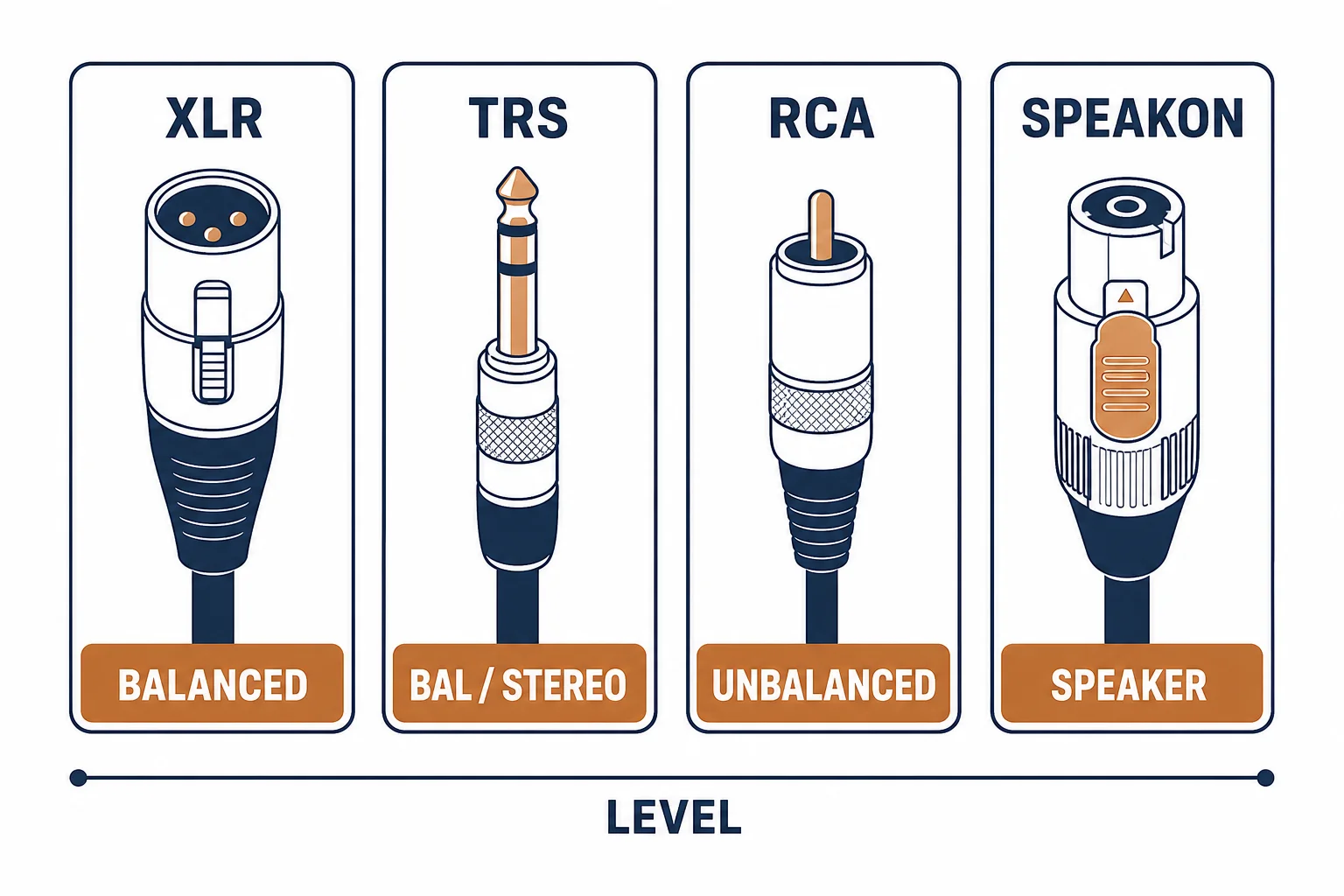
A headphone cable fails before the drivers do: the conductors break where the cable enters the plug, or the jack wears in the device. Understanding the wiring – TRS for stereo, TRRS for a microphone – decides whether a replacement cable will work at all.
This is the headphone-cable guide: the wiring, the failure point, and the repair decision for headphones with detachable or fixed cables.
The Wiring
| The plug | The contacts | The use |
|---|---|---|
| TRS | Tip, ring, sleeve | Stereo headphones |
| TRRS | Tip, ring, ring, sleeve | Headset with microphone |
| 2.5 mm | Same wiring, smaller | Compact devices |
The wiring is standard within each type, which is why a replacement cable usually works – and why a TRRS plug in a TRS socket can behave oddly.
Where It Fails
- At the plug: conductor fatigue from bending
- At the strain relief: the jacket splits
- At the earcup: the joint on detachable designs
- In the device jack: wear that mimics a cable fault
Testing the cable on a second device distinguishes a cable fault from a worn jack in seconds.
Standards and Verification
| The reference | The relevance |
|---|---|
| IEC 60268 | Audio interconnection |
| CTIA / OMTP | TRRS wiring conventions |
| Continuity test | Tip, ring, sleeve discrete |
Per-model connectors are not provided in the knowledge base. The wiring conventions are standard; check whether the headphone uses a proprietary connector before ordering a cable.
Practical Notes
A right-angle plug or a short extension protects the device jack and the cable's weakest point at once. On a device that lives in a pocket, that small part extends the life of both.
Real-World Applications
The detachable cable
Studio headphones with a 3.5 mm detachable cable: a replacement fitted when the original failed at the plug – the headphones outliving three cables.
The worn jack
A phone whose audio cut out when the cable moved: the device jack was worn, not the cable. A short extension used to move the strain – the fault avoided without repair.
Related reading: Headphone extension options — blogs/news/headphone-extension-cable
Related reading: The 3.5 mm wiring variants — blogs/news/3-5mm-audio-cable
Frequently Asked Questions
TRS or TRRS for headphones?
TRS for stereo headphones; TRRS where a microphone is included.
Why does one channel cut out?
Usually a break at the plug or a worn device jack.
Can I replace a moulded cable?
Rarely – detachable designs are the repairable ones.
Does cable quality affect sound?
A working cable does not; length and shielding rarely matter at headphone levels.
Sourcing cables for a project, a store, or a private-label line? Contact our B2B sales team for specifications, certification evidence, and volume terms – FOB and CIF options available. Request a quote or sample.