
HDMI Cable Tester: The Limits
Quick answer / TL;DR: Short answer: a continuity tester finds open and shorted conductors – useful for dead cables and for checking a batch. It cannot measure bandwidth, impedance or crosstalk, so a marginal cable will pass and still fail at 4K. For bandwidth faults, test the cable in the actual source and display at the target mode.
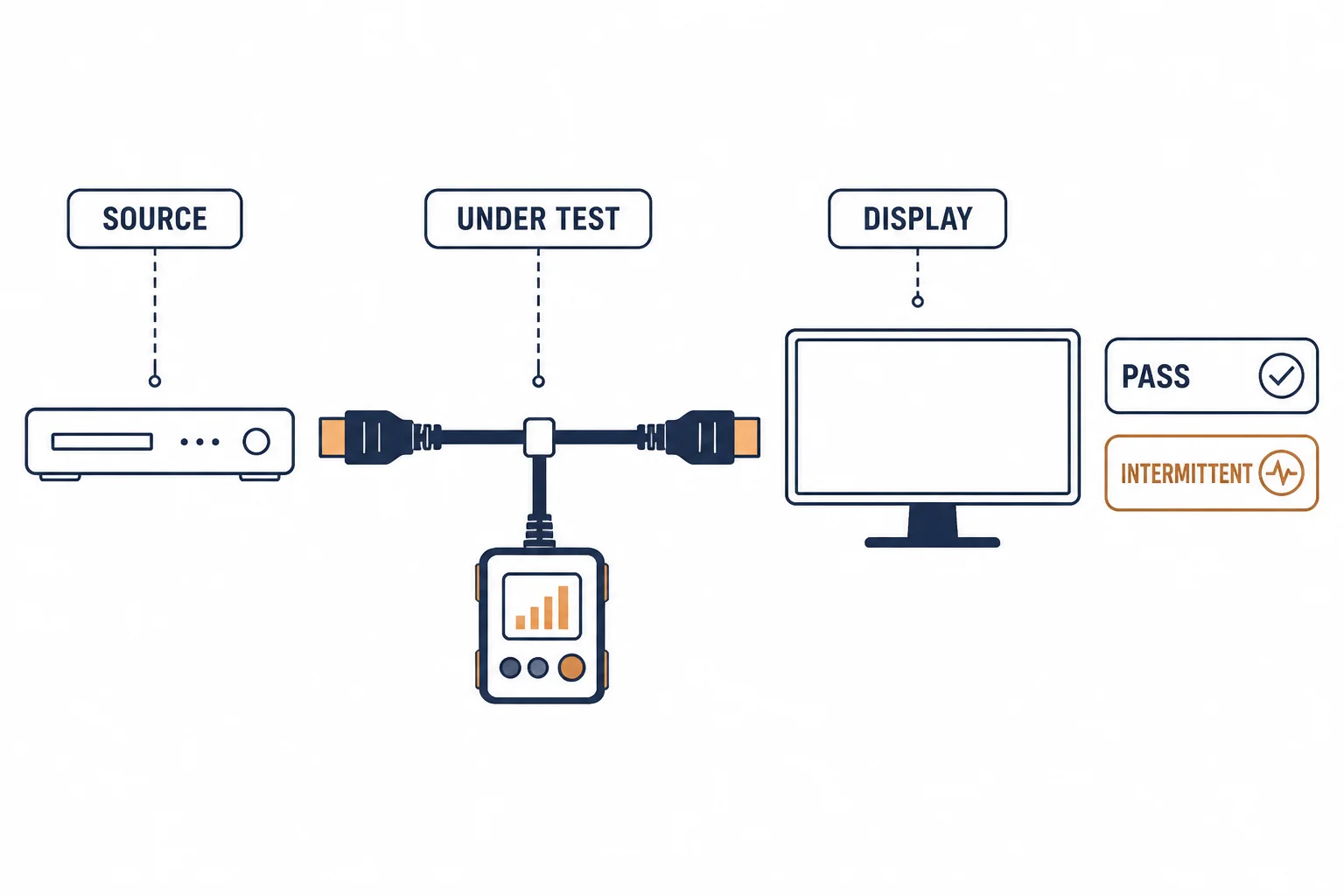
An HDMI cable tester checks continuity across the nineteen pins and often reports which conductor is open or shorted. That is useful for a cable that is clearly dead, and insufficient for the fault that matters most: a cable that passes continuity and still cannot carry 4K.
This is the tester guide: what the instrument proves, what it cannot, and the test arrangement that actually settles a bandwidth problem.
What It Proves
| The test | What it shows | The limit |
|---|---|---|
| Continuity | Each pin connected | No bandwidth measure |
| Short test | Adjacent pins not bridged | No impedance |
| Pin map | Correct wiring | No signal integrity |
| Cable ID | Which cable is which | No performance |
The instrument answers 'is this cable wired correctly and intact', not 'will it carry this mode'.
What It Cannot Prove
- Bandwidth or impedance
- Crosstalk between pairs
- Whether 4K at 60 Hz will lock
- Whether HDCP will negotiate
- Whether the cable is marginal at length
The gap is exactly where the expensive faults live: intermittent sparkle and mode fallback on cables that test fine.
The Test That Settles It
| The step | The arrangement |
|---|---|
| Source | The actual device, at the target mode |
| Cable | The one under test |
| Display | Reporting the mode and any errors |
| Observation | Ten minutes, watching for sparkle or dropouts |
Time matters: many marginal cables fail only after the interface has trained and warmed.
Standards and Verification
| The reference | The relevance |
|---|---|
| HDMI specification | Signal requirements |
| HDCP | Handshake that must complete |
| Field test | The display's reported mode and stability |
Per-SKU tester capabilities are not provided in the knowledge base. The continuity function is standard; check whether the model tests bandwidth before relying on it.
Practical Notes
A tester is most valuable for a batch: twenty cables from a supplier can be screened for opens and shorts in minutes. It is least valuable as a diagnostic for one intermittent cable in a living room.
Real-World Applications
The batch screen
Fifty cables received for an installation: every one tested for continuity and shorts – three rejected before they reached a wall.
The cable that passed
A 4K fault on a cable that tested perfect: the tester had proved wiring, not bandwidth. A known-good cable substituted – the diagnosis in one minute.
The dead cable
A cable with no picture: the tester showed an open conductor two pins from the end. The fault was mechanical, and the instrument found it immediately.
Related reading: Diagnosing a 4K fault — blogs/news/4k-hdmi-cable
Related reading: The length that limits modes — blogs/news/20-ft-hdmi-cable
Frequently Asked Questions
What does an HDMI cable tester check?
Continuity, shorts and pin mapping – not bandwidth.
Can it tell if a cable supports 4K?
No – that needs a real source and display at the target mode.
Is it worth buying?
For screening batches, yes; for one-off diagnosis, a known-good cable is faster.
Why does a cable pass and still fail?
Continuity is not signal integrity; marginal cables fail only under load.
Sourcing cables for a project, a store, or a private-label line? Contact our B2B sales team for specifications, certification evidence, and volume terms – FOB and CIF options available. Request a quote or sample.