
HDMI Cable Factory Sourcing: The Verification
Quick answer / TL;DR: Short answer: verify an HDMI cable factory in four stages – licensor/adopter status and product listing, specification response (AWG, length, bandwidth tier), sample testing (eye diagram at the claimed bandwidth, bend and pull), and pre-shipment inspection. HDMI's bandwidth claims are measurable; a factory that resists testing is telling you the answer.
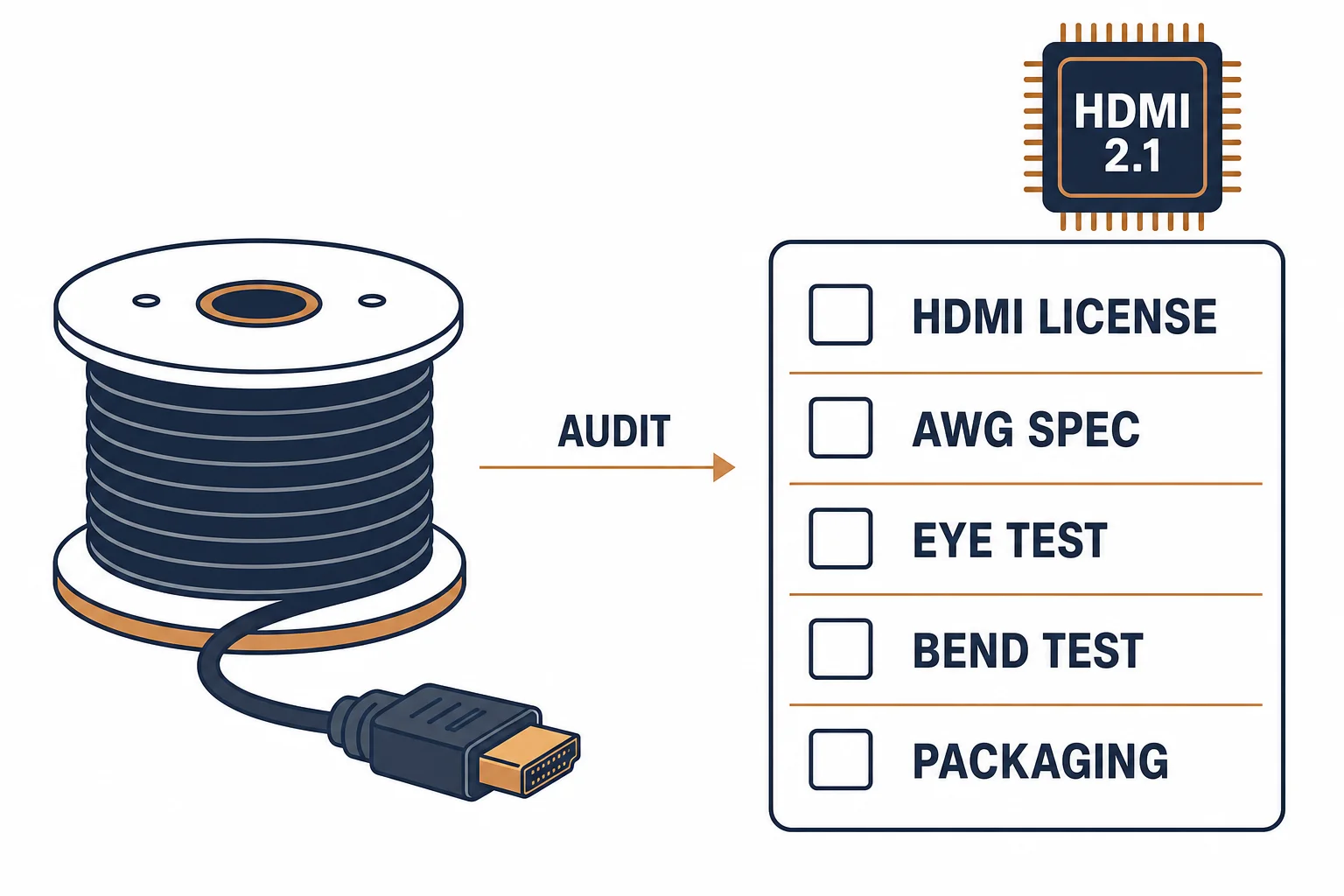
HDMI cable sourcing has a verification layer most cable families do not: the HDMI specification is licensed, and bandwidth claims are testable. A factory that cannot show licensor status, conductor specifications, and eye-diagram results is selling a cable-shaped object. This guide is the audit sequence.
This is the HDMI sourcing guide: the licence question, the test evidence, and the audit order that costs least to fail first.
Stage 1: Licence and Listing
| The evidence | What it proves |
|---|---|
| HDMI Adopter status | The entity may manufacture under the specification |
| Product listing | The specific product is covered |
| Certificate of compliance | The claim is backed by a test program |
The licence layer is unique to HDMI sourcing: without it, the cable's claims are marketing. Ask for the adopter record and the product listing, not a logo on a box.
Stage 2: Specification Response
- AWG and conductor construction – the bandwidth depends on it
- Length range offered at each bandwidth tier
- Connector construction – shell, strain relief, plating
- Jacket and bend radius for the intended install
The specification response separates engineers from resellers: a factory with test data answers in numbers, a trader answers in adjectives.
Stage 3 and 4: Test and Inspect
| The stage | The evidence |
|---|---|
| Sample test | Eye diagram at the claimed bandwidth, continuity, bend test |
| Inspection | Pre-shipment check of length, labeling, packaging, and a test sample |
Standards and Verification
| The reference | The relevance |
|---|---|
| HDMI 2.1 specification | Bandwidth tiers and the certification program |
| HDMI Adopter agreement | The licence framework |
| Eye diagram testing | The measurable evidence of signal integrity |
Specific factory names, licence numbers, and prices are not provided in the knowledge base. The verification sequence is standard; confirm licences with the HDMI licensing administrator.
Real-World Applications
The private-label launch
A brand building an HDMI line: adopter status confirmed first, then samples tested at the claimed tier – the label launched on evidence.
The bandwidth claim
A supplier quoting 48 Gbps without eye data: the sample sent for testing – the claim reduced to its measured tier.
The packaging audit
A container opened at goods-in: lengths short on two SKUs, labels swapped – the inspection clause invoked before the stock went live.
Related reading: The length tiers the factory must certify? Read the HDMI length guide — blogs/news/hdmi-cable-length-buying
Related reading: The optical option beyond copper? Read AOC vs copper — blogs/news/aoc-vs-copper-hdmi
Frequently Asked Questions
How do I verify an HDMI cable factory?
Four stages: licence and product listing, specification response, sample eye-diagram testing at the claimed bandwidth, and pre-shipment inspection.
What is HDMI Adopter status?
The licence framework that permits manufacturing under the HDMI specification. Without it, bandwidth claims are unbacked.
Can HDMI bandwidth be tested?
Yes – eye-diagram testing at the claimed tier is the measurable evidence. A factory that resists it is a red flag.
What should the sample test include?
Eye diagram at the claimed bandwidth, continuity on all lanes, bend and pull tests, and connector inspection.
Sourcing cables for a project, a store, or a private-label line? Contact our B2B sales team for specifications, certification evidence, and volume terms – FOB and CIF options available. Request a quote or sample.