
HDMI 2.2 Cable: The Next Tier
Quick answer / TL;DR: Short answer: HDMI 2.2 raises the bandwidth ceiling for future 8K and high-refresh modes, and cables must be certified for the higher rate to carry them. No current consumer display needs it for 4K; if you are cabling a wall for the long term, buy the highest certified tier, otherwise Premium or Ultra High Speed covers everything available today.
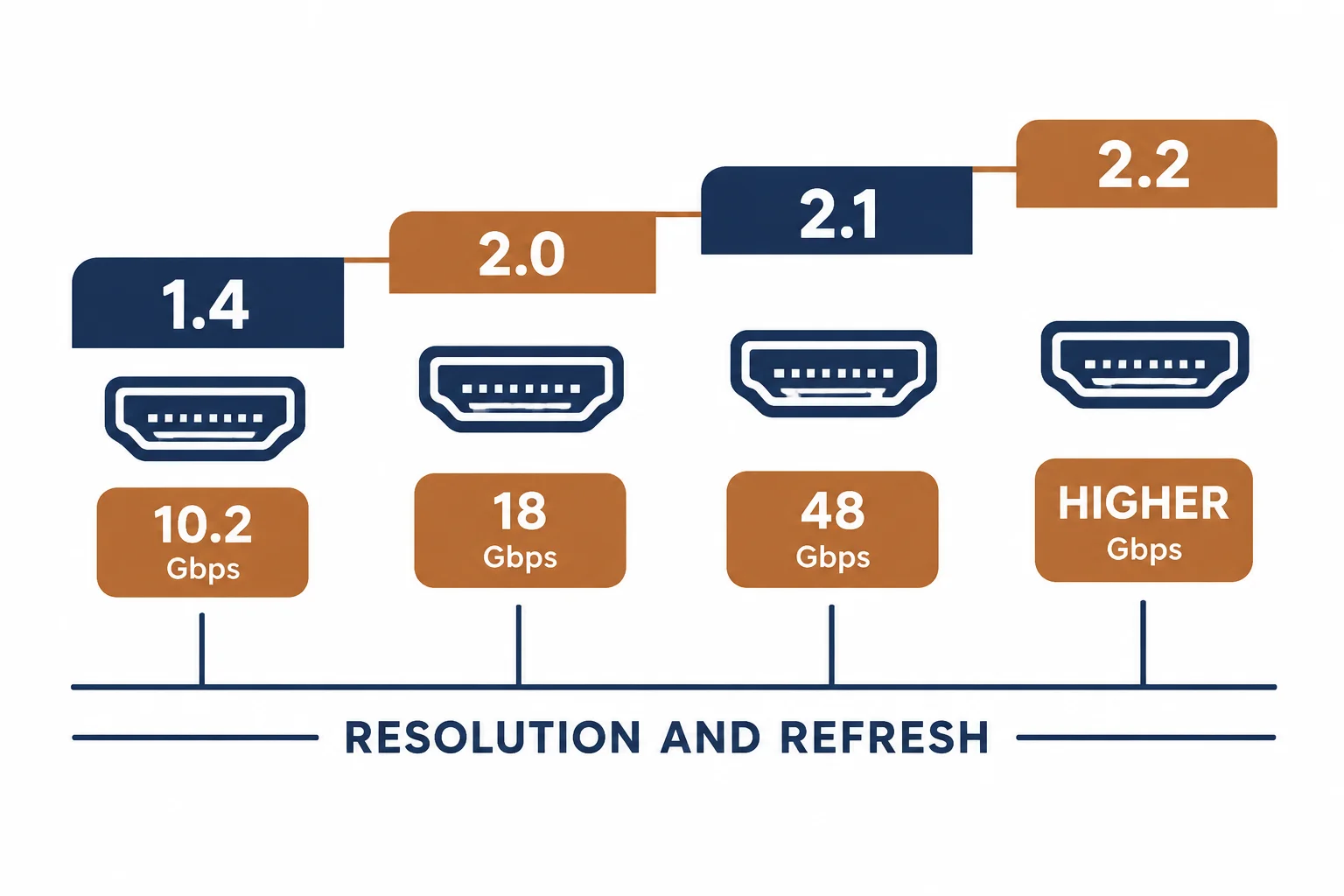
HDMI 2.2 raises the ceiling again, targeting higher resolutions and refresh rates than 2.1 can carry. As with every version step, the cable matters only when the source and display can both use the extra bandwidth – and the certification programme is what distinguishes a real 2.2 cable from a label.
This is the 2.2 guide: what the version changes, how to read a cable claim, and the practical decision for anyone buying today.
What the Version Changes
| The version | The ceiling | The typical use |
|---|---|---|
| 2.0 | 18 Gbps | 4K 60 Hz |
| 2.1 | 48 Gbps | 8K, 4K high refresh |
| 2.2 | Higher still | Future modes |
Each step raises the bandwidth available; whether anything uses it arrives years later, as with 2.1 and 8K.
Reading a Cable Claim
- Version numbers describe the specification the cable was designed against
- Certification is what proves a bandwidth tier
- A '2.2 cable' without certification is a marketing statement
- The connector type is unchanged across versions
The certification is the only evidence that survives contact with a marginal installation.
The Practical Decision
| The situation | The purchase |
|---|---|
| 4K 60 Hz today | Premium High Speed |
| 4K high refresh or 8K | Ultra High Speed |
| Cable buried in a wall | Highest certified tier |
| Replacing a working cable | Not yet |
The wall case is the only one where the future premium reliably pays.
Standards and Verification
| The reference | The relevance |
|---|---|
| HDMI 2.x | Version and bandwidth tiers |
| HDMI certification | Cable compliance programmes |
| HDCP | Content protection |
Per-SKU certification status is not provided in the knowledge base. The version definitions are published; ask for the certificate rather than the packaging claim.
Practical Notes
Cable length becomes the binding constraint as bandwidth rises: passive copper shortens sharply at the top tiers, so a 2.2 purchase for a long run should be fiber, not a heavier copper cable.
Real-World Applications
The future-proof wall
A media wall being closed up: the highest certified cable installed in conduit – the decision made once, with access for later.
The premature upgrade
A 2.2 cable replacing a working Premium cable on a 4K television: no change, as expected. The old cable kept as a spare.
The long-run mistake
A 2.2 copper cable specified for a 12 m run: dropouts at high modes. A fiber cable used – the bandwidth tier and the construction are separate decisions.
Related reading: What 8K needs today — blogs/news/8k-hdmi-cable
Related reading: The 4K requirement — blogs/news/4k-hdmi-cable
Frequently Asked Questions
Do I need an HDMI 2.2 cable?
Only for future high-bandwidth modes; nothing current requires it.
Is it backward compatible?
Yes – a higher-tier cable works with lower modes.
What matters more, version or certification?
Certification – it proves a tested bandwidth tier.
Can a 2.2 cable be long?
Long runs need fiber at these bandwidths.
Sourcing cables for a project, a store, or a private-label line? Contact our B2B sales team for specifications, certification evidence, and volume terms – FOB and CIF options available. Request a quote or sample.