
Gigabit Ethernet Cable: The Real Requirement
Quick answer / TL;DR: Short answer: gigabit needs a four-pair cable rated Cat5e or better, terminated on all eight contacts, within 100 m. Most gigabit failures are not the cable: they are a two-pair termination, a damaged pair, a 100 Mbps switch port, or a device negotiating lower. Check the negotiated rate and the termination before replacing cable.
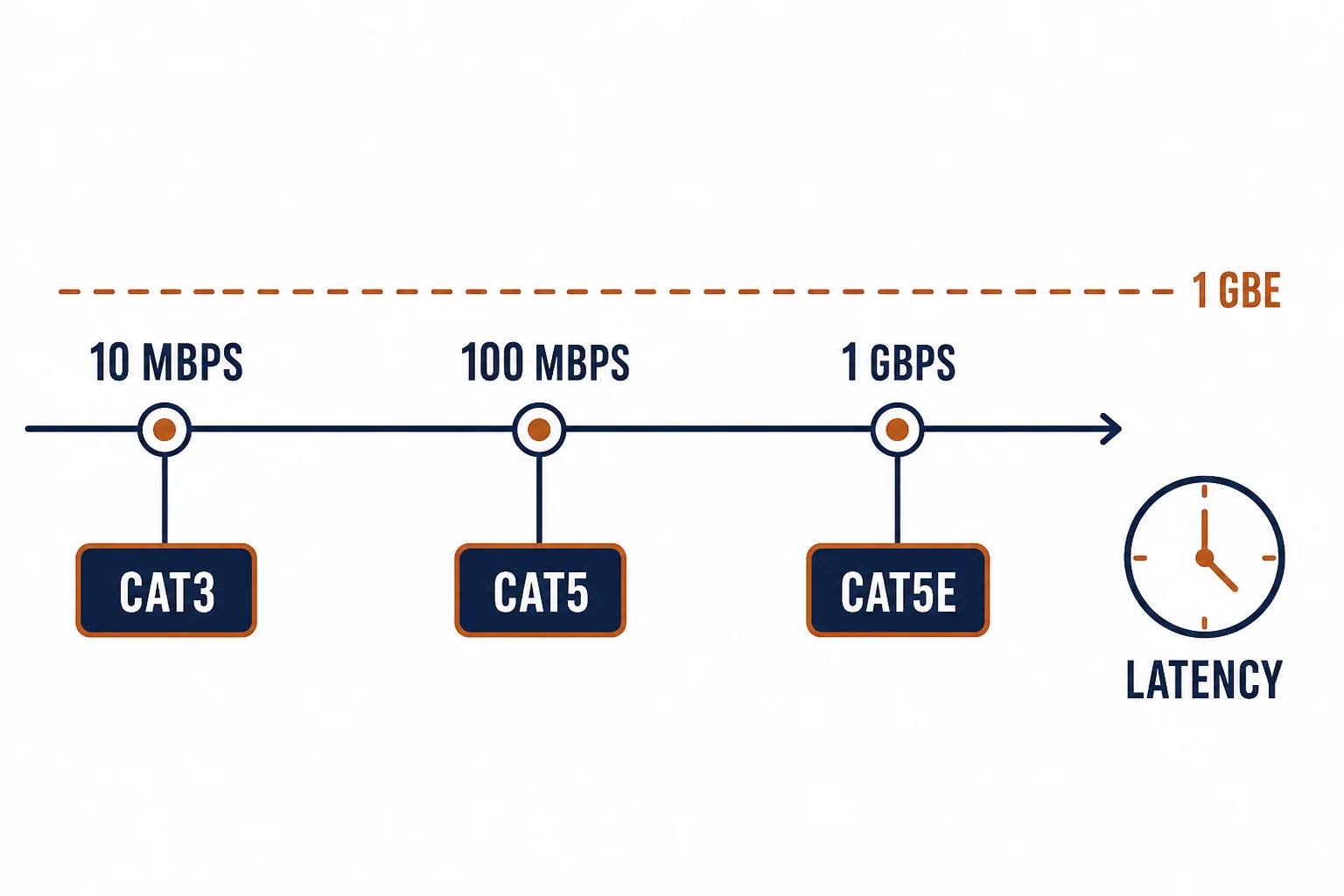
A gigabit ethernet cable is not a special product: it is a cable that meets the requirements of 1000BASE-T, which Cat5e and every later category do. The phrase is marketing, and the requirement behind it is specific – four pairs, controlled crosstalk, 100 metres.
This is the gigabit guide: the minimum specification, the conditions that make a link fall back to 100 Mbps, and the checks that find the real culprit when gigabit does not appear.
The Requirement
| The element | The requirement | The note |
|---|---|---|
| Category | Cat5e or better | Cat3 and two-pair cable cannot |
| Pairs | Four, all terminated | Eight contacts used |
| Length | 100 m channel | Includes cords |
| Crosstalk | Controlled by the category | The reason the category exists |
The four-pair line is the most common failure: a cable terminated on two pairs works for 100 Mbps and never for gigabit.
Why a Link Falls Back
- Two-pair termination, or a damaged pair
- A 100 Mbps port on the switch or device
- A marginal cable that fails the higher rate's margin
- Auto-negotiation settling lower after errors
Fallback is a symptom, not a setting: the link negotiates what it can actually sustain.
The Checks
| The check | What it shows |
|---|---|
| Negotiated rate | What the link actually achieved |
| Cable tester | Pair continuity and length |
| Swap a known cord | Cord against permanent run |
| Port speed setting | Whether the port is fixed at 100 Mbps |
Standards and Verification
| The reference | The relevance |
|---|---|
| IEEE 802.3ab | 1000BASE-T |
| TIA-568.2-D | Category 5e and above |
| Field test | Channel test at the installed category |
Per-SKU performance is not provided in the knowledge base. The 1000BASE-T requirement is standard; measure the negotiated rate before assuming the cable is at fault.
Real-World Applications
The 100 Mbps surprise
A desk link negotiating at 100 Mbps: the outlet terminated on two pairs. Re-terminated on all four – gigabit negotiated without touching the cable.
Related reading: What Cat5 actually delivers — blogs/news/cat5-cable-speed
Related reading: The budget line that still ships — blogs/news/cat5e-network-cable-line
Frequently Asked Questions
What cable do I need for gigabit?
Cat5e or better, with all four pairs terminated, within a 100 m channel.
Why is my gigabit link running at 100 Mbps?
Usually a two-pair termination, a damaged pair, or a 100 Mbps port – not the cable category.
Does Cat6 make gigabit faster?
No – gigabit is gigabit. Cat6 adds headroom for 2.5G and 5G.
Can Cat5 do gigabit?
Sometimes over short runs, but it is not rated for it. Cat5e is the rated minimum.
Sourcing cables for a project, a store, or a private-label line? Contact our B2B sales team for specifications, certification evidence, and volume terms – FOB and CIF options available. Request a quote or sample.