
FTP vs UTP: The Buying Decision
Quick answer / TL;DR: Short answer: choose FTP (shielded) when the run passes strong interference, shares a path with power, or the specification requires it; choose UTP everywhere else. FTP costs more per meter, needs grounded panels, is stiffer to install, and fails tests if the shield is not bonded. UTP asks none of that – and is sufficient in quiet residential and office environments.
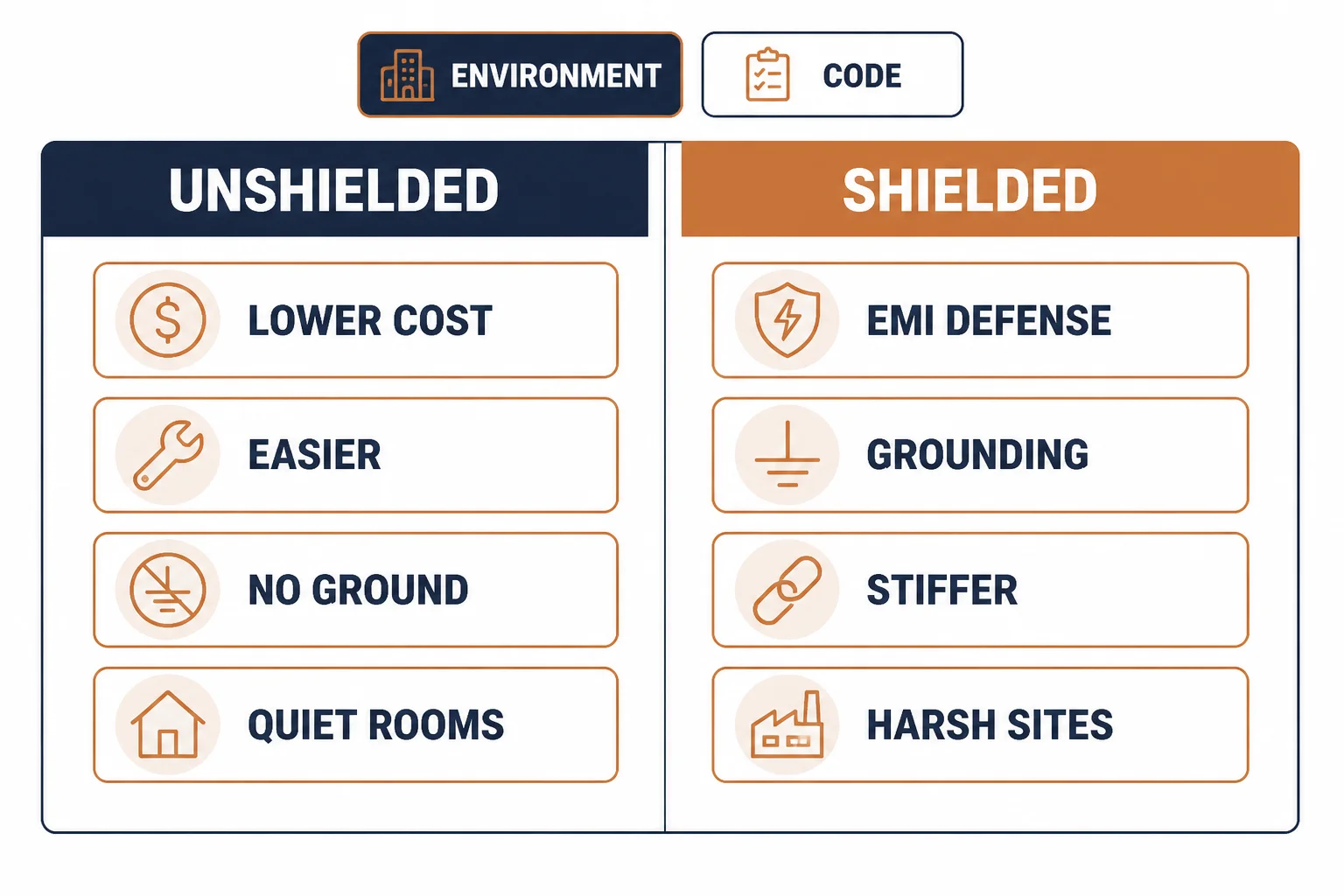
FTP versus UTP is usually framed as a performance question and decided as a cost question – which is backwards. The shield answers interference; if there is no interference, the foil buys an obligation rather than a benefit. This guide frames the decision the way a project actually makes it.
This is the buying comparison: what each construction costs, what each demands of the installer, and the questions that settle it.
The Comparison
| The attribute | UTP | FTP |
|---|---|---|
| Shield | None | Overall foil plus drain |
| Interference | Standard immunity | Better rejection |
| Grounding | None required | Required at the panel |
| Diameter | Smaller | Larger |
| Cost | Lower | Higher |
The table's last three rows are the ones that decide budgets: the foil's price is not the cable alone – it is the grounded panels and the installation care.
What Each Costs Beyond the Cable
- FTP: shielded jacks and panels, grounding continuity, longer termination time, stiffer pulls
- UTP: none of those – the savings are in labor and components
- The hidden cost: an ungrounded FTP install pays the cable premium and gets none of the benefit
- The hidden saving: UTP in a quiet building needs no grounding work at all
Comparing per-meter prices misses the system: the construction choice changes the bill of materials and the labor line together.
The Questions That Settle It
| The question | The answer it points to |
|---|---|
| Is there strong EMI on the path? | FTP |
| Does the cable share trunking with power? | FTP with separation |
| Does the specification name shielded? | FTP to the named code |
| Is the route quiet and the budget tight? | UTP |
Standards and Verification
| The reference | The relevance |
|---|---|
| TIA-568.2-D | Shielded and unshielded installation practice |
| ISO/IEC 11801-1 | Screening classes and channel definitions |
| Local codes | Route and jacket requirements that sit above the construction choice |
Per-SKU constructions and prices are not provided in the knowledge base. The decision structure is standard; confirm the code and grounding requirements with the supplier and the project specification.
Real-World Applications
The quiet office
A software floor with no heavy equipment: UTP Cat6 throughout – the shield premium and the grounding work both avoided.
The mixed building
An office whose east wing passes the plant room: FTP on those runs only – the shield where the interference is, UTP elsewhere.
The tender requirement
A specification naming shielded Cat6a: the code read, the grounding scope priced – the bid complete rather than optimistic.
Related reading: What the FTP construction is? Read the FTP primer — blogs/news/what-is-ftp-cat6
Related reading: The Cat6 shielding default? Read is Cat6 shielded — blogs/news/is-cat6-shielded
Frequently Asked Questions
Is FTP better than UTP?
Only where interference exists or the specification demands shielding. In quiet environments UTP is simpler, cheaper, and sufficient.
Can I mix FTP and UTP in one network?
Yes – runs are documented individually. Mixing is common when only some paths face interference.
Does FTP cost more to install?
Yes – stiffer cable, larger diameter, grounded panels, and longer termination. The installed cost is the number to compare.
What happens if FTP is not grounded?
The shield floats; interference rejection is lost and intermittent faults can appear. Grounding is part of the product.
Sourcing FTP (F/UTP) Cat6 for a project, a store, or a shielded system? Contact our B2B sales team for shield construction data, category reports, and volume terms – FOB and CIF options available. Request a quote or sample.