
FTP Cat6 Factory Sourcing: The Audit
Quick answer / TL;DR: Short answer: audit an FTP Cat6 factory in four stages – documents (license, ISO 9001, category test report), sample measurement (foil coverage, drain bond, pair geometry, jacket print), production evidence (video or on-site, showing foil application and drain contact), and pre-shipment inspection with a shield continuity check. Each stage is cheaper than the next.
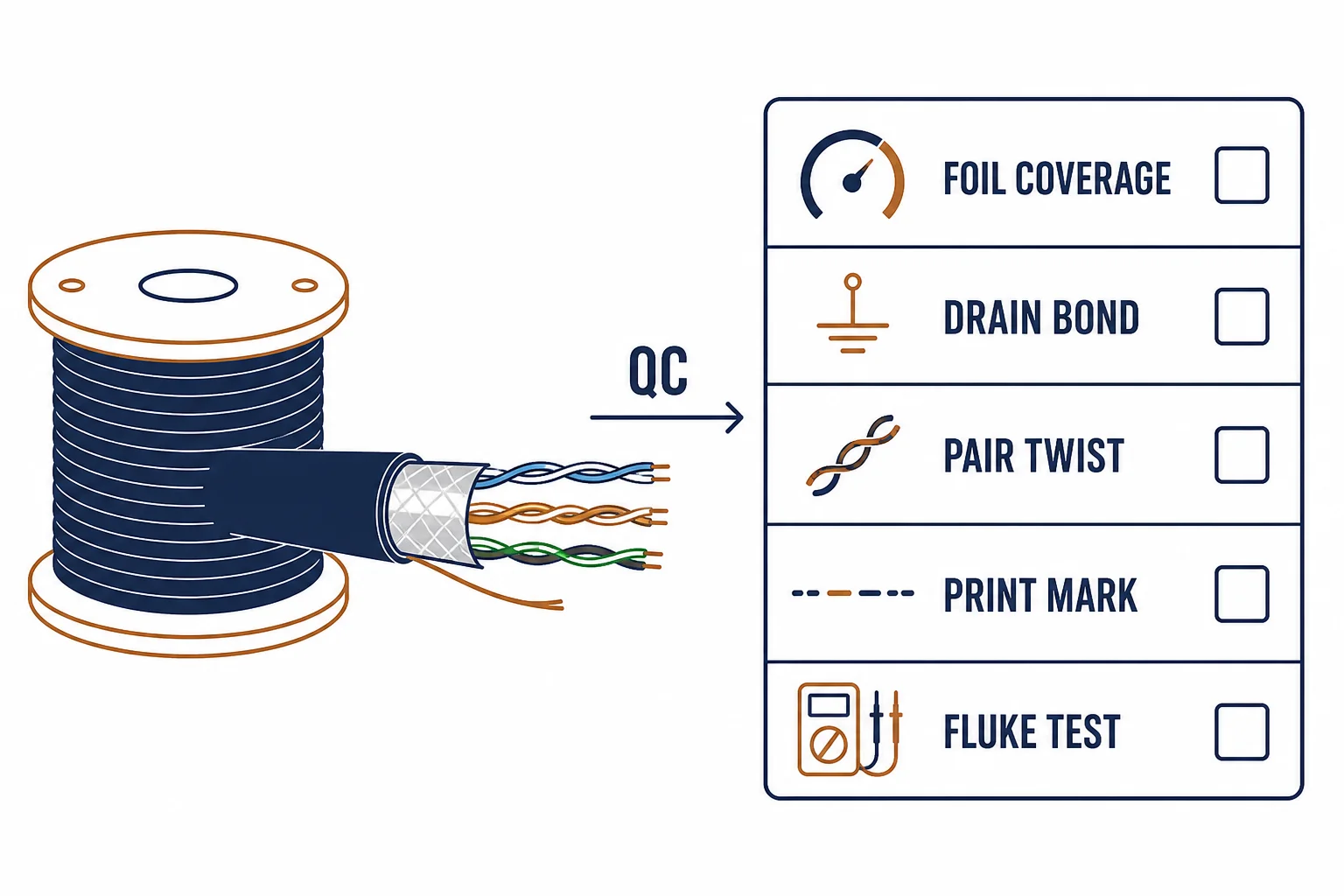
FTP Cat6 sourcing adds one layer of proof to the standard cable audit: the shield. Foil coverage, drain bonding, and the shield's continuity are manufacturing facts that a photograph cannot show and a datasheet can claim. The audit sequence below makes them measurable.
This is the FTP-specific audit: the document set, the sample measurements, and the production evidence that covers the shield.
Stage 1: Documents
| The document | What it proves |
|---|---|
| Business license | The entity and its scope |
| ISO 9001 | A quality system – scope verified |
| Category test report | The Cat6 channel result, naming the product |
| Shield construction spec | The F/UTP build the factory claims |
The documents filter the catalog sellers: each should name the entity or the product, and the test report should reference the category and the construction.
Stage 2: Sample Measurement
- Foil coverage: the shield should wrap the pairs fully, with an overlap
- Drain bond: the drain wire in continuous contact with the foil
- Pair geometry: twist maintained to the termination point
- Jacket print: category, construction code, and length marks
- Shield continuity: end to end on the sample
The measurements are the shield's evidence: coverage, contact, and continuity. Each has a cheap test on a cut length.
Stage 3 and 4: Production and Inspection
| The stage | The evidence |
|---|---|
| Production | Video of foil application and drain contact |
| Inspection | Pre-shipment check with shield continuity sampling |
Standards and Verification
| The reference | The relevance |
|---|---|
| TIA-568.2-D | Cat6 and shielded requirements |
| ISO/IEC 11801-1 | Screening classes (F/UTP) |
| IEC 61156 | Construction definitions |
Specific factory names and certificate numbers are not provided in the knowledge base. The audit sequence is standard; verify each document with its issuer.
Real-World Applications
The coverage check
A sample cut length under the light: the foil's overlap measured – short coverage found – the specification restated with the overlap requirement.
The drain that was not bonded
A batch with a loose drain contact: continuity failing on sampling – the production corrected before shipment.
The print mismatch
A shipment printed U/UTP arriving against an F/UTP order: the print checked at goods-in – the pallet held and replaced.
Related reading: The system the cable joins? Read shielded system supply — blogs/news/shielded-system-supply
Related reading: The Cat7 construction comparison? Read the Cat7 guide — blogs/news/cat7-shielded-buying
Frequently Asked Questions
How do I verify an FTP Cat6 factory?
Four stages: documents (license, ISO 9001, category report, shield spec), sample measurement (foil coverage, drain bond, geometry, print), production evidence, and pre-shipment inspection.
What should I measure on an FTP sample?
Foil coverage and overlap, drain continuity, pair twist, jacket print, and end-to-end shield continuity.
Is a category test report enough for FTP?
No – it proves the channel, not the shield's construction. Add the foil and drain measurements.
Why inspect before shipment?
Shield defects are cheap to fix at the factory and expensive to discover after installation.
Sourcing FTP (F/UTP) Cat6 for a project, a store, or a shielded system? Contact our B2B sales team for shield construction data, category reports, and volume terms – FOB and CIF options available. Request a quote or sample.