
Flexible Ethernet Cable: Flex Life
Quick answer / TL;DR: Short answer: use flexible ethernet cable where the cable moves – drag chains, robotic axes, retractable reels, moving gantries. Look for a stated bend-life rating rather than the word 'flexible', prefer finely stranded conductors, and respect the minimum bend radius. A standard solid cable in a moving application fails at the conductor, with no external sign.
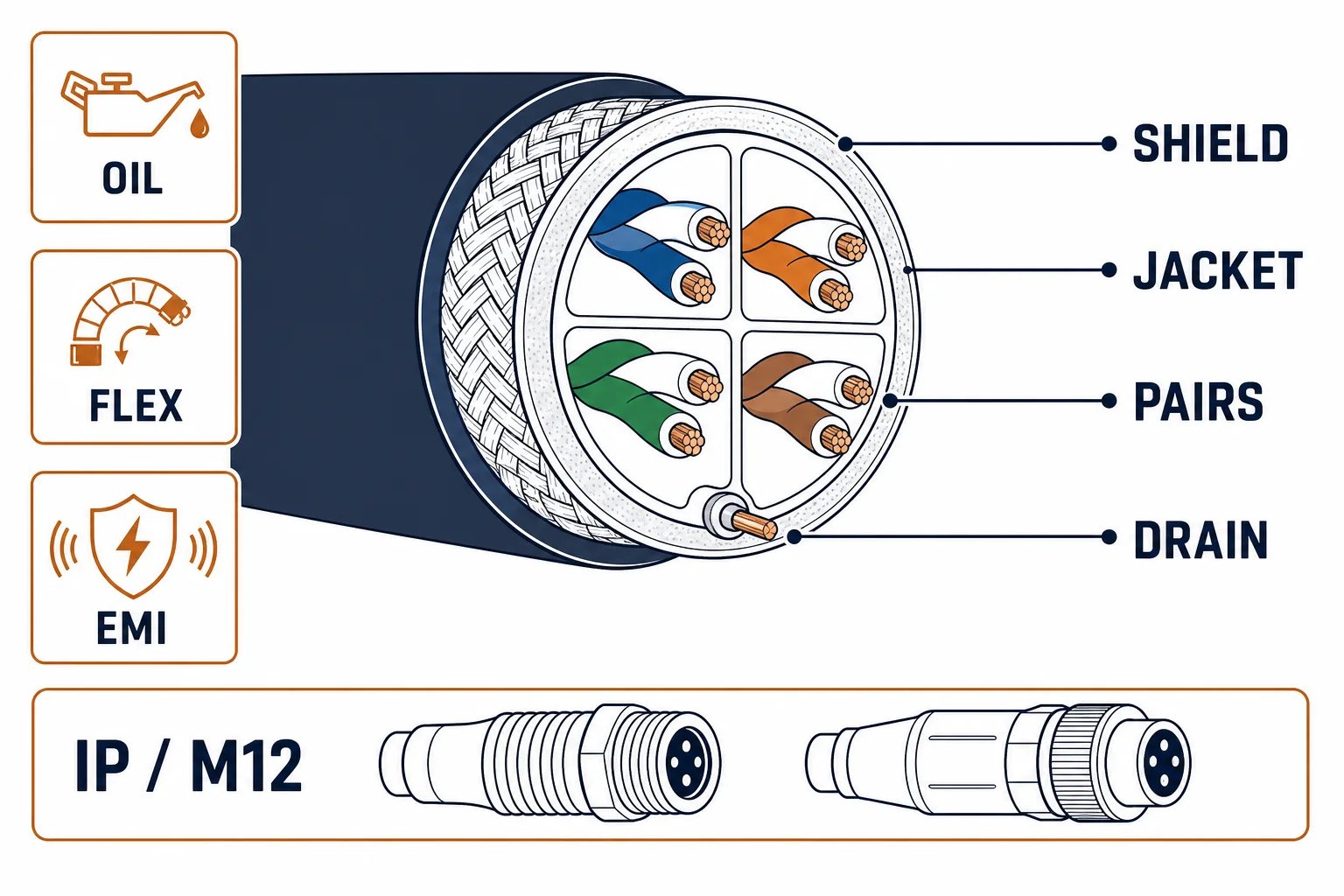
A flexible ethernet cable is built for movement: finely stranded conductors and a jacket compound that survives repeated bending. It exists because a standard solid-conductor cable fails inside an intact jacket after enough cycles – the conductor work-hardens and breaks where nobody can see it.
This is the flex guide: what changes in the construction, how flex life is specified, and the installations where the standard cable is the wrong choice.
What Changes
| The element | Standard cable | Flexible cable |
|---|---|---|
| Conductor | Solid | Finely stranded |
| Jacket | Rigid compound | Flex-rated compound |
| Bend life | Not rated | Stated in cycles |
| Use | Fixed installation | Continuous movement |
The construction change is the conductor: strands share the bending, where a single core concentrates it.
How Flex Life Is Specified
- Cycles at a stated bend radius – the number means nothing without the radius
- Travel distance and speed in the application
- Whether the movement is one-axis (drag chain) or multi-axis (robot)
- Temperature, oil and coolant exposure
The rating is a test condition, not a guarantee: match the test to the motion.
The Failure Mode
| The symptom | The cause |
|---|---|
| Intermittent link at a particular position | A conductor broken inside intact jacket |
| Link fine when straight, fails when bent | Same, at the break point |
| No visible damage | The jacket outlives the conductor |
Standards and Verification
| The reference | The relevance |
|---|---|
| IEC 61156 | Cable construction and test |
| TIA-568.2-D | Channel requirements |
| IEC 60228 | Conductor classes (stranding) |
| Continuity test | While flexing, where possible |
Per-SKU flex ratings are not provided in the knowledge base. Ask for the test condition – cycles, radius, travel – rather than accepting the word flexible.
Real-World Applications
The packaging line
A camera on a moving gantry: flex-rated Cat6 in a drag chain, rated for the travel and radius – two years of continuous motion without a conductor failure.
The standard cable
A standard Cat6 cable installed on a moving axis: the link failing at one end of the travel after eight months. Replaced with flex-rated cable – the failure position was the diagnosis.
Related reading: The industrial four decisions — blogs/news/industrial-ethernet-cable
Related reading: The jacket that governs the route — blogs/news/cat6-riser-cable
Frequently Asked Questions
What is flexible ethernet cable?
Cable built with finely stranded conductors and a flex-rated jacket for repeated movement.
How is flex life measured?
In cycles at a stated bend radius; the number is meaningless without the radius and travel.
Can I use standard Cat6 in a drag chain?
No – the solid conductor work-hardens and breaks inside an intact jacket.
Does flexible cable perform as well?
It meets its category, but check the datasheet: stranding trades a little electrical margin for mechanical life.
Sourcing cables for a project, a store, or a private-label line? Contact our B2B sales team for specifications, certification evidence, and volume terms – FOB and CIF options available. Request a quote or sample.