
Flat vs Round Ethernet Cable: The Placement Rule
Quick answer / TL;DR: Short answer: use flat cable where the route demands a low profile – under carpet, behind skirting, through a door frame – and round cable everywhere else. Flat constructions can have less pair separation and lower crosstalk margin, and many are rated below Cat6; check the printed category and keep flat runs short.
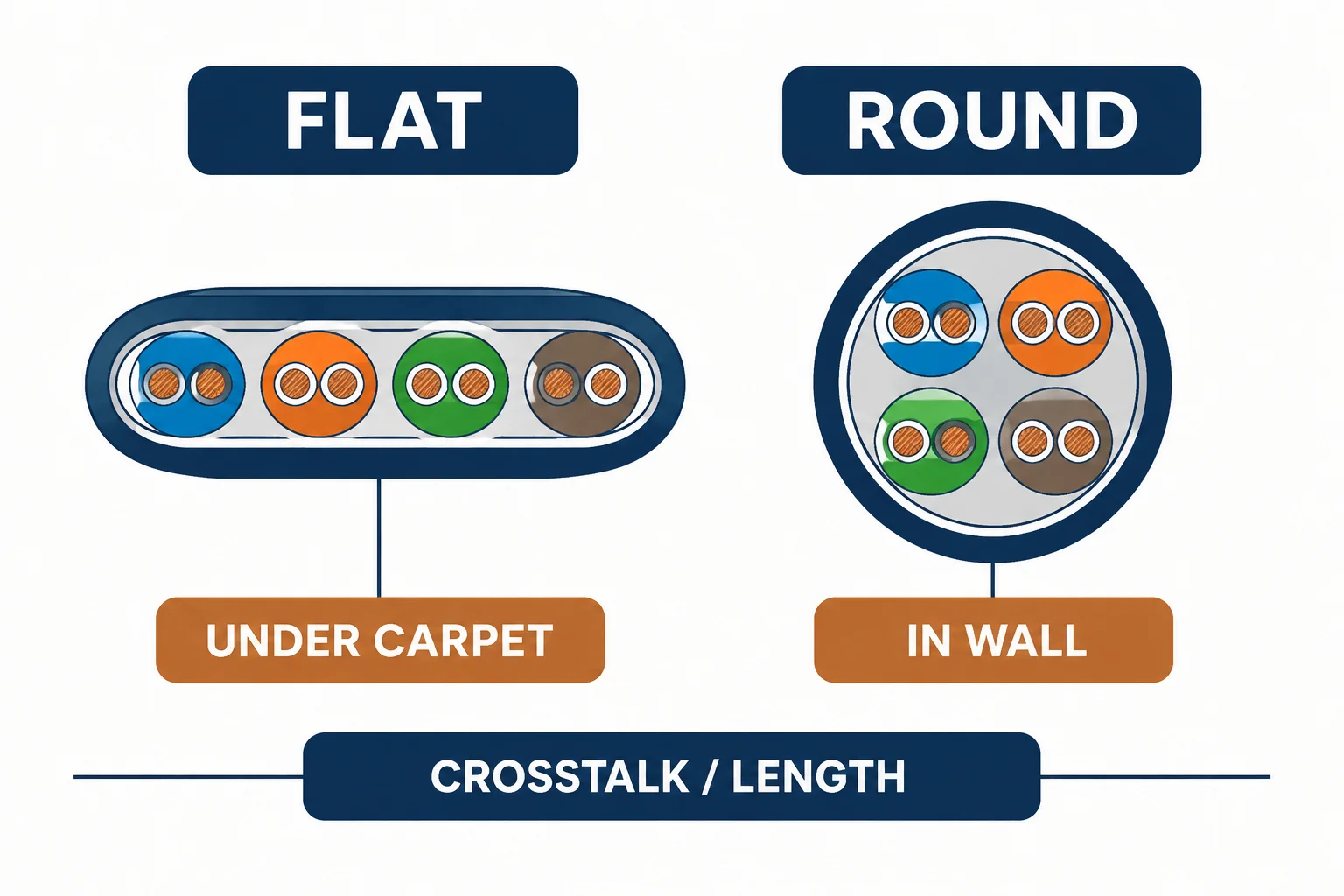
Flat and round ethernet cable carry the same signals in different cross-sections, and the difference shows up in two places: how the pairs sit relative to each other, and how the cable handles the route. Flat cable solves a routing problem – it does not improve performance, and in some builds it costs margin.
This is the placement guide: the construction difference, the performance consequence, and the routes where flat is the right answer.
The Cross-Section Difference
| The form | The construction | The consequence |
|---|---|---|
| Round | Four pairs in a circular jacket | Consistent pair geometry, standard ratings |
| Flat | Pairs laid side by side | Low profile, but geometry less symmetrical |
The geometry is the whole story: twisted pairs rely on symmetry, and a flat layout changes how the pairs sit against each other.
What It Costs
- Crosstalk margin: less separation between pairs can mean a lower category rating
- Length: many flat cables are sold in fixed lengths and rated for shorter runs
- Shielding: flat shielded constructions exist but are rarer and stiffer
- Durability: thin jackets resist abrasion less than round ones
The costs are real but bounded: for a two-metre run under a carpet edge, none of them change the outcome.
Where Flat Belongs
| The route | The choice |
|---|---|
| Under carpet across a room | Flat |
| Behind skirting board | Flat |
| Through a door frame gap | Flat, with a protector |
| In wall or conduit | Round |
| Patch panel to switch | Round, stranded |
Standards and Verification
| The reference | The relevance |
|---|---|
| TIA-568.2-D | Cable requirements and category ratings |
| IEC 61156 | Construction and test definitions |
| Field test | Confirmation of the installed channel |
Per-SKU flat-cable ratings are not provided in the knowledge base. Ratings vary by product; read the printed category and do not assume Cat6 on a flat SKU.
Real-World Applications
The rented flat
A link from the router to a desk across a doorway: flat cable under a protector – no drilling, no damage, the deposit safe.
The wall run
A permanent run inside a stud wall: round Cat6 in a channel – the standard construction where the profile does not matter.
The flat-cable disappointment
A flat cable taped along a skirting board, then painted over: the link working but the cable unserviceable. Replaced with round cable in a channel the next time the room was decorated.
Related reading: The budget line for short runs? Read the Cat5e guide — blogs/news/cat5e-network-cable-line
Related reading: The joints to avoid? Read couplers and junction boxes — blogs/news/ethernet-coupler-junction-box
Frequently Asked Questions
Is flat ethernet cable as good as round?
For short runs in awkward routes, yes in practice. Flat constructions can carry a lower category rating and less crosstalk margin – check the print.
Can flat cable run 100 metres?
Many flat products are rated for shorter runs. Check the specification rather than assuming the category's standard distance.
Where should I not use flat cable?
In walls, in conduit, and in permanent structured cabling – round cable is the standard choice there.
Does flat cable support PoE?
Within its rating and length, generally yes, but thinner conductors raise voltage drop. Keep runs short for powered devices.
Sourcing cables for a project, a store, or a private-label line? Contact our B2B sales team for specifications, certification evidence, and volume terms – FOB and CIF options available. Request a quote or sample.