
Fiber to RJ45 Converter: The Media Boundary
Quick answer / TL;DR: Short answer: a media converter is a powered pair – fiber in, RJ45 out – and it must match the fiber type (single mode or multimode), the connector (LC or SC), the wavelength, and the speed on both sides. Buy a matched pair from one maker where possible. If you also need switching, a switch with an SFP port usually costs less than a converter plus a switch.
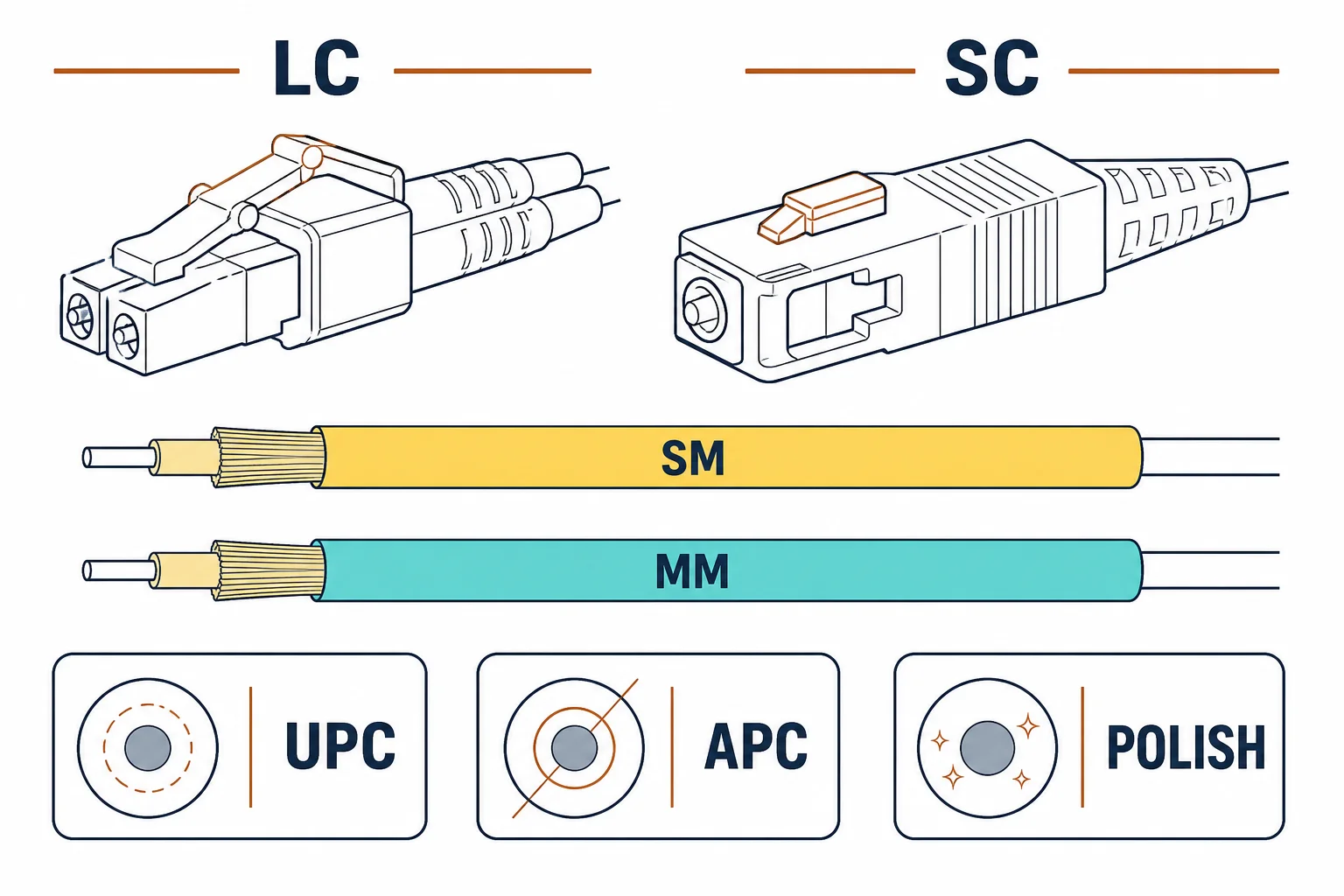
A fiber to RJ45 converter joins two media: an optical link on one side, twisted-pair ethernet on the other. It exists for the distance problem copper cannot solve – a building 500 m away, an outbuilding beyond 100 m – and for the isolation a fiber link provides.
This is the converter guide: what the device actually does, the speed and distance pairs that work, and the cases where a switch with an SFP port is the better purchase.
What It Does
| The side | The medium | The requirement |
|---|---|---|
| Optical | Single or multimode fiber | Match the fiber type |
| Electrical | Twisted pair | 10/100/1000 as specified |
| Power | External supply | Both ends, usually |
| Speed | Both sides equal | A mismatch will not link |
The device is a translator, not a router: it moves frames between media without deciding anything about them.
The Pairing Rules
- Fiber type must match the plant – single mode for long runs, multimode for in-building
- Connector must match the patch panel and cords
- Wavelength must match at both ends
- Speed must match – a gigabit converter will not link to a 100 Mbps port
- One maker for both ends removes most incompatibility
The pairing rules explain why converters are sold in pairs: half a pair is not a product.
Converter or SFP Switch
| The situation | The choice |
|---|---|
| One legacy device on fiber | Converter |
| New installation with several devices | Switch with SFP |
| Space and power are tight | SFP switch, fewer boxes |
| Budget only | Converter pair |
Standards and Verification
| The reference | The relevance |
|---|---|
| IEEE 802.3 | Ethernet media and rates |
| ITU-T G.652 | Single-mode fiber |
| TIA-568.3 | Fiber cabling practice |
| Link test | Traffic test plus optical loss |
Per-SKU wavelength and reach are not provided in the knowledge base. The pairing rules are standard; confirm the exact model pair before ordering.
Real-World Applications
The gatehouse
A gatehouse 600 m from the main building: a converter pair on single-mode fiber with LC connectors – gigabit on both sides where no copper category could reach.
Related reading: When fiber beats copper — blogs/news/fiber-vs-copper-buying
Related reading: The 100 m wall and what beats it — blogs/news/long-ethernet-cable
Frequently Asked Questions
What does a fiber to RJ45 converter do?
It translates between an optical ethernet link and a twisted-pair one, extending a network beyond copper distance.
Do I need a matched pair?
Yes – one at each end, with matching fiber type, wavelength and speed.
Can I use one converter only?
No: the pair is the link. One converter alone has nothing to talk to.
Converter or switch with SFP?
For several devices or a new installation, an SFP switch is usually simpler and cheaper.
Sourcing cables for a project, a store, or a private-label line? Contact our B2B sales team for specifications, certification evidence, and volume terms – FOB and CIF options available. Request a quote or sample.