
Fiber Network Cable: The Copper Alternative
Quick answer / TL;DR: Short answer: choose fiber for runs beyond 100 m, between buildings, near heavy electrical equipment, or where galvanic isolation matters. You will need media converters or SFP ports at both ends, plus patch cords and cleaning. For in-building runs under 100 m, copper remains cheaper and simpler.
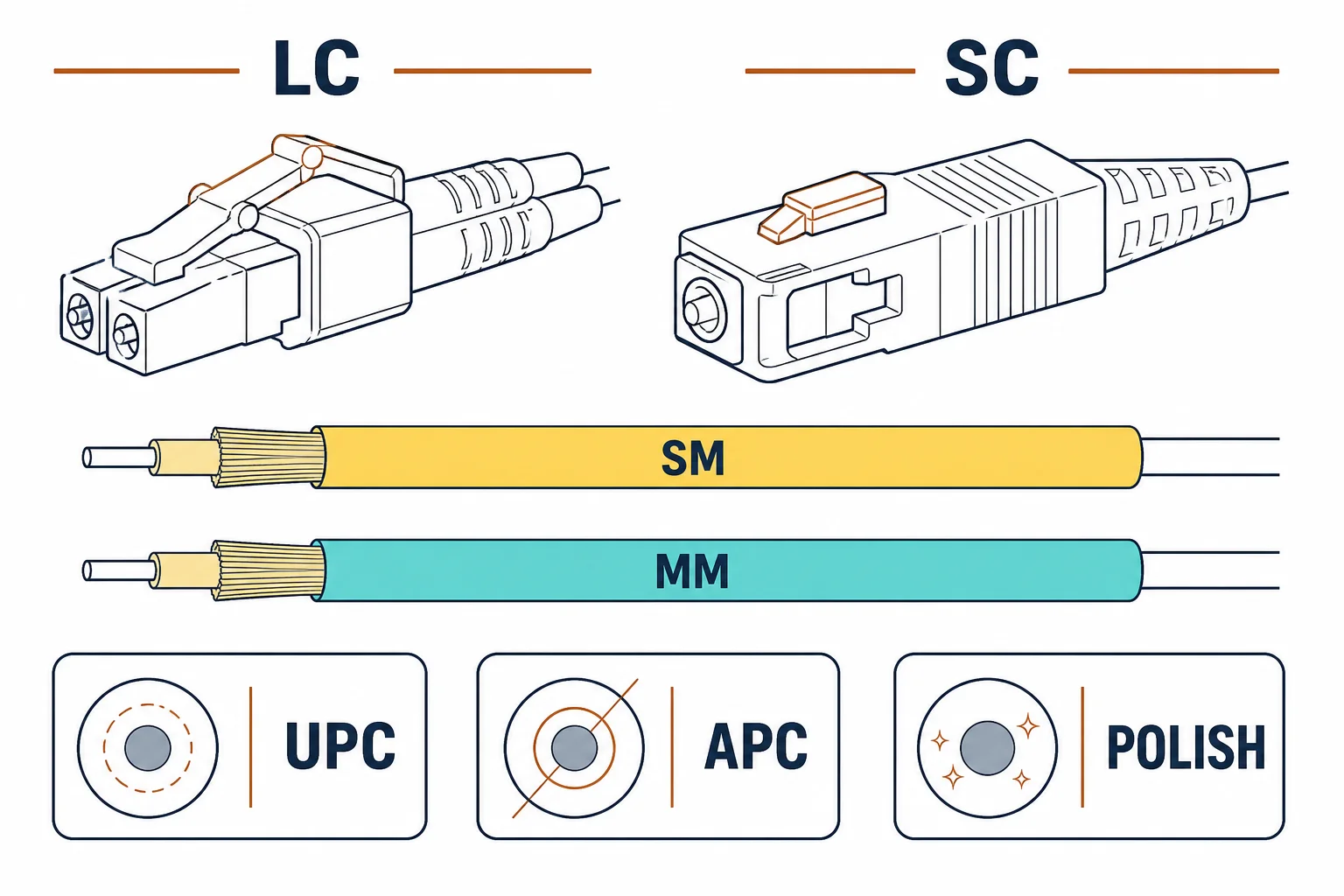
Fiber network cable carries data as light and is chosen for two reasons that copper cannot match: distance beyond 100 metres, and immunity to electrical interference. Everything else – cost, termination skill, connector cleanliness – is easier with copper.
This is the fiber decision guide: the cases where light wins, the electronics needed at each end, and the comparison that keeps a project from buying fiber for the wrong reason.
When Fiber Wins
| The case | The reason |
|---|---|
| Over 100 m | Copper cannot reach |
| Between buildings | Distance plus isolation |
| Near drives or welding | Immunity to EMI |
| Lightning-prone routes | No metallic path |
| High aggregate bandwidth | Multiple lanes |
The first two rows cover most projects; the rest are specialist but decisive when they apply.
What Fiber Requires
- Media converters or switch SFP ports at each end
- Patch cords in the right fiber type and connector
- Clean end faces – contamination is the top cause of failure
- A loss budget calculation, not an assumption
The electronics and the cleanliness are the two costs that surprise first-time fiber buyers.
The Comparison
| The factor | Fiber | Copper |
|---|---|---|
| Distance | Kilometres | 100 m |
| EMI | Immune | Susceptible |
| Termination | Specialist | Simple |
| Cost at short distance | Higher | Lower |
The cost comparison flips with distance: fiber is expensive per link and cheap per metre of reach.
Standards and Verification
| The reference | The relevance |
|---|---|
| ITU-T G.652 | Single-mode fiber |
| ISO/IEC 11801-1 | OM3-OM5 multimode |
| TIA-568.3 | Fiber cabling practice |
| Field test | Loss measurement per link |
Per-SKU loss figures are not provided in the knowledge base. The distance advantages are standard; measure each link rather than trusting datasheet reach.
Real-World Applications
The outbuilding
A workshop 400 m from the main building: single-mode fiber with converters at both ends – the distance solved in one cable where copper would need three switches.
The welding cell
A controller inside a welding area: fiber to the cabinet, no metallic path – the interference that had corrupted copper links disappeared.
The dirty connector
A fiber link installed and not cleaned: intermittent loss. End faces cleaned and re-tested – the fault had been dust, not the cable.
Related reading: When fiber beats copper on cost — blogs/news/fiber-vs-copper-buying
Related reading: The single-mode cord specification — blogs/news/single-mode-fiber-patch-cable
Frequently Asked Questions
When should I use fiber instead of copper?
Beyond 100 m, between buildings, in high-interference areas, or where isolation matters.
What else do I need?
Media converters or SFP ports, patch cords in the right type, and cleaning supplies.
Is fiber faster?
It carries higher aggregate rates over far greater distances; at short range copper is equivalent.
What is the most common fiber fault?
Contaminated connector end faces.
Sourcing cables for a project, a store, or a private-label line? Contact our B2B sales team for specifications, certification evidence, and volume terms – FOB and CIF options available. Request a quote or sample.