
Ethernet Wall Outlet: Three Types
Quick answer / TL;DR: Short answer: use a flush plate with a recessed back box in solid walls, a surface box where chasing is impossible or undesirable, and a modular frame on furniture or trunking. The outlet type is mechanical; performance comes from the jack – match it to the cable's category and test every port.
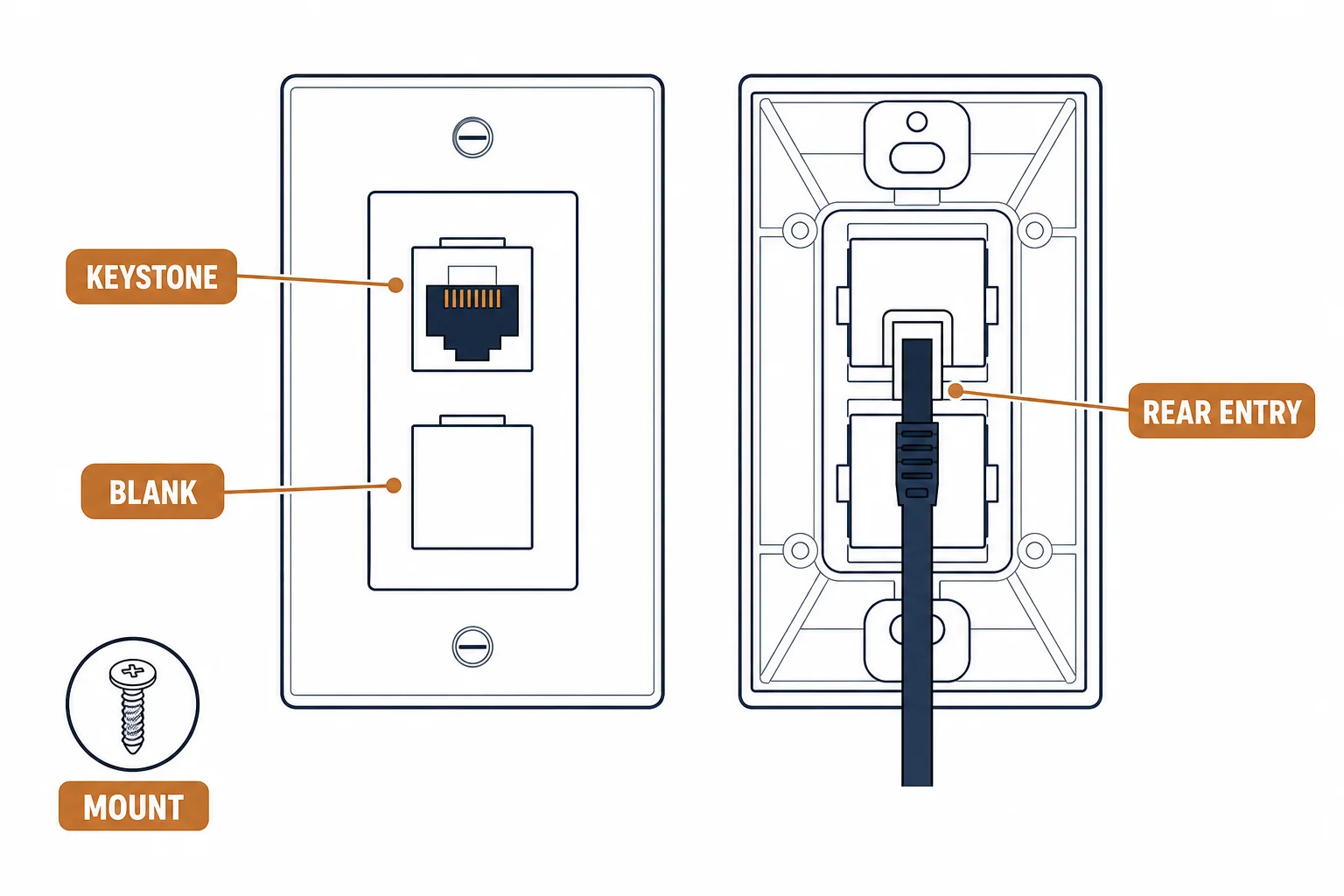
An ethernet wall outlet comes in three practical forms: a flush plate on a recessed box, a surface-mounted box for walls that cannot be chased, and a modular frame for furniture or trunking. The choice is set by the wall, not by preference – and the jack inside sets the performance.
This is the outlet guide: the three types, where each belongs, and the mounting and testing checks that decide whether the outlet lasts.
The Three Types
| The type | The mounting | The best use |
|---|---|---|
| Flush plate | Recessed back box | Solid walls, finished rooms |
| Surface box | Screwed to the wall surface | Brick, concrete, retrofits |
| Modular frame | Clips to trunking or furniture | Offices, desks, modular walls |
The type follows the wall: the electrical performance is identical, the installation risk is not.
The Jack and Blank Decisions
- Jack category: match the cable, or the channel is capped
- Shielded jack: only where the cable is shielded, with a bond point
- Blanks: fill unused openings
- Labeling: port identity at the back of the plate
The jack is the part that has to be right; the plate is the part that has to fit.
Mounting Checks
| The check | The question |
|---|---|
| Box depth | Enough for the cable bend? |
| Cable support | Is the cable fixed before it reaches the box? |
| Service loop | Slack for a future re-termination? |
| Surface box entry | Glanded or grommeted, not a raw hole? |
Standards and Verification
| The reference | The relevance |
|---|---|
| TIA-568.2-D | Connecting hardware and administration |
| IEC 60603-7 | The jack interface |
| Field test | Permanent link test at the outlet |
Per-SKU dimensions are not provided in the knowledge base. Gang and box standards are regional; measure before ordering in bulk.
Real-World Applications
The brick wall
A Victorian office with solid brick: surface boxes along the skirting – no chasing, no plaster repair, the outlets where the desks needed them.
The modular partition
A partition system with trunking: modular frames clipped into the trunking – outlets movable with the layout.
The shallow box
A plate fitted to a 25 mm back box: the cable bent tighter than its radius and the jacket creased. A deeper box fitted – the bend restored.
Related reading: The plate and jack in detail? Read the wall plate guide — blogs/news/ethernet-wall-plate-buying
Related reading: The jack that sets the performance? Read the keystone jack guide — blogs/news/rj45-keystone-jack-buying
Frequently Asked Questions
What types of ethernet wall outlet are there?
Flush plates on recessed boxes, surface-mounted boxes, and modular frames for trunking or furniture.
Which outlet is best?
Whichever suits the wall: flush in solid walls, surface where chasing is impossible, modular on trunking.
Does the outlet affect speed?
The plate does not; the jack inside does. A lower-category jack caps the channel.
Can I mount an outlet without a back box?
Only with a surface box or a rated modular frame – a plate needs a box to mount to and to protect the termination.
Sourcing cables for a project, a store, or a private-label line? Contact our B2B sales team for specifications, certification evidence, and volume terms – FOB and CIF options available. Request a quote or sample.