
Ethernet Plug Buying: The Crimp That Holds
Quick answer / TL;DR: Short answer: buy RJ45 plugs rated for the cable's category and conductor range (typically 23-24 AWG solid), and match the plug to the cable type – solid for permanent runs, stranded for cords. Wire to T568B consistently, keep untwisting minimal, and test every terminated end rather than sampling.
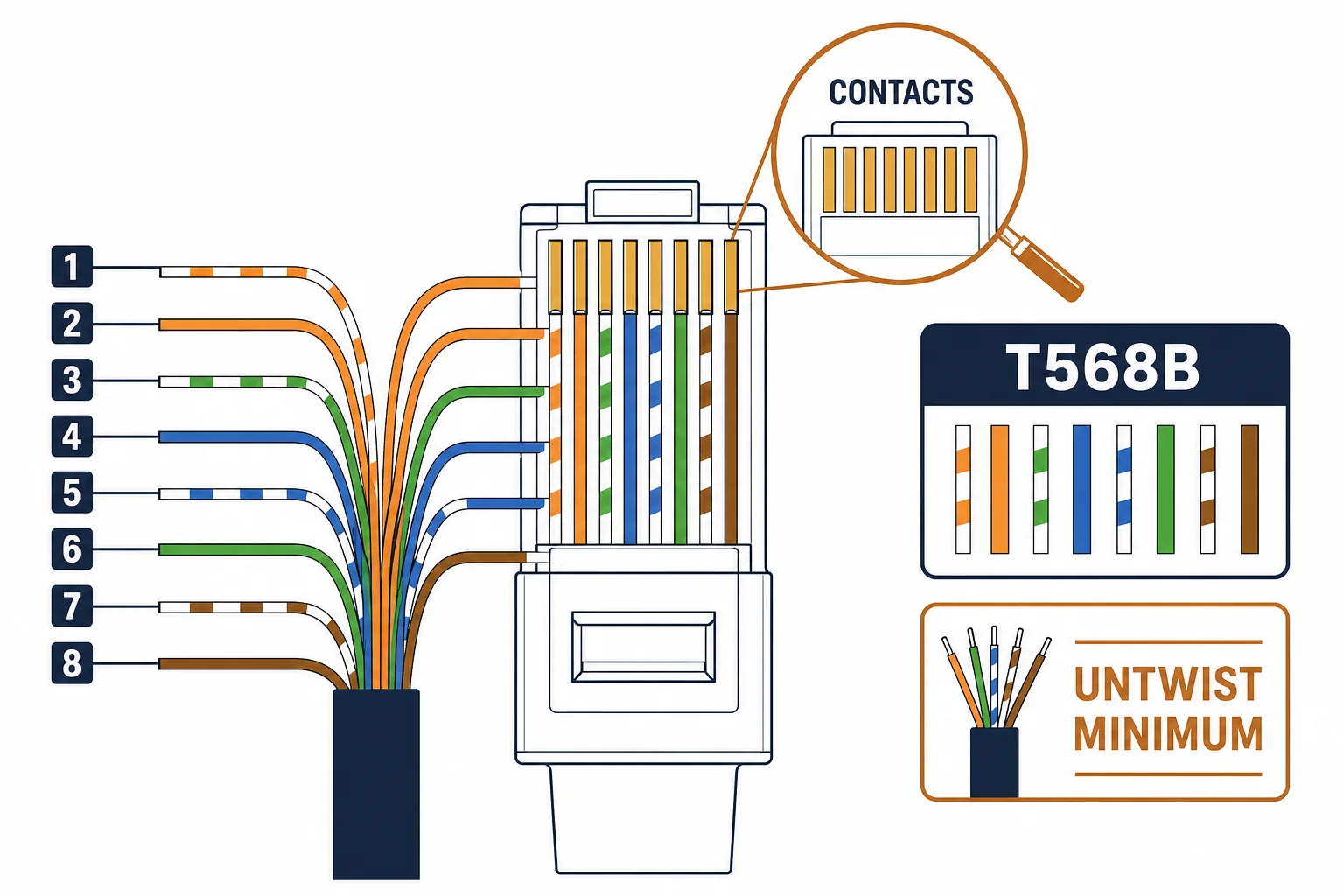
An ethernet plug is a two-dollar part that decides whether a custom cable works: the wrong category, the wrong conductor range or the wrong wiring pattern produces a cable that either fails immediately or fails later. Buying plugs is buying compatibility.
This is the plug guide: the category rating, the conductor range, the wiring pattern and the load bar that makes field termination repeatable.
The Compatibility Lines
| The line | The check | The failure if wrong |
|---|---|---|
| Category | Plug rated for Cat5e, Cat6 or Cat6a | Channel capped below the cable |
| Conductor range | 23-24 AWG solid typical | Loose or crushed crimp |
| Cable type | Solid or stranded plug | Contacts miss the conductor |
| Shield | Shielded plug for shielded cable | Floating shield |
The lines are compatibility, not quality: a premium plug outside the cable's range is still the wrong plug.
The Wiring Pattern
- T568B is the common pattern in North America; T568A exists and both work if consistent
- Both ends must use the same pattern for a straight-through cable
- A crossover swaps pairs 1-2 and 3-6 – rarely needed today
- Keep untwisting to the minimum the plug allows
Consistency is the rule: a cable wired A on one end and B on the other is a crossover, whether or not that was the intention.
The Load Bar
| The plug type | The advantage | The limit |
|---|---|---|
| One-piece | Cheapest, fastest | Harder to hold geometry |
| Load bar | Holds pair order and reduces untwist | Extra step |
| Shielded with bar | Best geometry plus shield bond | Higher cost, stiffer |
Standards and Verification
| The reference | The relevance |
|---|---|
| TIA-568.2-D | Connector and channel requirements |
| IEC 60603-7 | The RJ45 interface |
| Field test | Continuity and channel test per end |
Per-SKU plug dimensions are not provided in the knowledge base. The compatibility rules are standard; confirm the AWG range on the packaging.
Real-World Applications
The custom-length batch
Twenty bespoke cords for a rack: Cat6 plugs with load bars on stranded cable – every end tested before installation.
The AWG mismatch
Plugs rated for 24 AWG used on 23 AWG cable: the crimp closing but the continuity test failing on two pairs. The right plugs ordered.
The mixed-pattern cable
A cable wired A at one end and B at the other: it worked as a crossover by accident. Relabelled and kept – the pattern documented rather than assumed.
Related reading: The jack these plugs meet? Read the keystone jack guide — blogs/news/rj45-keystone-jack-buying
Related reading: The field termination rules for Cat8? Read the Cat8 RJ45 guide — blogs/news/cat8-rj45-connector
Frequently Asked Questions
What ethernet plug do I need?
One rated for the cable's category and conductor range, matched to solid or stranded cable, shielded if the cable is shielded.
T568A or T568B?
Either, as long as both ends match. T568B is the common convention in North America.
Can I crimp Cat6 with Cat5e plugs?
Physically sometimes, but the channel is limited and the crimp may be unreliable. Use category-matched plugs.
Do I need a load bar?
It improves consistency and reduces untwisting, which matters more at higher categories.
Sourcing cables for a project, a store, or a private-label line? Contact our B2B sales team for specifications, certification evidence, and volume terms – FOB and CIF options available. Request a quote or sample.