
Ethernet Installation Kit: The Useful Tools
Quick answer / TL;DR: Short answer: a useful kit contains a ratchet crimper with interchangeable dies, a punch-down tool with a replaceable blade, a stripper that does not nick conductors, and a tester that reads all eight pins. Buy the tester separately if the kit's is a simple continuity light – a pin-map tester is what finds a split pair.
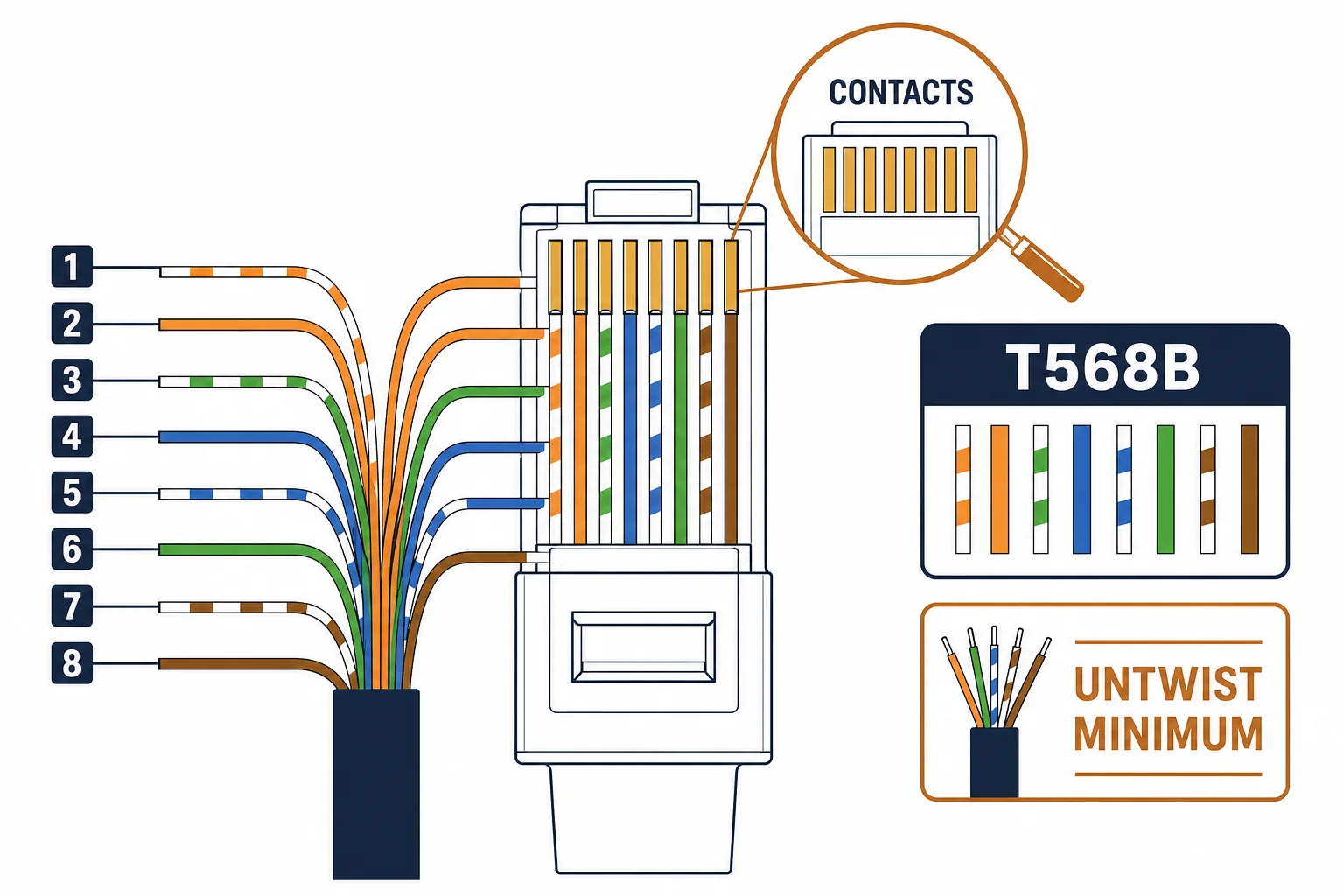
An ethernet installation kit bundles the tools a small job needs: crimper, cable stripper, punch-down tool, tester and a bag of plugs. The kits vary enormously in quality, and the two items that decide whether the kit is useful are the crimper's die and the tester's ability to read a pin map.
This is the kit guide: what belongs in one, what usually gets left out, and the checks before trusting a cheap crimper with a hundred terminations.
What Belongs in a Kit
| The tool | The job | The quality marker |
|---|---|---|
| Crimper | RJ45 plugs | Ratchet action, replaceable die |
| Stripper | Jacket removal | Adjustable, no nicks |
| Punch-down | Jacks and panels | Replaceable 110 blade |
| Tester | Fault finding | Eight-pin map, not a light |
The four tools cover the whole termination process; anything else in a kit is convenience rather than capability.
What Kits Usually Omit
- A pin-map tester that shows split pairs
- A spare punch-down blade
- A cable snip that cuts square
- A pouch that keeps the dies together
- Instruction for the wiring pattern
The omissions are predictable, which is why the first upgrade to a cheap kit is almost always the tester.
The Checks
| The check | The method |
|---|---|
| Crimp | Terminate three test plugs and test them |
| Stripper | Strip ten ends: no nicked conductors |
| Punch-down | Terminate a jack and check continuity |
| Tester | Compare a known-good and a deliberately faulty cord |
The three-plug test is quick and tells you whether the crimper's die aligns with the plugs you bought.
Standards and Verification
| The reference | The relevance |
|---|---|
| TIA-568.2-D | Termination and test practice |
| IEC 60603-7 | The plug interface |
| Field test | Pin map plus a channel test |
Per-SKU tool quality is not provided in the knowledge base. The tool roles are standard; test any new crimper before a production run.
Practical Notes
A cheap crimper that produces one bad plug in twenty is worse than no crimper: the faults appear later as intermittent links. The tool is the cheapest part of the job and the one most able to waste a day.
Real-World Applications
The first job
A twelve-drop office wired with a starter kit: the included tester found two split pairs before the plates went on – the cheap tool earning its price.
The bad die
A crimper whose die sat a fraction high: three plugs in twenty failed intermittently. Replaced with a ratchet crimper – the fault rate went to zero.
The missing blade
A punch-down blade worn smooth mid-project: two jacks terminated with poor contact. A spare blade in the kit afterwards – the delay avoided for the price of a small part.
Related reading: The plug specification the crimper must match — blogs/news/ethernet-plug-buying
Related reading: The wiring pattern to test for — blogs/news/t568a-vs-t568b
Frequently Asked Questions
What should an ethernet kit contain?
Crimper, stripper, punch-down tool and a pin-map tester at minimum.
Is the included tester good enough?
Often not – a simple continuity light will not reveal a split pair.
Do I need a ratchet crimper?
For more than a few plugs, yes: consistent pressure is the difference between working and intermittent.
What is usually missing?
A spare punch-down blade and a proper tester.
Sourcing cables for a project, a store, or a private-label line? Contact our B2B sales team for specifications, certification evidence, and volume terms – FOB and CIF options available. Request a quote or sample.