
Ethernet Double Adapter: One Port, Two Plugs
Quick answer / TL;DR: Short answer: a passive double adapter cannot give two devices a working network link – ethernet is point-to-point. Buy a small unmanaged switch instead: five ports cost little, deliver full rate per device, and pass PoE where needed. Use a double adapter only for a single device that is occasionally moved between two cables.
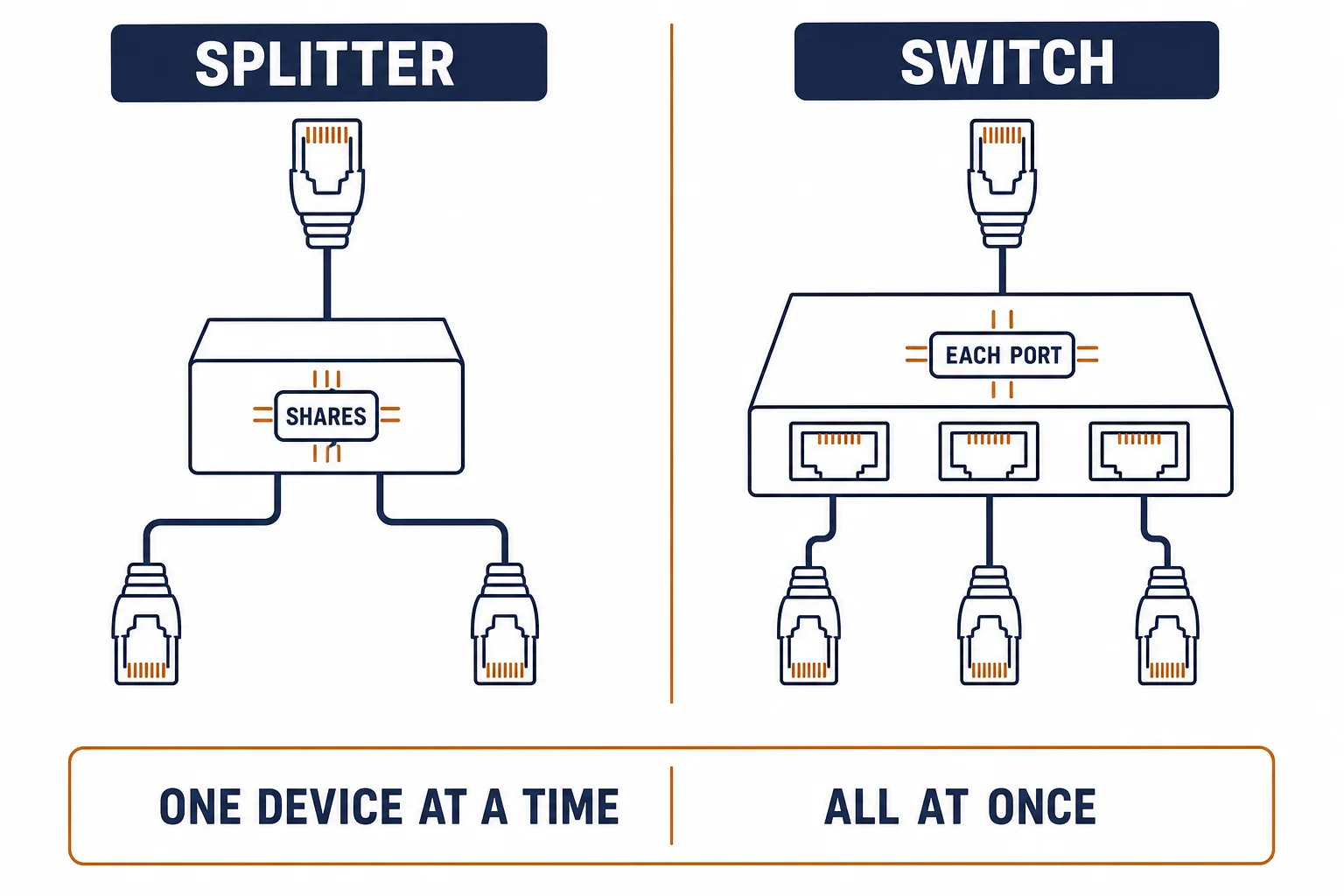
An ethernet double adapter plugs two cables into one socket. It is a passive Y-joint, not a switch: the two devices share the link, cannot communicate simultaneously, and will usually fail to negotiate a working connection at all because ethernet expects a point-to-point segment.
This is the double-adapter guide: what the device actually does electrically, why it disappoints, and the small switch that solves the problem for a similar price.
What It Does Electrically
| The device | The mechanism | The result |
|---|---|---|
| Double adapter | Wires two sockets in parallel | Collisions, failed negotiation |
| Splitter pair | Uses spare pairs for a second link | Needs a matching pair at both ends |
| Switch | Stores and forwards per port | Proper connectivity |
Ethernet assumes one transmitter per segment; two in parallel produce a segment that neither device can use reliably.
Why It Disappoints
- Negotiation fails or flaps between rates
- PoE is not passed as expected
- Troubleshooting becomes confusing – two devices, one link
- The adapter is often blamed on the devices
The failure is structural rather than a defect: the product does what its wiring allows, which is not what buyers expect.
The Right Answer
| The need | The product |
|---|---|
| Two devices, one outlet | 5-port unmanaged switch |
| A printer used occasionally | Switch, or move the cable |
| PoE device added | PoE switch port |
| Temporary test access | A short cord and patience |
A small switch is the correct solution in every row, and its cost is close to the adapter's.
Standards and Verification
| The reference | The relevance |
|---|---|
| IEEE 802.3 | Point-to-point ethernet segments |
| TIA-568.2-D | Cabling to the outlet |
| PoE standards | Why passive adapters cannot deliver power reliably |
Per-SKU adapter wiring is not provided in the knowledge base. The point-to-point requirement is standard; test any adapter with two live devices before relying on it.
Real-World Applications
The home office
A laptop and a printer on one wall outlet: a 5-port switch – both online at full rate, one spare port for a camera later.
The adapter that almost worked
A double adapter with a printer and a PC: the printer worked until the PC was busy. Replaced with a switch – the shared segment had been the explanation.
The PoE disappointment
A camera through a double adapter: no power. A PoE switch port used instead – the passive adapter had no path for power.
Related reading: The splitter against a switch — blogs/news/ethernet-splitter-vs-switch
Related reading: The couplers that join runs properly — blogs/news/ethernet-coupler-junction-box
Frequently Asked Questions
Does an ethernet double adapter work?
Not for two simultaneous devices – ethernet is point-to-point.
What should I use instead?
A small unmanaged switch, which costs about the same.
Will it pass PoE?
Not reliably – use a PoE switch port.
Can I use one for a single device?
Yes, as a way to switch one device between two cables.
Sourcing cables for a project, a store, or a private-label line? Contact our B2B sales team for specifications, certification evidence, and volume terms – FOB and CIF options available. Request a quote or sample.