
Ethernet Cable vs Cat6: The Generic Problem
Quick answer / TL;DR: Short answer: Cat6 is a specific category with defined bandwidth and test requirements; 'ethernet cable' is a family name that could be Cat5e, Cat6, or an unrated product. Before buying, check three things: the category printed on the jacket, the conductor (copper, AWG), and the jacket rating. A listing without a category is a listing without a claim.
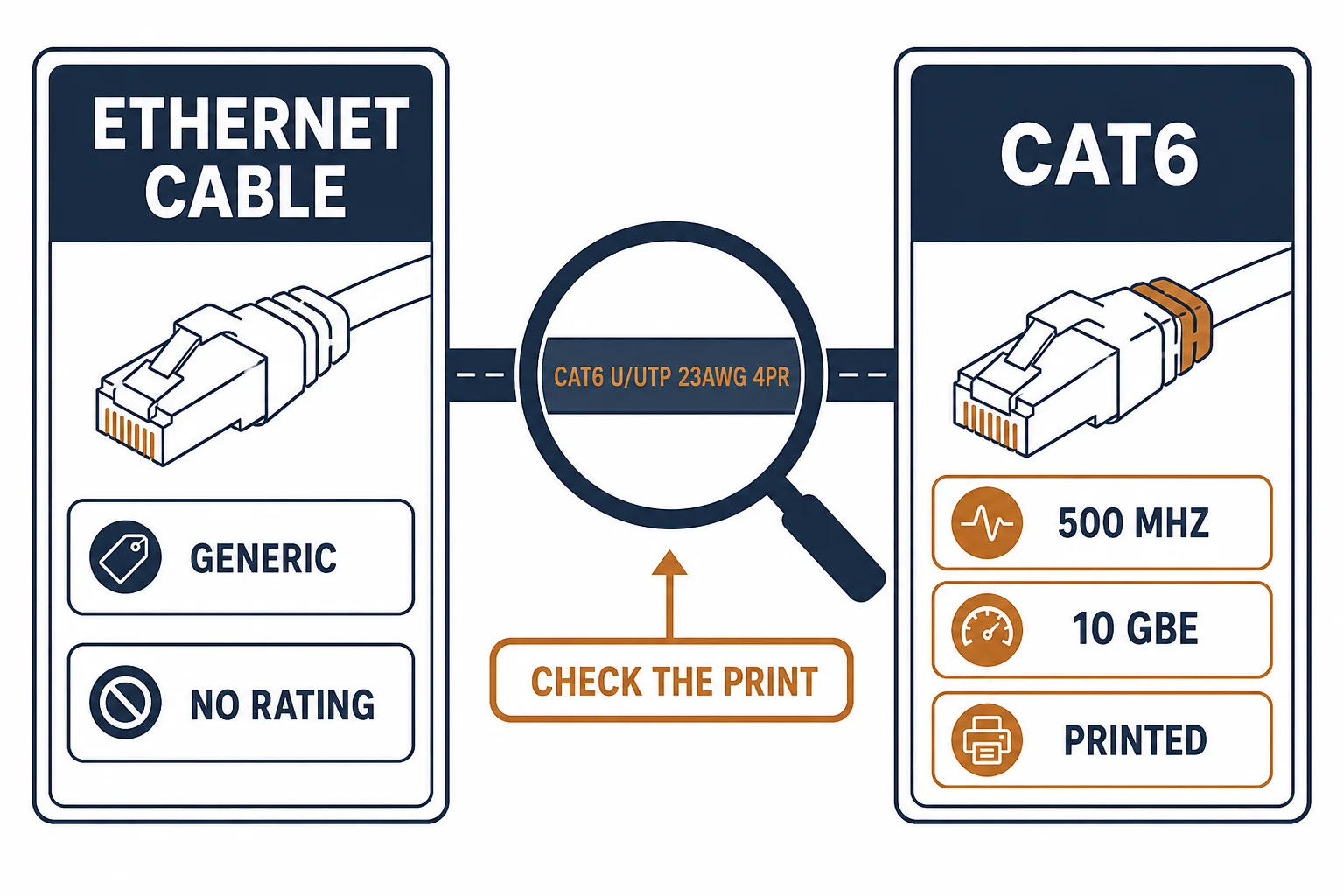
'Ethernet cable' describes a family; 'Cat6' describes a specification within it. A listing that says only 'ethernet cable' has not told you the bandwidth, the conductor, or the jacket – and those three determine whether the cable does the job it was bought for.
This is the terminology guide: what the generic term leaves out, how listings exploit it, and the three checks that convert a vague product into a specified one.
What the Generic Term Leaves Out
| The attribute | 'Ethernet cable' | 'Cat6' |
|---|---|---|
| Bandwidth | Unstated | Specified by category |
| Conductor | Unstated | Typically 23 AWG copper |
| Test | Unstated | Category test required |
| Route rating | Unstated | Jacket rating stated |
The table is the argument for the specific term: four attributes that matter and one word that supplies none of them.
How the Gap Gets Used
- Marketplace listings labelled 'high speed ethernet cable' with no category
- Category claims in the title but not on the print
- Copper-clad aluminium sold as copper
- Photos of Cat6 reused for a Cat5e SKU
The gap is not usually fraud – it is a listing optimized for search rather than for specification.
The Three Checks
| The check | The evidence |
|---|---|
| Jacket print | Category, AWG, jacket rating |
| Datasheet | Conductor material and test data |
| Price sanity | Copper at a price below copper's cost |
Standards and Verification
| The reference | The relevance |
|---|---|
| TIA-568.2-D | Category definitions and test requirements |
| ISO/IEC 11801-1 | Class equivalents |
| Field test | The channel result at the installed category |
Per-SKU claims are not provided in the knowledge base. The category system is standard; treat a listing without a printed category as unrated.
Real-World Applications
The marketplace order
A 'high speed ethernet cable' bundle at a low price: the print on arrival unmarked. Returned – Cat6 with a category and AWG specified instead.
The tender schedule
A project schedule listing 'ethernet cable, quantity 40 boxes': the line rewritten as Cat6 F/UTP CMR 305 m – the bidders quoting the same product.
The copper-clad surprise
A box bought on price and cut open: a silver core under a thin copper skin. The order re-placed with bare copper specified, the price difference finally explained.
Related reading: The dimensions a listing omits? Read the cable size guide — blogs/news/cat6-cable-size
Related reading: The construction families? Read the UTP cable guide — blogs/news/utp-cable-line
Frequently Asked Questions
Is ethernet cable the same as Cat6?
No – ethernet cable is a family name; Cat6 is one specification within it with defined bandwidth and test requirements.
Does a generic ethernet cable work?
Often, at whatever rating it happens to meet – which is unknown without a printed category. That is the problem.
How can I tell what I bought?
Read the jacket print for category, AWG and jacket rating, then check the datasheet for conductor material and test data.
Should I always buy Cat6?
Buy the category the application needs – Cat5e is fine for gigabit. The point is to buy a named category, not a generic listing.
Sourcing cables for a project, a store, or a private-label line? Contact our B2B sales team for specifications, certification evidence, and volume terms – FOB and CIF options available. Request a quote or sample.