
Ethernet Cable for Access Points: Three Requirements
Quick answer / TL;DR: Short answer: use Cat6 (or Cat6a for high-density deployments) rated for the ceiling void – CMP in a plenum, CMR in a riser – and confirm the PoE class matches the AP's draw. Keep the run within 100 m including patch cords, and test the channel after termination; a marginal link shows up as dropped clients, not as a dead AP.
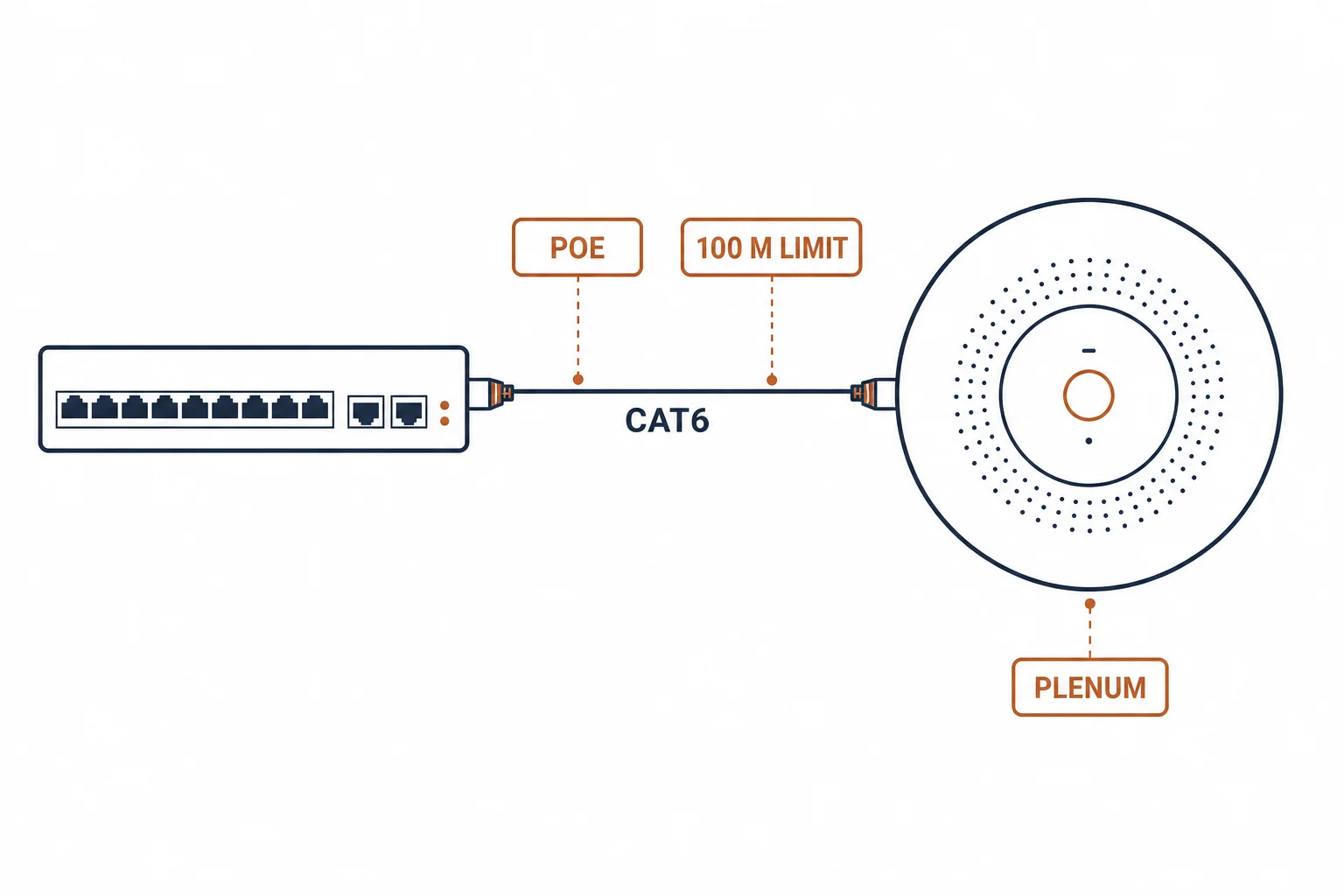
An access point is the easiest device to cable badly: it lives in a ceiling void, it is powered over the same cable that carries its data, and its performance is judged by users standing underneath it. Three requirements decide whether the run works – PoE class, length, and jacket rating.
This is the AP cabling guide: the PoE budget, the distance arithmetic, and the ceiling-specific checks.
The Three Requirements
| The requirement | The check | The failure |
|---|---|---|
| PoE class | AP draw versus switch budget | AP reboots under load |
| Length | Channel total, cords included | Link negotiates lower or drops |
| Jacket | CMP for plenum voids | Inspection failure, or code breach |
The requirements are independent, and each fails differently: power shows as reboots, length as instability, jacket as a compliance problem.
The PoE Arithmetic
- Read the AP's maximum draw, not its idle figure
- Sum the APs per switch against the switch's PoE budget
- Allow for cable loss over the run – longer runs deliver less
- Higher-power APs (Wi-Fi 6E, 7) may need PoE+ or PoE++
The arithmetic is per switch, not per port: a budget exceeded shows as APs that boot but drop radios under load.
The Ceiling Checks
| The check | The practice |
|---|---|
| Jacket rating | CMP for air-handling voids |
| Support | J-hooks or tray, not ceiling grid wire |
| Service loop | Slack at the AP for future moves |
| Labeling | Port and AP identity at both ends |
Standards and Verification
| The reference | The relevance |
|---|---|
| IEEE 802.3af/at/bt | The PoE classes |
| TIA-568.2-D | Channel and installation requirements |
| UL 444 / NEC | Jacket ratings for plenum and riser |
| Field test | Channel test after termination |
Per-SKU PoE budgets are not provided in the knowledge base. The requirements are standard; confirm the AP draw and switch budget before ordering cable.
Real-World Applications
The office ceiling
Twelve Wi-Fi 6 APs on PoE+: Cat6 CMP in the plenum void, each run tested – the deployment passing survey first time.
The warehouse span
APs at the far end of a long aisle: the run measured including cords, just inside 100 m – the link stable at gigabit.
The rebooting AP
An AP that rebooted under load: the switch's PoE budget exceeded by the last two units. A second switch added – the power arithmetic done late but done.
Related reading: The distance arithmetic? Read the long cable guide — blogs/news/long-ethernet-cable
Related reading: The PoE and shielding question? Read the PoE shielding guide — blogs/news/poe-shielded-cable
Frequently Asked Questions
What cable do I need for a wireless access point?
Cat6 rated for the ceiling void (CMP in plenum), with the PoE class matching the AP's draw and the run within 100 m.
Can PoE run 100 metres?
The channel limit is 100 m including patch cords; power loss grows with length, so check the AP's draw against the delivered power.
Does an access point need shielded cable?
Usually not. Shielded cable is for high-interference environments, and it brings grounding requirements.
Why does my AP reboot randomly?
Most often a PoE budget or cable-length issue. Check the switch's budget and the channel's negotiated rate.
Sourcing cables for a project, a store, or a private-label line? Contact our B2B sales team for specifications, certification evidence, and volume terms – FOB and CIF options available. Request a quote or sample.