
Effects Pedal Patch Cables: Board Wiring
Quick answer / TL;DR: Short answer: use short unbalanced instrument patch cables with low-profile right-angle plugs, sized to the gap between pedals rather than coiled up. Keep the total chain as short as practical, use shielded cable throughout, and check that each plug seats fully – a partly inserted jack is the most common cause of a dead pedal.
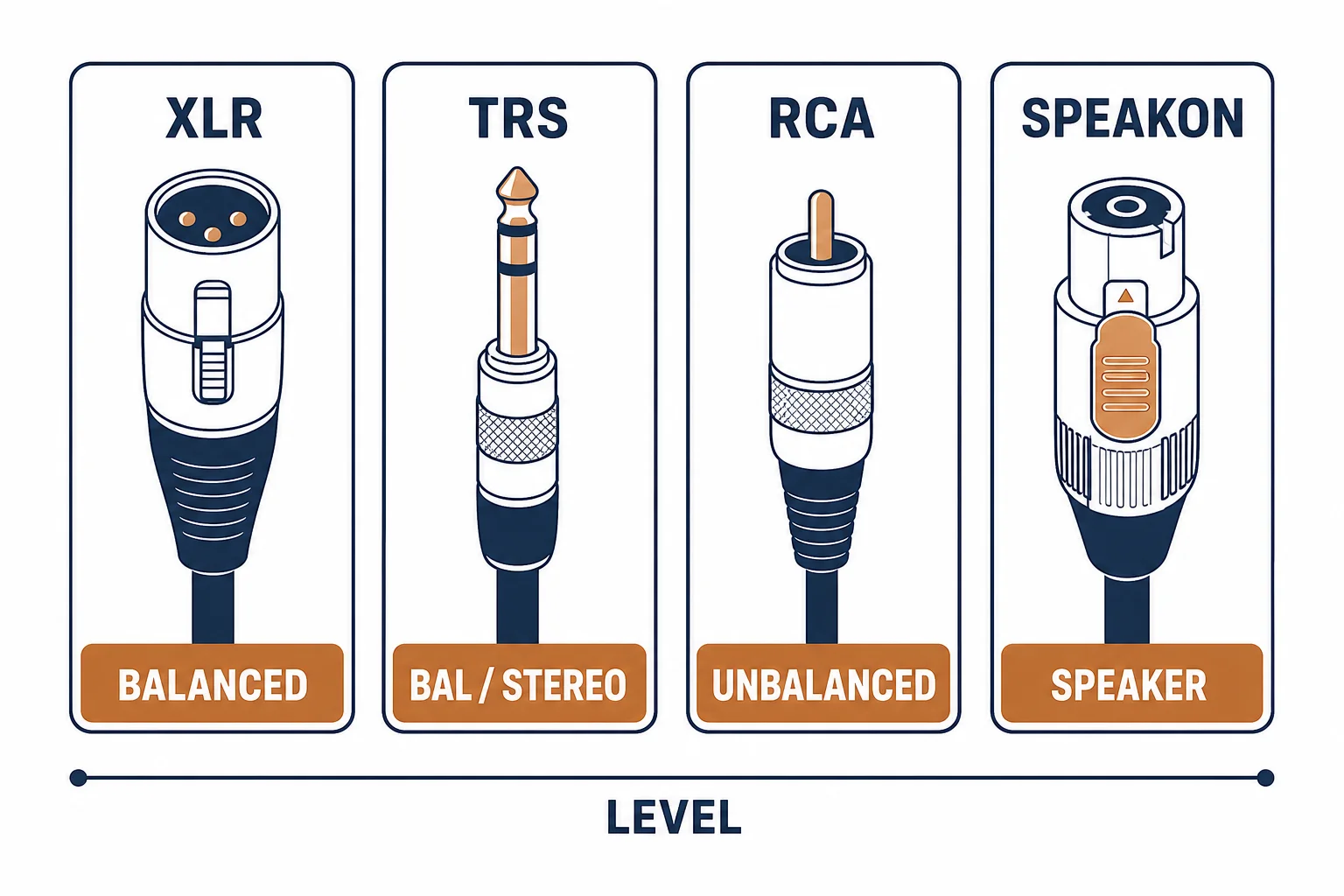
Pedal patch cables are instrument cables shortened to centimetres and reshaped to fit a board: low-profile plugs, flexible jackets, and lengths measured against the gap between two pedals rather than the distance to an amplifier. The electrical rules do not change – unbalanced, high impedance, shielded – but the mechanical ones do.
This is the pedalboard guide: the plug profiles, the shielding that keeps a chain quiet, and the length and routing discipline that stops a board from becoming a noise source.
The Plug Profiles
| The profile | The advantage | The trade-off |
|---|---|---|
| Right-angle low profile | Fits tight boards | Harder to grip when removing |
| Flat pancake | Very low clearance | Less strain relief |
| Straight | Easy to handle | Needs vertical space |
| Solderless | Custom length | A joint that can loosen |
The profile is a mechanical decision that determines how many pedals fit on a board of a given size.
The Electrical Rules
- Unbalanced, shielded cable – the same type as a guitar lead
- Short lengths: a pedalboard chain of short leads adds little capacitance
- Shield connected at both ends as normal for instrument cable
- Avoid mixing solderless joints into a long chain without checking each one
The rules are inherited from instrument cable; the pedalboard only changes the geometry.
Length and Routing
| The position | The length |
|---|---|
| Adjacent pedals | 10-15 cm |
| Across the board | 30-50 cm |
| To the amp or interface | Use a full instrument cable |
| Spare | One of each length |
Standards and Verification
| The reference | The relevance |
|---|---|
| IEC 60268 | Audio interconnection practice |
| Continuity test | Tip and sleeve discrete, no short |
| Noise check | Chain powered, listen for hum |
Per-SKU plug dimensions are not provided in the knowledge base. Measure the gap between pedals before ordering; a 5 mm error can prevent the board closing.
Real-World Applications
The twelve-pedal board
A board rebuilt with low-profile right-angle patch cables: two more pedals fitted in the same case – the profile decision paying for itself in space.
The solderless joint
A custom solderless run that went intermittent after a month: one screw-backed joint loosened. Re-terminated and checked – the joint documented as a maintenance point.
The half-inserted jack
A pedal silent at soundcheck: the patch plug not fully seated behind a tight housing. Reseated – no component was faulty.
Related reading: The instrument cable these derive from? Read the instrument cable guide — blogs/news/what-is-an-instrument-cable
Related reading: The full-length guitar leads? Read the quarter inch guitar cable guide — blogs/news/quarter-inch-guitar-cable
Frequently Asked Questions
What are effects pedal patch cables?
Short unbalanced instrument cables with compact plugs, used to connect pedals on a board.
Right-angle or straight plugs?
Right-angle low-profile for tight boards; straight where there is vertical clearance and easy handling matters.
Do patch cables affect tone?
Short leads add little capacitance; long coiled ones can. Keep them sized to the gap.
Are solderless patch cables reliable?
They can be, but each joint is a maintenance point – check them when a pedal goes silent.
Sourcing cables for a project, a store, or a private-label line? Contact our B2B sales team for specifications, certification evidence, and volume terms – FOB and CIF options available. Request a quote or sample.