
DIN Rail Patch Panel: Inside the Cabinet
Quick answer / TL;DR: Short answer: choose a DIN rail panel sized to the rail width and the cable count, with shielded jacks if the cable is shielded and a strain relief bar for the incoming cables. Bond the shield to the cabinet earth, keep data separated from power terminals, and test each link from the panel – not just at the far end.
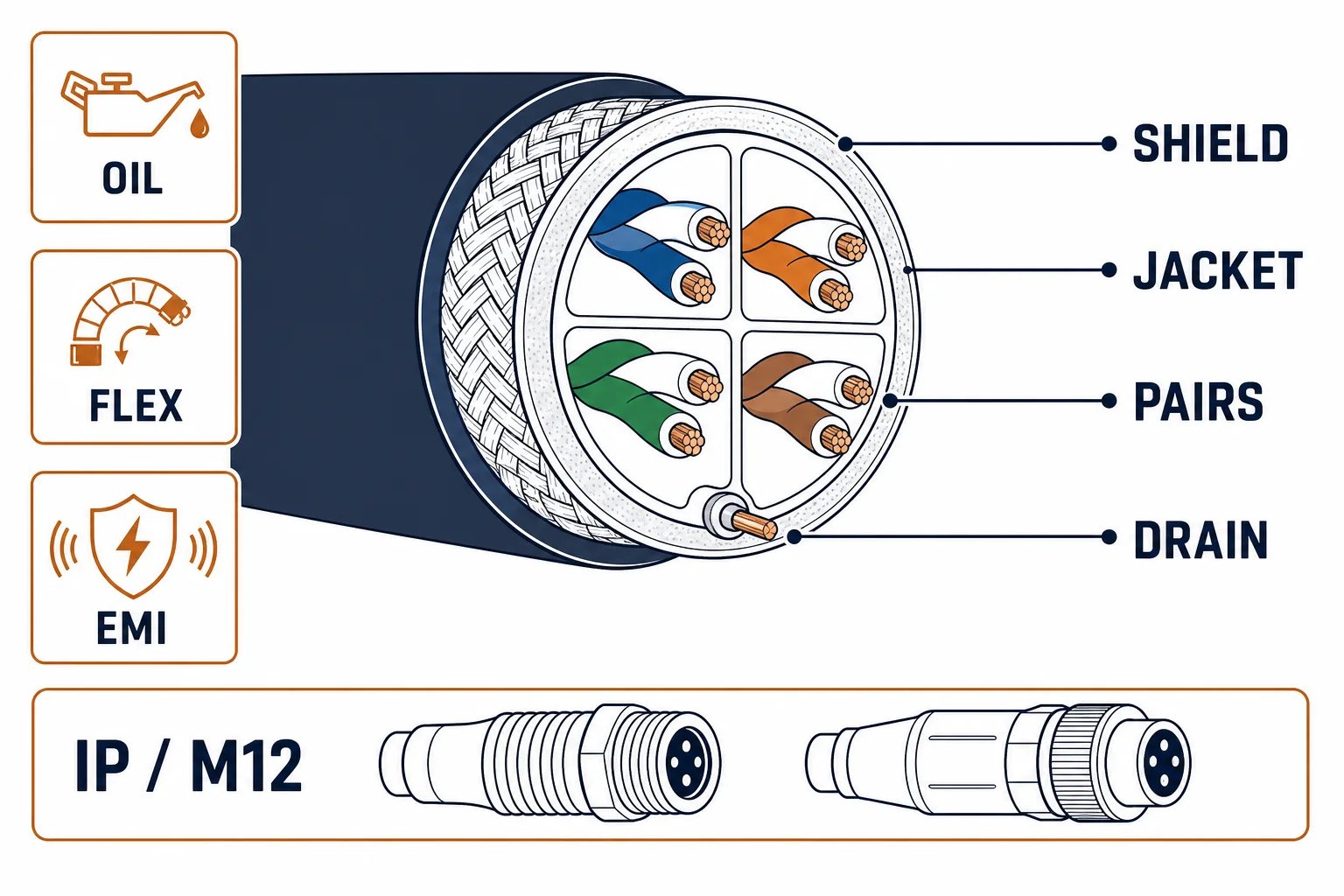
A DIN rail patch panel mounts network terminations inside a control cabinet, on the same rail as the PLC and the terminals. It exists because industrial cabinets are not data rooms: there is no 19-inch rack, the environment vibrates, and the terminations have to be serviceable by an electrician.
This is the DIN rail guide: the formats, the bonding and strain relief, and the details that decide whether a cabinet link survives its environment.
The Formats
| The format | The capacity | The use |
|---|---|---|
| DIN rail module | 2-8 ports | Small machines and panels |
| DIN rail strip | 8-24 ports | Larger cabinets |
| Hybrid | Data plus power terminals | Where space is minimal |
Capacity follows the rail: a compact machine may need only four ports, while a line cabinet may need twenty.
The Industrial Details
- Strain relief: a bar or gland for every incoming cable
- Shield bonding: to the cabinet earth, not to a floating rail
- Separation: data modules away from contactors and drives
- Temperature: cabinet internal conditions, not room conditions
These are the details that separate an industrial panel from a data-room one; the jacks themselves are the same components.
Standards and Verification
| The reference | The relevance |
|---|---|
| IEC 60715 | DIN rail dimensions |
| TIA-568.2-D | Connecting hardware |
| IEC 61131-2 | Industrial control equipment practice |
| Field test | Link test from the panel |
Per-SKU rail widths are not provided in the knowledge base. The rail standard is fixed; measure the available width and depth before choosing modules.
Practical Notes
Cabinets are assembled by electricians and patched by network engineers, and neither group owns the boundary. A labelled panel with a documented port map is the cheapest way to make that boundary work.
Real-World Applications
The machine panel
A packaging machine with four networked devices: a four-port DIN module, strain relief bar, shield bonded to the cabinet – the machine serviceable without opening a data cabinet.
The drive interference
Data modules mounted beside a drive: intermittent link faults. The modules moved to the opposite rail end and the shield re-bonded – the separation and the bond fixed both.
The undocumented cabinet
A cabinet with twelve network terminations and no labels: a fault took a shift to trace. Port map added inside the door – the next fault took ten minutes.
Related reading: The industrial cable decisions — blogs/news/industrial-ethernet-cable
Related reading: The 600V rating for shared trays — blogs/news/600v-ethernet-cable
Frequently Asked Questions
What is a DIN rail patch panel?
A network termination module that mounts on a standard DIN rail inside a control cabinet.
Does it need shielding?
If the cable is shielded, yes – with the shield bonded to the cabinet earth.
How many ports should it have?
As many as the cabinet needs plus one or two, sized to the rail width.
What is the most common mistake?
No strain relief and no labels – both make the cabinet unmaintainable.
Sourcing cables for a project, a store, or a private-label line? Contact our B2B sales team for specifications, certification evidence, and volume terms – FOB and CIF options available. Request a quote or sample.