
Custom Ethernet Cables: Build or Buy
Quick answer / TL;DR: Short answer: order custom ethernet cables only for a real constraint – non-standard length, printed identification, a specific boot or colour for a scheme, or an assembly that must be tested as a unit. Give the supplier category, conductor, wiring pattern, length tolerance and test requirement, and approve a sample before the batch.
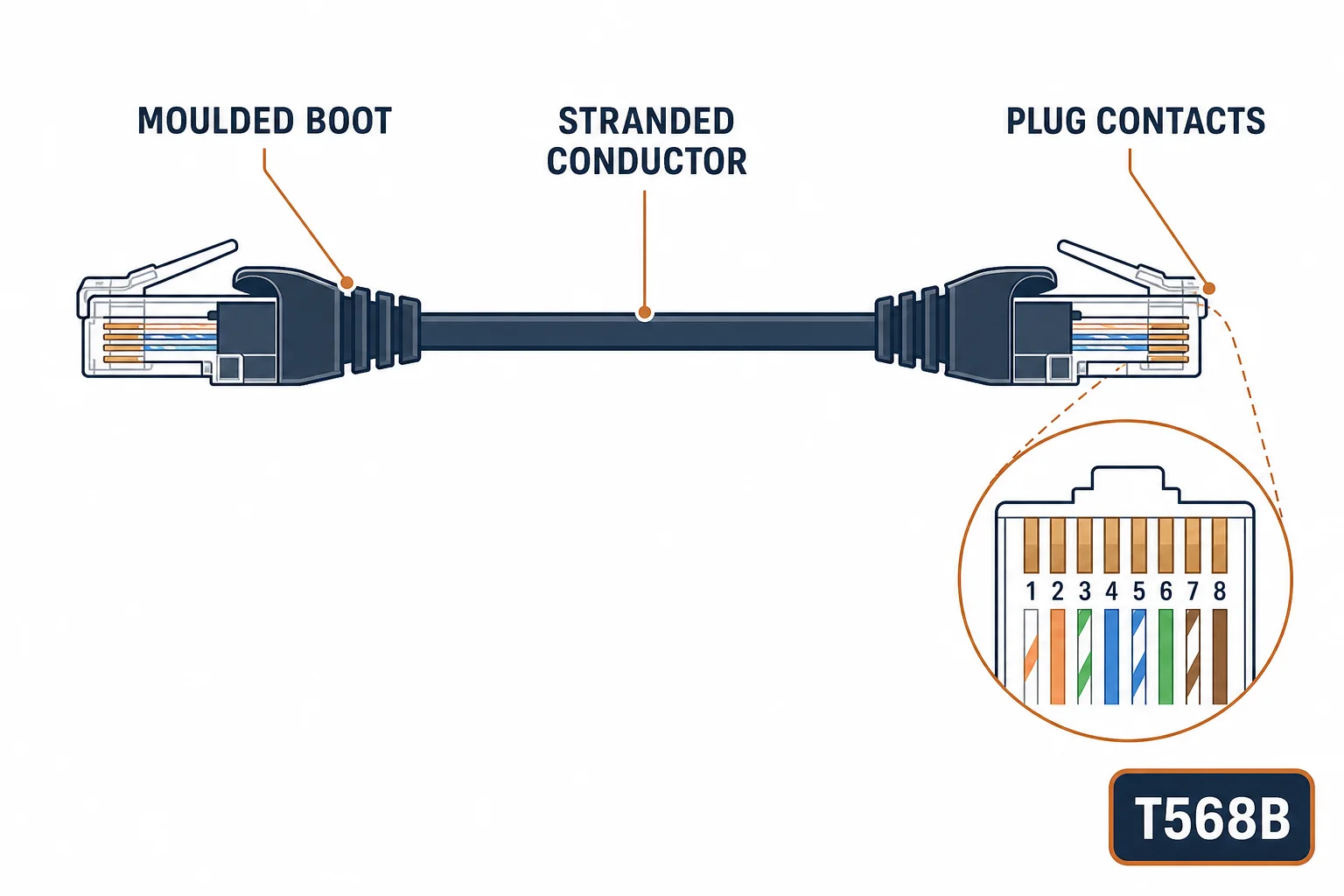
Custom ethernet cables make sense in a narrow band of cases: a length no one stocks, a colour that must match a scheme, a label printed on the jacket, or a boot that fits a specific panel. Outside that band, a stock cord is cheaper, tested, and replaceable tomorrow.
This is the custom-cable guide: the cases that justify a build, the specification a supplier needs, and the acceptance test that keeps a custom batch from becoming a custom problem.
When Custom Is Justified
| The constraint | The justification | The alternative |
|---|---|---|
| Length | A cabinet needs 37 cm | Stock 0.5 m, coiled |
| Identification | Printed part number on the jacket | Labels wrapped at each end |
| Colour scheme | Customer-facing rack | Two stock colours |
| Boot or shell | Panel clearance | A different stock cord |
| Assembly | Multiple legs joined | A small harness |
Each row has an alternative; custom wins only when the alternative costs more in labor or appearance than the assembly does.
The Specification a Supplier Needs
- Category and conductor – Cat6 stranded, for example
- Wiring pattern – T568B, stated explicitly
- Length and tolerance – 37 cm plus or minus 5 mm
- Boot type and colour
- Test requirement – continuity and channel test per assembly
- Marking – printed text, orientation, position
The wiring pattern and tolerance are the two lines most often omitted, and both cause rejections.
Acceptance Testing
| The test | The method |
|---|---|
| Continuity and pinout | Per assembly, not per batch |
| Channel test | On a sample of each length |
| Visual | Boot moulding, marking legibility |
| Length | Measured against the tolerance |
Standards and Verification
| The reference | The relevance |
|---|---|
| TIA-568.2-D | Cord and channel requirements |
| IEC 60603-7 | The plug interface |
| Field test | Channel test with the custom cord in place |
Per-supplier capability and pricing are not provided in the knowledge base. The specification structure is standard; approve a sample and define the test before production.
Real-World Applications
The broadcast rack
A rack needing 37 cm cords in a specific colour with printed IDs: a custom batch, sampled and tested – the rack readable without labels peeling off.
The stock alternative
A request for a 2.2 m cord in a custom colour: the stock 2 m cord and a different colour scheme satisfied the need. The custom order cancelled – the constraint was preference, not requirement.
The untested batch
Two hundred custom cords delivered without a test record: eleven failed continuity in service. The next order specified per-assembly testing – the acceptance clause earning its place.
Related reading: The stock cord matrix instead? Read the ethernet patch cable line — blogs/news/ethernet-patch-cable-line
Related reading: The plug and wiring rules? Read the ethernet plug guide — blogs/news/ethernet-plug-buying
Frequently Asked Questions
When should I order custom ethernet cables?
For a genuine constraint: non-standard length, printed identification, specific boot or colour scheme, or a multi-leg assembly.
What must the specification include?
Category, conductor, wiring pattern, length tolerance, boot type, marking and test requirement.
Should I approve a sample?
Yes – a sample reveals marking quality, boot moulding and length accuracy before a batch is built.
How should a custom batch be tested?
Continuity and pinout per assembly, plus a channel test on a sample of each length.
Sourcing cables for a project, a store, or a private-label line? Contact our B2B sales team for specifications, certification evidence, and volume terms – FOB and CIF options available. Request a quote or sample.