
Crossover Cable: The Remaining Use
Quick answer / TL;DR: Short answer: a crossover cable wires T568A at one end and T568B at the other, swapping pairs 1-2 with 3-6. Modern switches, routers and NICs auto-detect and do not need one; older direct device-to-device links and some industrial or legacy equipment still do. If a link fails between two like devices, test the cable's pinout before assuming a hardware fault.
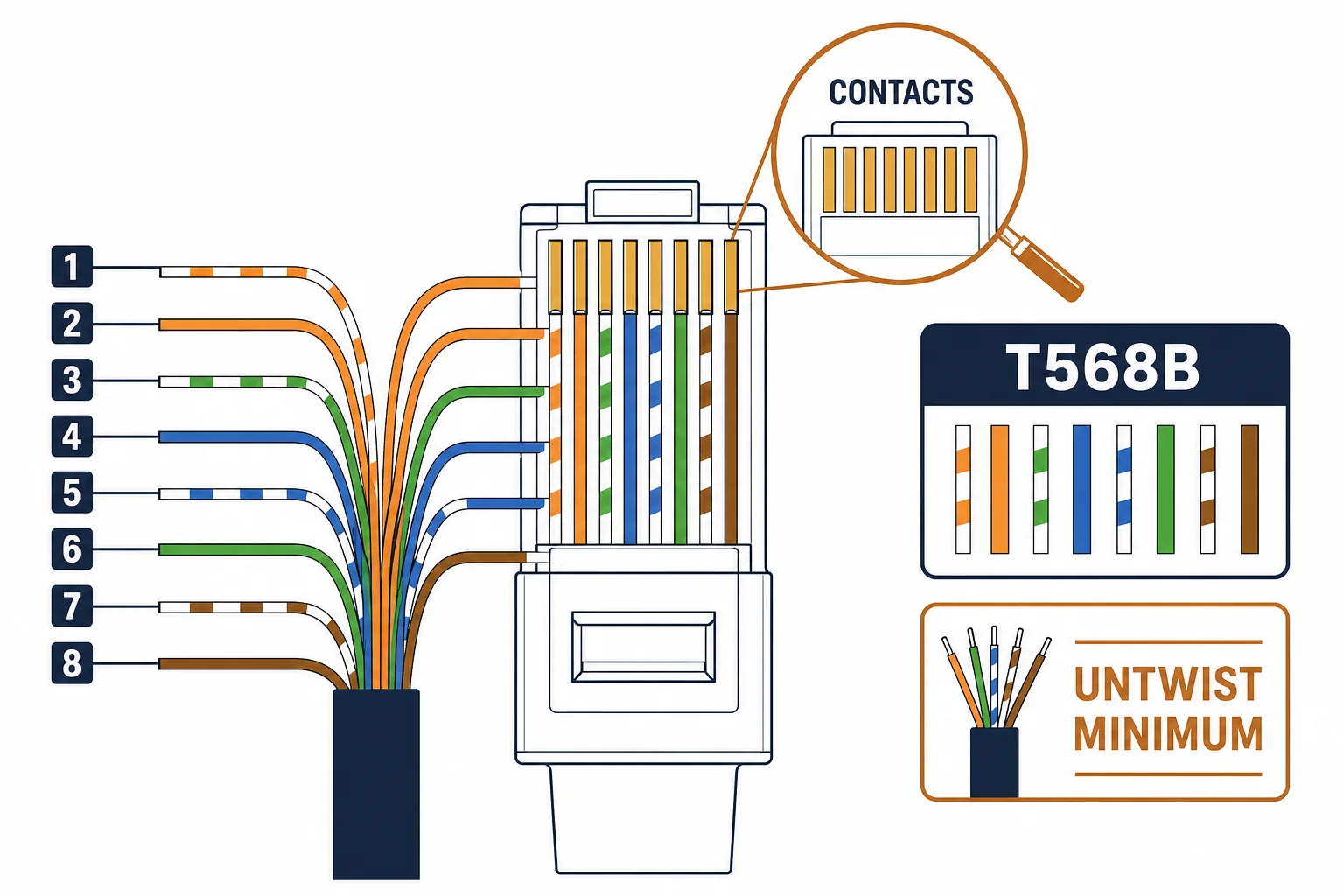
A crossover cable swaps the transmit and receive pairs so two devices of the same type can talk without a switch. It solved a real problem for a decade, and then auto-MDI/X solved it in silicon: most modern ports detect the wiring and adapt, which made the crossover cable a specialist item.
This is the crossover guide: the wiring difference, the devices that still need one, and the test that tells a crossover from a badly made straight cable.
The Wiring Difference
| The cable | End A | End B |
|---|---|---|
| Straight-through | T568B | T568B |
| Crossover | T568A | T568B |
| Result | Pairs 1-2 and 3-6 swapped | Transmit meets receive |
The swap is a single pattern change at one end, which is why a crossover looks identical to a straight cable from outside.
What Still Needs One
- Older device-to-device links without auto-MDI/X
- Some industrial controllers and legacy switches
- Uplink ports on very old hubs
- Lab and test setups where the wiring is deliberate
The list is short and getting shorter: most failures attributed to a missing crossover are actually a faulty cable or a disabled port.
Telling Them Apart
| The test | The result |
|---|---|
| Continuity tester | Pin map shows the swap |
| Link light | Ambiguous – auto-MDI/X hides it |
| Substitution | A known straight cable in the same link |
Only a pin map distinguishes them; link lights lie on modern equipment.
Standards and Verification
| The reference | The relevance |
|---|---|
| TIA-568.2-D | Both wiring patterns |
| IEEE 802.3 | Auto-negotiation and MDI/MDI-X |
| Continuity test | Pin-by-pin mapping |
Per-device auto-MDI/X support is not provided in the knowledge base. The wiring rule is standard; check the device documentation before building a crossover.
Real-World Applications
The legacy controller
An industrial controller linking directly to an older switch: no link with a straight cable, working with a crossover. The requirement documented on the panel – the next technician saved an hour.
The modern non-problem
Two laptops connected directly: a straight cable worked because both ports auto-detect. The crossover that had been ordered was unnecessary – the capability was in the hardware.
The misdiagnosis
A link failing between two switches: a crossover assumed and built, with no change. The real fault was a damaged pair in the permanent run, found by a pin-by-pin test – the cable had been innocent all along.
Practical Notes
The pattern is often written as A-to-B, which is accurate but easy to misread: the two ends differ, and both must be terminated properly. A cable wired A at one end and B at the other is a crossover by definition, whether or not it was intended as one.
Per-SKU wiring is not provided in the knowledge base. The pattern rule is standard; verify with a pin map rather than a link light.
The lab bench
A test bench needing deliberate crossover wiring between two units: cables made and labelled A-to-B, kept separate from the straight stock – the ambiguity removed from the drawer.
The mixed drawer
A drawer of unlabelled cords where one was a crossover: three hours lost on an unrelated fault. All cords tested and the crossover tagged – the drawer became reliable.
The legacy printer
A network printer without auto-MDI/X connected to a modern switch: a straight cable was correct, and the crossover in the box was the wrong tool. The documentation settled it in a minute.
Related reading: The wiring patterns behind the swap — blogs/news/t568a-vs-t568b
Related reading: The connector genders involved — blogs/news/rj45-male-female-connectors
Frequently Asked Questions
Do I still need a crossover cable?
Only for older or industrial devices without auto-MDI/X. Most modern ports adapt automatically.
How is a crossover wired?
T568A at one end and T568B at the other, swapping pairs 1-2 and 3-6.
Can a crossover damage equipment?
No – at worst the link does not come up.
How do I identify one?
With a pin-by-pin continuity tester; link lights will not reveal it on modern gear.
Sourcing cables for a project, a store, or a private-label line? Contact our B2B sales team for specifications, certification evidence, and volume terms – FOB and CIF options available. Request a quote or sample.