
Coaxial Output Cable: The Digital Audio Path
Quick answer / TL;DR: Short answer: a coaxial digital output needs a 75-ohm RCA cable, not a standard audio lead, and the source must be set to output PCM or bitstream over coax rather than HDMI only. An RF output needs a proper TV aerial lead. If the sound is absent, check the source menu before replacing the cable – output selection is the usual cause.
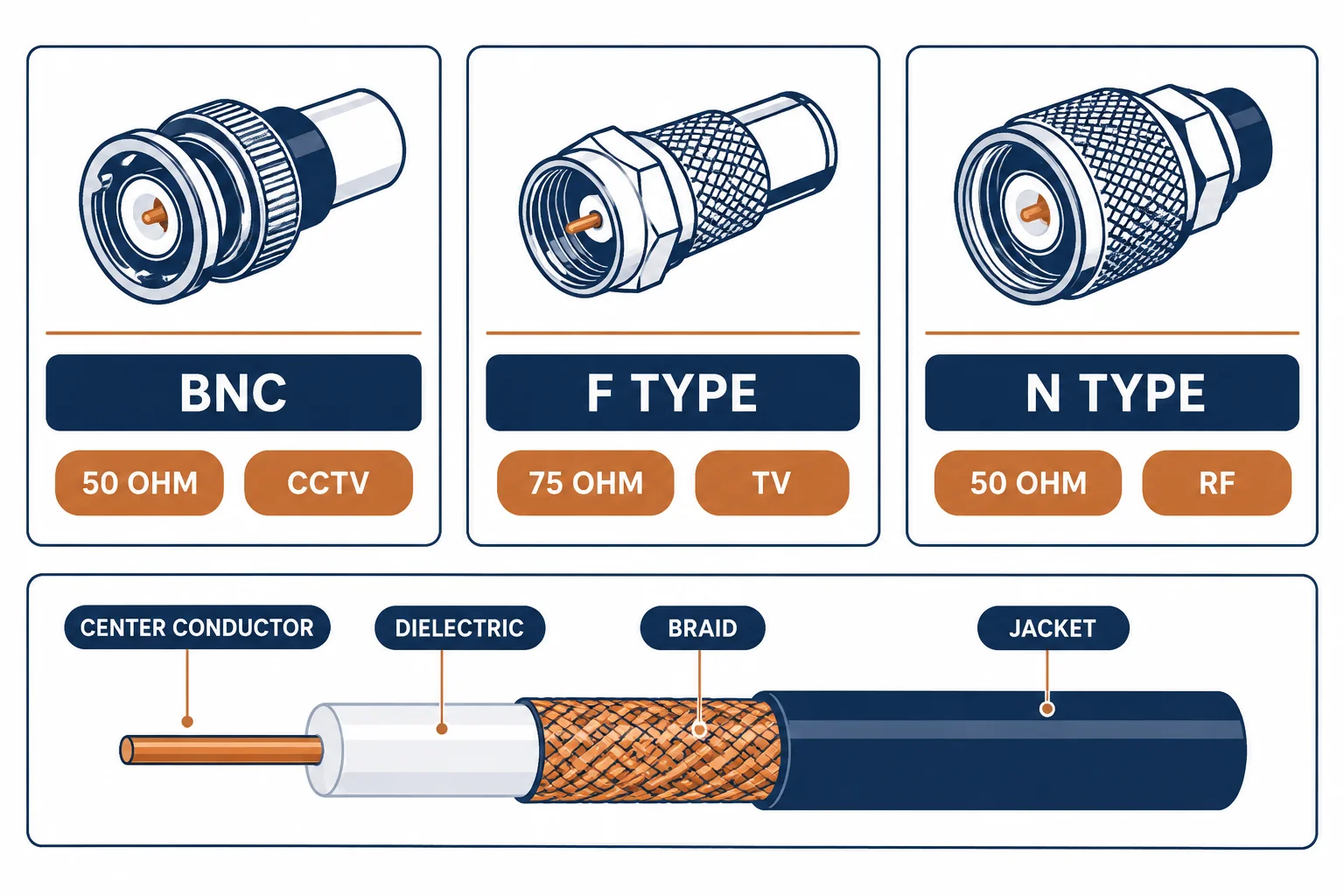
A coaxial output on a TV, decoder or disc player is usually a digital audio output: S/PDIF on an RCA socket, needing a 75-ohm cable rather than an audio lead. The same connector appears on RF outputs carrying antenna signals, which is a different job with a different cable.
This is the coax output guide: the two signals that share a socket, the cable each needs, and the settings that decide whether sound arrives at all.
The Two Signals
| The output | The signal | The cable |
|---|---|---|
| Coaxial digital | S/PDIF audio | 75-ohm RCA |
| RF | Antenna or modulator | TV aerial lead, 75-ohm |
| Composite video | Analogue video | 75-ohm RCA, often yellow |
The socket looks the same in all three cases; the cable and the source setting differ.
The Cable Requirement
- 75-ohm characteristic impedance for digital and RF
- Audio leads are not specified for impedance and can fail at longer lengths
- Short runs tolerate substitution, which is why the fault appears late
- Shielded construction for both
The impedance rule is why a cheap audio lead sometimes works and then stops working when the run gets longer.
The Settings
| The setting | The options |
|---|---|
| Audio output | PCM, bitstream or auto |
| Output device | Coax rather than HDMI |
| Format | Stereo PCM for older receivers |
| Test | A known 5.1 source |
Settings cause more silent coax outputs than cables: the connector is rarely the fault.
Standards and Verification
| The reference | The relevance |
|---|---|
| IEC 60958 | S/PDIF digital audio interface |
| IEC 61169 | RF connector standards |
| Field test | Signal at the receiver plus a listening check |
Per-device menu names are not provided in the knowledge base. The interface standard is fixed; confirm the output menu in the device manual.
Practical Notes
A coaxial digital cable is directional in practice only because of how it was made, not by specification. Keep the run short, avoid coiling it beside a power supply, and label both ends if the installation will be touched again.
Real-World Applications
The soundbar connection
A TV and soundbar with no HDMI ARC: a 75-ohm coax cable to the soundbar, the TV set to PCM over coax – sound restored without new hardware.
The audio lead substitution
An audio RCA lead used for digital coax: working at one metre, dropping out at four. A 75-ohm cable fitted – the length had revealed the impedance problem.
The RF confusion
A TV RF output fed into a digital audio input: no sound and a puzzled owner. The socket labels read properly – two different signals, two different cables.
Related reading: The digital coax variant in detail — blogs/news/digital-coaxial-rca-buying
Related reading: The coaxial connector families — blogs/news/coaxial-cable-wholesalers
Frequently Asked Questions
What cable does a coaxial digital output need?
A 75-ohm RCA cable, not a standard audio lead.
Why is there no sound from coax?
Usually the source is set to output over HDMI or the wrong format. Check the menu first.
Can I use an audio RCA cable?
At short lengths it often works, but it is outside the impedance specification.
Is RF output the same socket?
It may look the same, but it carries an antenna signal and needs a TV lead.
Sourcing cables for a project, a store, or a private-label line? Contact our B2B sales team for specifications, certification evidence, and volume terms – FOB and CIF options available. Request a quote or sample.