
Coaxial Cable Wholesale: The Connector Families
Quick answer / TL;DR: Short answer: buy coaxial cable by connector family and impedance – BNC 50-ohm (CCTV, test), F-type 75-ohm (TV, satellite, cable), N 50-ohm (RF, antenna). Confirm the cable type (RG designation), the shield construction (braid percentage), and the jacket rating for the route. Impedance must match end to end.
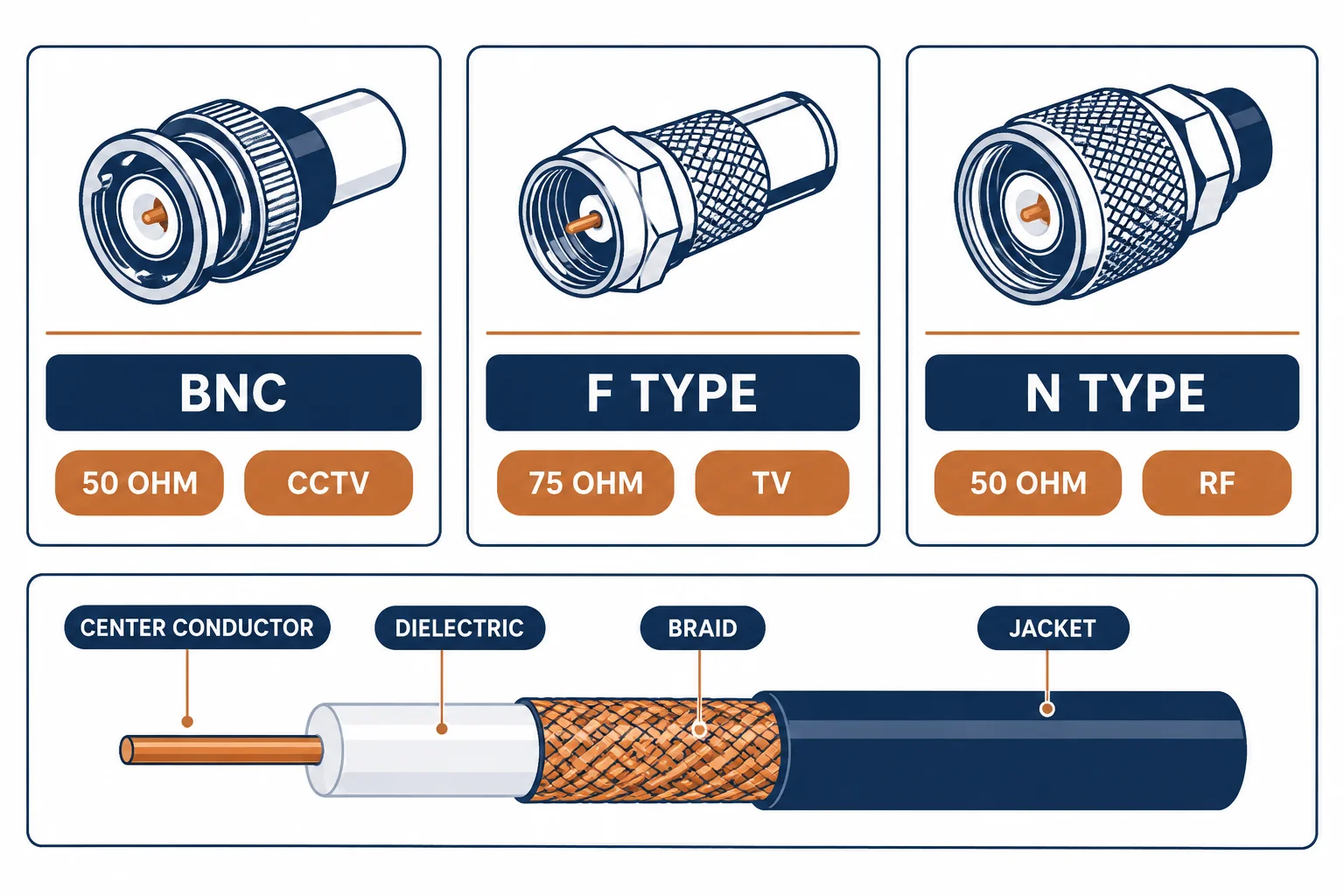
Coaxial cable wholesale is organized by connector family and impedance: BNC on 50-ohm for CCTV and instrumentation, F-type on 75-ohm for TV and satellite, N on 50-ohm for RF and antenna runs. Buying the wrong impedance is the classic wholesale error – the connector fits, the signal does not.
This is the coax wholesale guide: the families, the impedance rule, and the checks that protect a pallet order.
The Connector Families
| The family | The impedance | The application |
|---|---|---|
| BNC | 50 ohm | CCTV, lab, instrumentation |
| F-type | 75 ohm | TV, satellite, cable distribution |
| N-type | 50 ohm | RF, antenna, outdoor runs |
The family and the impedance travel together: a BNC connector on 75-ohm cable exists, but the standard pairing is the one above – mismatches show as reflections and level loss.
The Cable Specification
- RG designation: the cable's construction class – RG6 and RG59 for 75-ohm video
- Shield: braid percentage and foil – the screening performance
- Center conductor: copper-clad steel versus solid copper – the run's loss
- Jacket: indoor, outdoor, plenum, burial as the route requires
The specification list is the wholesale order's backbone: RG type, shielding, conductor, jacket. The connector family sits on top.
The Wholesale Checks
| The check | The method |
|---|---|
| Impedance continuity | Measure end to end, and the connector's rating |
| Shield coverage | Braid percentage stated on the datasheet |
| Length accuracy | Measure a sample reel |
| Connector quality | Pull test on a terminated sample |
Standards and Verification
| The reference | The relevance |
|---|---|
| IEC 61196 | Coaxial cable specifications |
| Broadcast video practice | BNC and 75-ohm video applications |
| Local code | Route ratings for exterior and plenum |
Per-SKU attenuation figures are not provided in the knowledge base. The family and impedance structure is standard; request attenuation and screening data with the sample.
Real-World Applications
The CCTV install
Sixteen cameras on RG59 with BNC: the 50-ohm family matched, the runs measured for loss – the wholesale order built on the drawing.
The satellite distribution
A multi-dwelling satellite system on RG6 F-type: 75 ohm throughout, the shield percentage specified – the signal budget met.
The impedance mistake
A 50-ohm BNC run into a 75-ohm distribution amp: reflections and level loss – the family and impedance re-checked, the cable replaced.
Related reading: The audio families alongside coax? Read the audio cable manufacturers guide — blogs/news/audio-cable-manufacturers
Related reading: The digital audio use of 75-ohm coax? Read the digital coaxial RCA guide — blogs/news/digital-coaxial-rca-buying
Frequently Asked Questions
How do I choose coaxial cable?
By connector family and impedance: BNC 50-ohm, F-type 75-ohm, N 50-ohm – then RG type, shielding, and jacket for the route.
Can I mix 50 and 75 ohm coax?
Physically sometimes, electrically no – the mismatch causes reflections and loss. Keep impedance consistent end to end.
What is the difference between RG6 and RG59?
Both are 75-ohm video cables; RG6 has a larger conductor and better loss characteristics over distance. RG59 suits shorter runs.
What should I check in a wholesale order?
Impedance continuity, shield percentage, reel length, and connector pull strength on a terminated sample.
Sourcing cables for a project, a store, or a private-label line? Contact our B2B sales team for specifications, certification evidence, and volume terms – FOB and CIF options available. Request a quote or sample.