
Cheap Fiber Patch Cables: Where to Save
Quick answer / TL;DR: Short answer: buy budget fiber cords for short in-rack patching where a failure is easy to swap, and insist on tested cords for backbone links and anywhere access is difficult. Check the polish type, the connector body quality and, above all, ask for a loss test – a cheap cord with a measured result is better than an expensive one without.
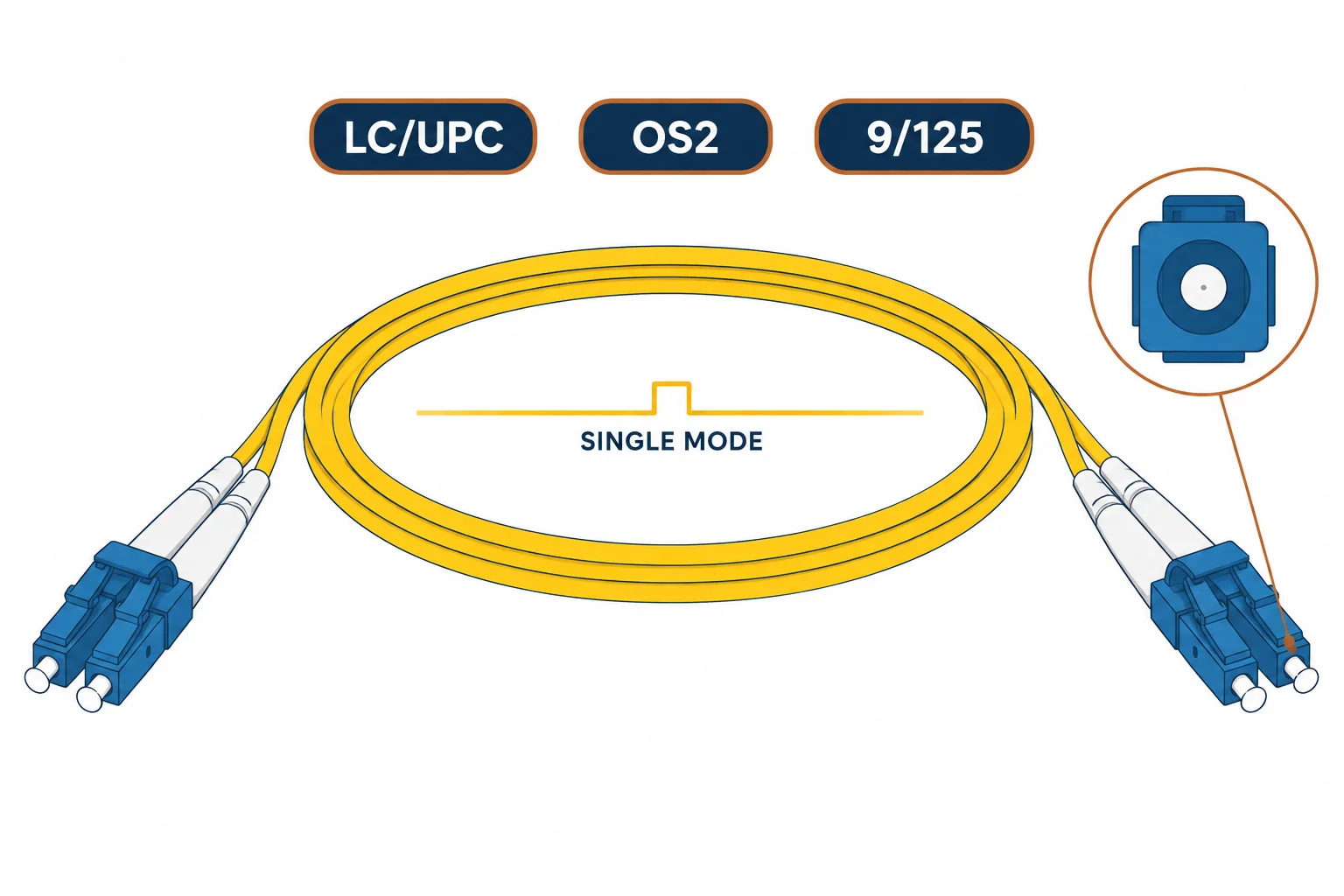
Fiber patch cables vary enormously in price for a product that looks identical: the difference is in the ferrule, the polish, the connector body and the testing. Some of that matters for a short in-rack link and some of it matters everywhere.
This is the budget-fiber guide: what actually varies, the tests that reveal it, and the installations where a cheap cord is a false economy.
What Varies
| The part | The cheap version | The consequence |
|---|---|---|
| Ferrule | Lower-grade ceramic | Higher loss, shorter life |
| Polish | Less controlled | Reflection, mating issues |
| Body | Thinner plastic | Latch breaks |
| Testing | Sampled or none | Unknown loss |
The ferrule and polish are where the optical performance lives; the body is where the handling failures happen.
Where the Saving Is Safe
- Short in-rack patching that is easy to reach
- Spares and test leads
- Non-critical monitoring links
- Cabinets where a swap takes seconds
The safe cases share one property: a failure is cheap to fix.
Where It Is Not
| The installation | The reason |
|---|---|
| Backbone links | A failure affects many users |
| Difficult access | A swap may need a lift |
| Long spans | Loss budget is tighter |
| Certified systems | The test record must hold |
In those cases the price difference is small against the cost of the failure it invites.
Standards and Verification
| The reference | The relevance |
|---|---|
| IEC 61300 | Connector test methods |
| ITU-T G.652 | Single-mode fiber |
| TIA-568.3 | Fiber cabling practice |
| Field test | Loss measurement, per cord and per link |
Per-SKU loss figures are not provided in the knowledge base. The test is the specification: request measured results rather than trusting a grade name.
Real-World Applications
The rack spares
A drawer of budget LC cords for in-rack patching: measured on arrival, the worst two set aside – the saving kept where a swap is a minute's work.
The backbone cord
A cheap cord used on a 300 m backbone: loss climbing and no spare path. Replaced with a tested cord – the saving had been a fraction of the outage cost.
The broken latch
A budget cord's latch snapped inside a panel: the plug could not be removed without opening the panel. A better-bodied cord used afterwards – the small part had caused the largest disruption.
Related reading: The fiber cord supply lines — blogs/news/fiber-patch-cord-suppliers
Related reading: The 1 m standard length — blogs/news/1m-fiber-patch-cable
Frequently Asked Questions
Are cheap fiber cables reliable?
For short, accessible links they can be – if you measure them on arrival.
What should I check first?
The loss test result, then the connector body and latch.
Where should I never save?
Backbones, difficult-access runs and certified systems.
Does polish type matter?
Yes – UPC and APC must not be mixed, regardless of price.
Sourcing cables for a project, a store, or a private-label line? Contact our B2B sales team for specifications, certification evidence, and volume terms – FOB and CIF options available. Request a quote or sample.