
Cat8 Patch Panel: The Class Depends on It
Quick answer / TL;DR: Short answer: specify a Cat8-rated panel with Cat8 jacks, shielded and bonded to the rack, matched to the cable class (Cat8.1 or 8.2) and to the cords at both ends. Do not fit a Cat8 panel to Cat6a cable or vice versa unless the whole channel is the lower class – the panel cannot raise the channel. Test every link at the installed class.
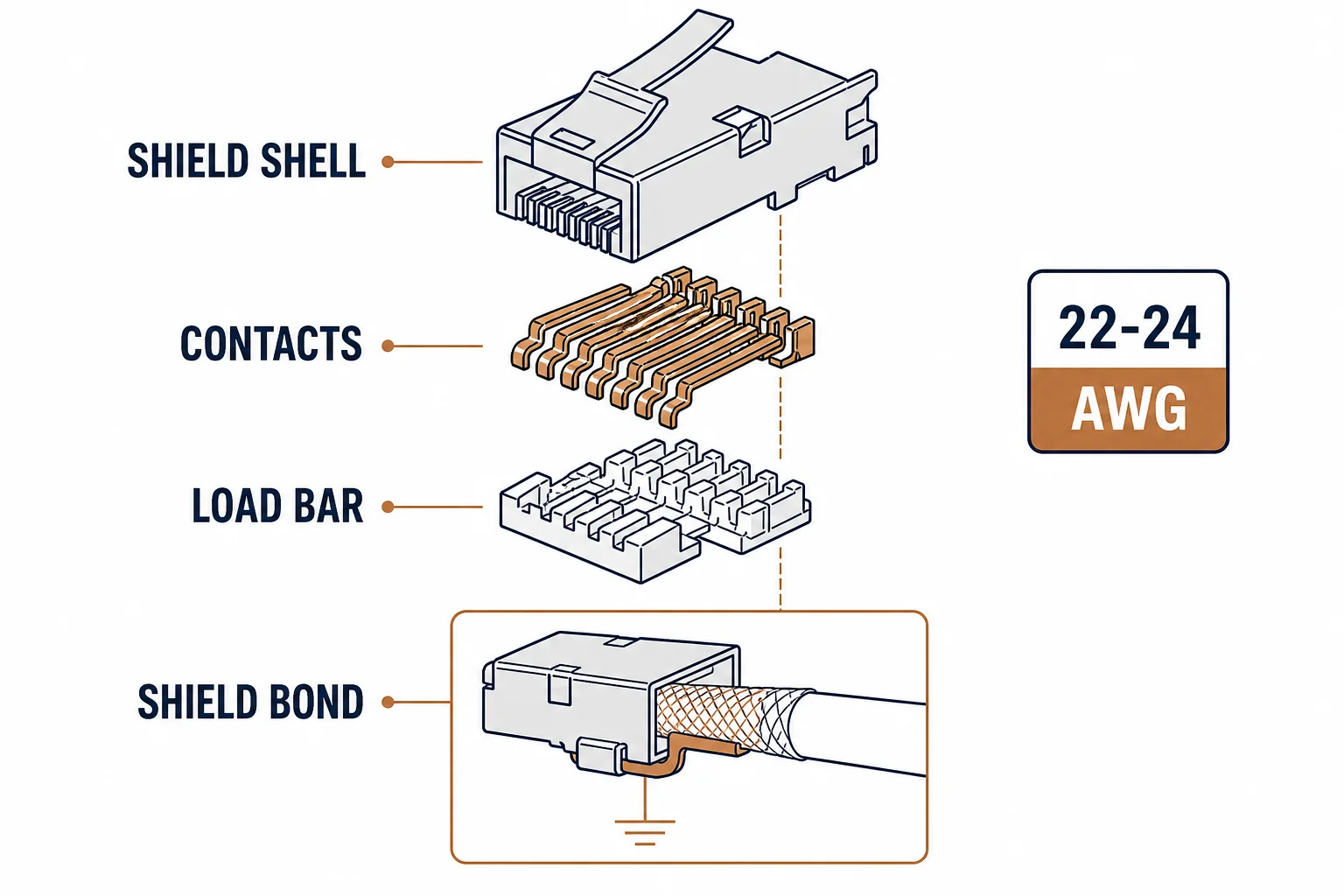
A Cat8 patch panel is the termination point for a 30-metre channel targeting 25G or 40G, and it is where those classes are most often lost: an unshielded panel, an unbonded shield, or a Cat6a jack in a Cat8 panel ends the claim at the first connection.
This is the Cat8 panel guide: the jack and bonding requirements, the density arithmetic in a compute row, and the test that proves the class.
The Requirements
| The element | The requirement | The failure |
|---|---|---|
| Jacks | Cat8 rated, shielded | Class lost at the connection |
| Bonding | Panel to rack | Shield floating |
| Class | Match 8.1 or 8.2 | Interface mismatch |
| Cords | Same class | Channel limited by the cord |
The panel is a passive component that can only preserve or destroy the class – it never adds performance.
Density in a Compute Row
- 24 ports in 1U is common; 48 is rare at this class
- Rear management matters more – Cat8 cable is stiff
- Bonding bars are not optional
- Angled panels help with bend radius in shallow racks
The physical constraints dominate: a Cat8 panel is a mechanical design problem before it is an electrical one.
Standards and Verification
| The reference | The relevance |
|---|---|
| TIA-568.2-D | Cat8 requirements |
| ISO/IEC 11801-1 | Class I and II |
| IEEE 802.3bq | 25G and 40GBASE-T |
| Field test | Channel test at the installed class |
The test is the only evidence that matters; a certificate for the components is not a certificate for the channel.
Per-SKU panel ratings are not provided in the knowledge base. The class definitions are standard; confirm the jack marking and the bonding provision before installation.
Practical Notes
Cat8 panels are usually bought as part of a matched system: cable, jacks, panel and cords from one source. Mixing manufacturers at this class is where channels quietly test below their label.
Real-World Applications
The storage row
A 25G storage row: Cat8.1 panel with shielded jacks, bonded to the rack, cords matched – every channel tested at the class and documented in the handover pack.
The mismatched purchase
A Cat8 panel fitted to Cat6a cable to 'future-proof': the channel tested at Class EA. The panel added cost and no performance – the class is set by the weakest component.
The unbonded panel
A Cat8 installation with the panel unbonded: two links failing under load near a power supply. The bonding bar fitted – the class and the stability returned together.
Related reading: The class these panels terminate — blogs/news/cat8-deployment-limits
Related reading: The Cat8 plug assembly — blogs/news/cat8-rj45-connector
Frequently Asked Questions
What is a Cat8 patch panel?
A panel with Cat8-rated shielded jacks for terminating 25G or 40GBASE-T channels within 30 m.
Can I use a Cat8 panel with Cat6a cable?
You can, but the channel is Cat6a – the panel cannot raise it.
Does it need bonding?
Yes – the shield must reach the rack earth or it provides no protection.
How is it tested?
Channel test at the installed class, every link.
Sourcing cables for a project, a store, or a private-label line? Contact our B2B sales team for specifications, certification evidence, and volume terms – FOB and CIF options available. Request a quote or sample.