
Cat7 looks simple on a bill of materials: Class F, 600 MHz, S/FTP with pair shielding. Sourcing it in India is where the trouble starts. Domestic stock is thin, most reels move through stockists rather than the plant that extruded them, and Class F test reports are often borrowed from a parent factory or an overseas partner. Buyers end up comparing per-metre prices without knowing whether the reel behind the price was ever swept to 600 MHz. This guide maps where Indian Cat7 supply actually sits, what MOQ and lead times to expect, and how to audit a supplier before a purchase order goes out.
Quick answer: Audit Indian Cat7 suppliers at the factory, not at the listing. For project volumes under 5 km, buy from a stockist in Delhi NCR, the Mumbai-Pune corridor or Gujarat that holds imported Class F reels and can show a recent DSX-8000 test. For private-label volumes above 5-10 km, qualify a domestic extruder with its own screening line and 600 MHz sweep data. Caveat: much Indian Cat7 is Cat6A construction with a Class F label, so insist on a permanent-link test report before the PO.
Which Cat7 Cable Suppliers in India Are Worth Auditing?
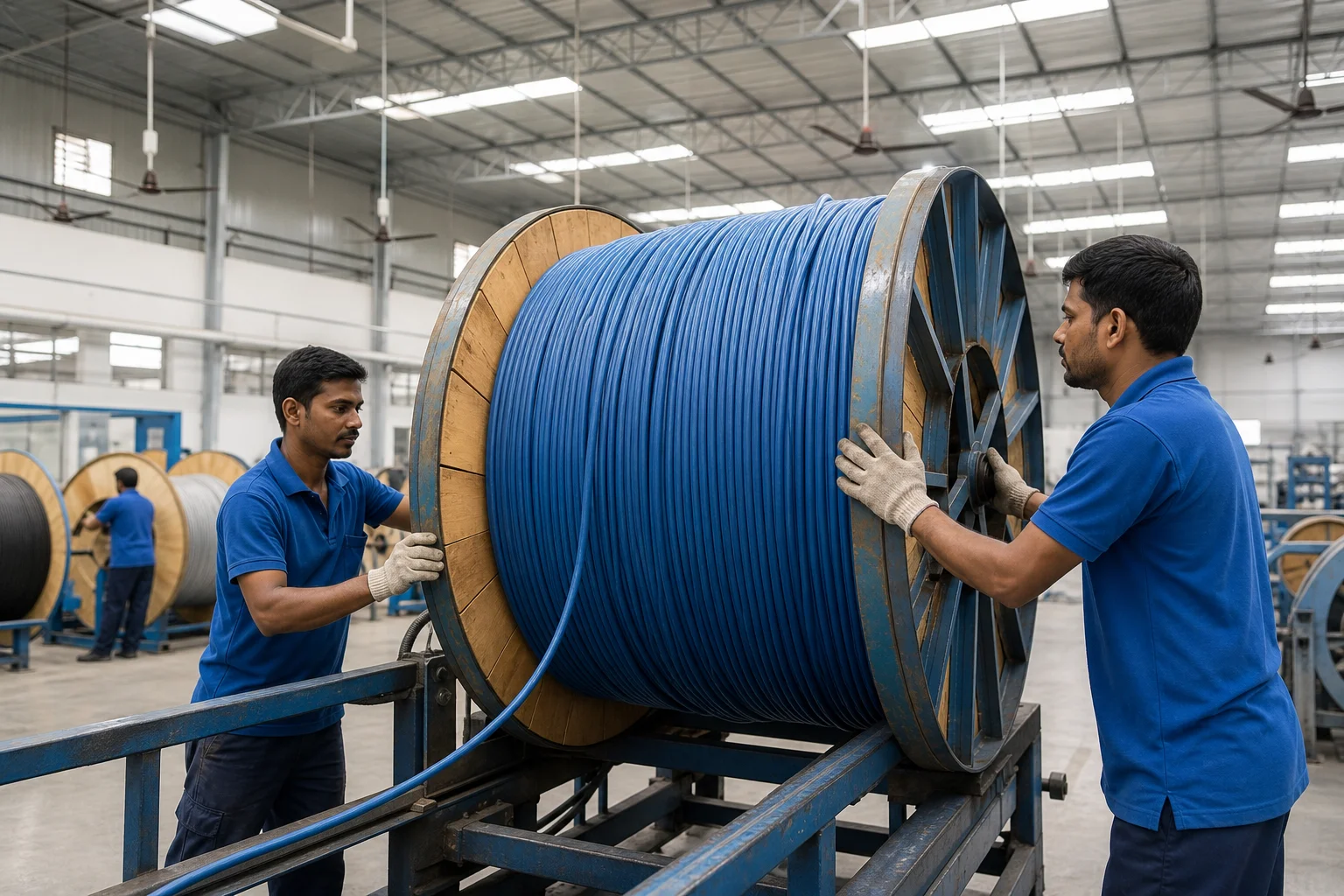
India is a large cable market with a small Cat7 market inside it. Most of the volume moving through Indian channel is Cat5e, Cat6 and, increasingly, Cat6A for data centre work. Class F product exists, but it is usually bought against a named project specification, imported on demand, or assembled locally from imported S/FTP reels. That structure decides how you should buy: rarely from a catalogue, almost always from a supplier who can name the plant that screened the pairs and the laboratory that tested the reel.
Where Cat7 Cable Supply in India Actually Comes From
India’s network cable capacity clusters in five belts: Delhi NCR (Noida, Greater Noida, Ghaziabad, Bhiwadi), the Mumbai-Pune corridor (Rabale, Chakan, Pimpri), Gujarat (Ahmedabad and Vadodara), Bengaluru and Hyderabad. The northern and western belts carry most extrusion and jacketing capacity; the south is stronger in assembly, patch cords and pre-terminated work. Inside those belts, three supplier types matter to a Cat7 buyer, and only one of them actually screens pairs.
The first type is the extruder that owns aluminium-foil and braid lines. These plants can quote S/FTP and run 600 MHz sweeps, but Cat7 is rarely their default output, so a Class F order means a minimum run and a scheduled machine slot. The second type is the stockist or import house: no plant, but imported reels in a warehouse and the fastest route to a small project volume. The third is the assembler, buying reels and selling tested patch leads or pre-terminated trunks. Online listings on IndiaMART or Alibaba.com verified suppliers mix all three, and the listing rarely tells you which one you are actually talking to.
There is also a paperwork layer. Many Indian suppliers resell Class F cable made elsewhere and present the parent plant’s certificate as their own. That is not necessarily dishonest, but it changes what you can audit: you verify the reel, not the process, and you inherit the original plant’s MOQ and lead time on any repeat order. Ask early which entity will issue the invoice and which plant the reel will physically leave.
India Against Other Cat7 Supply Regions
The table compares where Cat7 realistically comes from for an Indian buyer, including two import routes that many domestic quotations quietly depend on. Ranges are indicative and move with copper, jacket compound and volume.
| Region and role | What they actually supply | MOQ range | Lead time range | Certification focus |
|---|---|---|---|---|
| Delhi NCR, India – extruders and stockists | S/FTP reels, PVC and LSZH, mixed domestic and imported | 100-500 m per SKU in stock; 3,000-10,000 m custom jacket | 3-7 days stock; 15-30 days production | ISO 9001; DSX-8000 permanent link; RoHS and REACH |
| Mumbai-Pune, India – assemblers and project supply | Pre-terminated trunks and patch leads, import stock | 50-200 assemblies; 500 m reels | 5-10 days | Per-assembly channel test reports; ISO 9001 |
| Gujarat, India – jacketing and OEM reels | Volume extrusion, private-label reels, limited screening | 3,000-10,000 m | 15-30 days | ISO 9001; CPR print rarely offered |
| Shenzhen-Dongguan, China – OEM plants | Class F and Class FA S/FTP, full PiMF construction | 5-10 km for OEM print and packaging | 15-30 days plus 25-40 days sea freight | Fluke reports; CE and CPR data on request |
| Northern Vietnam – FDI-owned plants | Cat6A-led export output, Cat7 on request | 3,000-10,000 m | 20-35 days plus 25-40 days sea freight | ISO 9001; thin Class F lab evidence |
| Jebel Ali, UAE – re-export stockists | Mixed imported brands held in bond | 100-500 m ex-stock | 2-5 days locally | Supplier-provided test reports only |
What MOQ and Lead Times Look Like in Practice
Stocked reels in India usually start at 100-500 m per SKU, which is why a 2,000 m project can be filled from two or three stockists instead of one factory. Custom jacket colour, an LSZH compound or a specific print run pushes the order to 3,000-10,000 m, and OEM packaging under your own label typically lands at 5-10 km. Lead times follow the same pattern: 3-7 days for stock, 15-30 days for production, then 25-40 days of sea freight if the reel is coming from China and 30-45 days to Europe. Buyers who compare Cat7 MOQ norms across regions usually find the Indian domestic MOQ is friendly while the Class F MOQ is not.
The trap is mixing those numbers. A quotation that reads 15 days often means 15 days to leave the plant, not 15 days to reach your site. Ask for the dispatch date, the port of loading and the Incoterm on the same line, and confirm whether the quoted reel is already inside the country. For a project with a fixed commissioning date, the difference between stock and production is the difference between a workable schedule and a claim.
How Price Bands Behave in the Indian Market
Cat7 pricing in India is driven by four variables: copper content (AWG 23 versus AWG 22), shielding construction (S/FTP with PiMF pair shielding versus F/FTP or U/UTP), jacket compound (PVC, LSZH or outdoor PE) and order volume. Because copper is a commodity, any per-metre figure older than a month is a placeholder. Quote with a copper basis clause so both sides know which exchange reference the price was built on and how it will be adjusted. Our note on Cat7 price per metre bands explains how the basis clause works in practice.
Expect a genuine Class F reel to sit clearly above Cat6A in the same construction. If an Indian quote undercuts the Cat6A price on the same jacket and copper weight, either the pair shielding is foil-only without the overall braid, or the reel is Cat6A construction wearing a Cat7 label. Both are common, and both pass a continuity test.
Are Indian Cat7 Suppliers Actually Testing to Class F?
Sometimes, but not by default. Class F testing needs a shielded field tester with the correct permanent-link adapters, calibrated heads and a trained operator; that is a real cost, and many Indian suppliers test continuity and basic Cat6A parameters instead. When you ask for evidence, ask for the specific artefact: a Fluke DSX-8000 or DSX-5000 report showing a 90 m permanent link and a 100 m channel result at 600 MHz, with the reel lot number, test date and instrument serial visible on the page.
A 500 MHz Cat6A report is not a Class F report, and a patch-cord test is not a channel test. If the supplier sends a one-page summary with no frequency sweep and no lot number, treat the cable as unverified and price that risk into the order. The same logic applies to the connector end: a Class F link fails on grounding and bonding far more often than on the reel itself, so ask who terminates and how the shield is bonded at both ends.
How to Audit a Cat7 Supplier in India
- Confirm the legal entity, tax registration and factory address, then check that the address matches the plant you will inspect rather than a registered office.
- Verify ISO 9001 and ISO 14001 scope and validity with the issuing certification body, not with the PDF attached to the quotation.
- Request a DSX-8000 permanent-link report at 600 MHz that carries the reel lot number and test date. Undated reports prove nothing.
- Pull two sample reels from different lots and have them retested by a laboratory you appoint and pay for. Budget the cost into the unit price.
- Weigh a 100 m sample and compare copper weight and DC resistance against the datasheet for the stated AWG.
- Cut a short section and confirm PiMF pair shielding plus an overall braid. Foil-only construction is not S/FTP and will not hold Class F.
- Read the jacket print: CPR class where the project calls for it, RoHS and REACH declarations, and a lot code that matches the reel label and the delivery note.
- Book third-party pre-shipment inspection above 3 km and inspect before the balance payment, not after the container is sealed.
For a repeatable version of this process, see our guide on how to verify a Cat7 manufacturer, which covers audit questions and the documents worth collecting.
Three Buyer Scenarios
- Data centre fit-out in Pune, 3,000 m LSZH Cat7, four-week window. Buy from two stockists in the Mumbai-Pune corridor that hold imported reels, split the order to protect the schedule, and require a 90 m permanent-link test on one reel per lot. Domestic production will not hit the date, and pretending it will is how projects slip.
- European importer, private label, 12 km per year. Qualify an Indian extruder for jacketing, print and reel packaging, but keep the screened S/FTP core from a plant with Class F lab data, and require CPR and 600 MHz evidence issued against your brand before the first shipment leaves.
- Indian integrator, single 800 m run in a hospital. A stockist with one genuine imported reel and a channel test is enough. Skip the factory audit and spend the effort on connector bonding and grounding, because a Class F link fails at the termination long before it fails in the box.
Documentation to Collect Before You Release a PO
Collect a datasheet with a frequency sweep to 600 MHz, RoHS and REACH declarations, CPR or EN 50575 test data if the installation follows a European-influenced specification, and a reel label that ties to a lot number and a delivery note. Then ask one more question: what happens if the cable fails the test on site. Replacement, credit or a re-test at the supplier’s cost are all acceptable answers, but silence is not. A supplier who has not thought about failure has not tested enough reels to see one.
FAQ
1. Do Indian cable factories make genuine Cat7 cable?
Some do, but capacity is limited and most Class F volume is imported or assembled from imported reels. Indian plants are strong on Cat5e, Cat6 and Cat6A. Before you accept a domestic Cat7 quotation, ask which plant screened the pairs and request a 600 MHz permanent-link test report with a lot number.
2. What is a normal MOQ for Cat7 in India?
Stocked reels typically start at 100-500 m per SKU, so small project volumes can be covered from stock. Custom jacket colour, LSZH compound or a specific print run usually moves the order to 3,000-10,000 m, and OEM packaging under your own label typically starts at 5-10 km.
3. How long does delivery take from an Indian Cat7 supplier?
Stocked reels usually ship in 3-7 days and production runs in 15-30 days. Add transit within India of a few days, or 25-40 days of sea freight if the reel is imported from China and 30-45 days to Europe. Always confirm whether the quote refers to dispatch or delivery.
4. Is Cat7 more expensive than Cat6A in India?
Yes, for the same construction. S/FTP with PiMF pair shielding, an overall braid and typically AWG 23 copper cost more to make than unshielded Cat6A. If a Cat7 quote is cheaper than Cat6A on the same jacket and copper weight, the construction is probably not Class F.
5. Which Indian region is best for Cat7 project supply?
Delhi NCR and the Mumbai-Pune corridor hold most of the import stock and pre-termination capacity, so they respond fastest to project schedules. Gujarat is stronger for volume jacketing and OEM reels. The choice depends on whether you need metres next week or a private-label programme next quarter.