
Cat6a Slim Patch Cable: Density and Its Cost
Quick answer / TL;DR: Short answer: use Cat6a slim cords for short cabinet patching where density is the constraint – typically under 2 m – and stay with standard 24 AWG cords for longer runs and PoE loads. Check the cord's category and length rating, keep bend radius generous despite the thin jacket, and do not use slim cords for high-power PoE runs.
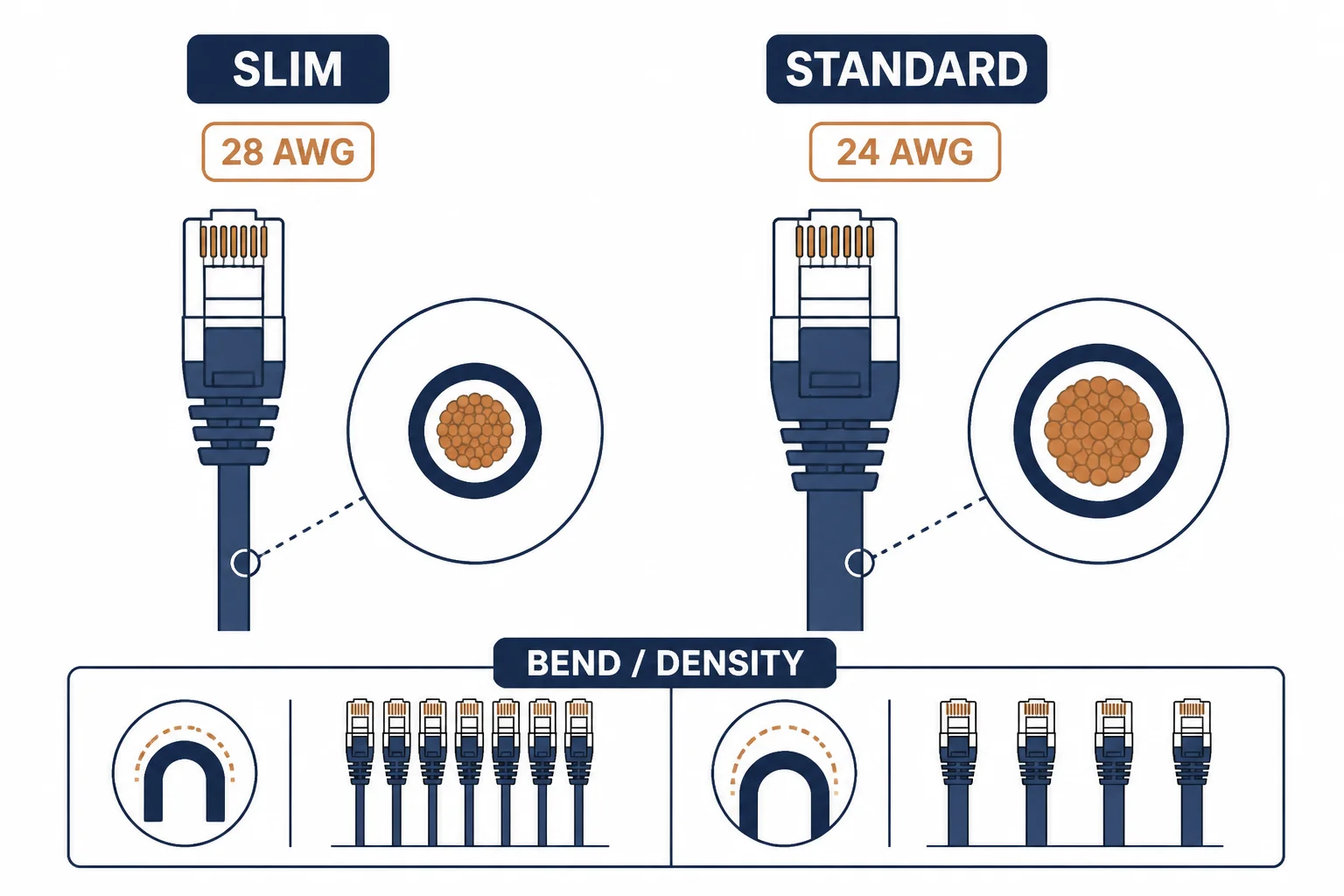
A slim Cat6a patch cable trades conductor size for density: 28 AWG instead of 24, a much thinner cord and a smaller plug body that fits high-density panels. The trade is real – higher attenuation and less bend tolerance – and it decides where slim cords belong.
This is the slim-cord guide: what the thinner conductor costs, the lengths where it still works, and the rack positions that justify it.
What Changes
| The element | Standard cord | Slim cord |
|---|---|---|
| Conductor | 24-26 AWG | 28 AWG |
| Diameter | Larger | Noticeably thinner |
| Plug body | Full size | Reduced |
| Attenuation | Lower | Higher |
The change is one number – conductor gauge – and everything else follows from it.
Where Slim Belongs
- High-density panels where full-size plugs block neighbours
- Short cabinet patching under about 2 m
- Cabinets with tight cable management
- Not for long runs – attenuation accumulates
- Not for high-power PoE – voltage drop rises
The rule is length and power: slim cords are a density tool for short distances.
The Handling Cost
| The risk | The practice |
|---|---|
| Kinking | Keep the bend radius generous |
| Latch damage | Handle by the body, not the cord |
| Over-tight ties | Velcro, loosely applied |
| PoE heat | Avoid dense bundles at high power |
Standards and Verification
| The reference | The relevance |
|---|---|
| TIA-568.2-D | Cord requirements |
| ISO/IEC 11801-1 | Class EA |
| IEEE 802.3 | PoE classes and cable heating |
| Field test | Channel test with slim cords installed |
Per-SKU conductor data is not provided in the knowledge base. Confirm the AWG and the cord's rated category on the packaging before specifying slim throughout.
Real-World Applications
The dense panel
A 48-port panel with slim Cat6a cords: the plug bodies clearing each other – the density the rack was designed for.
The long slim run
A slim cord used for a 6 m run to a printer: the link intermittent and the cord warm at the plug. Replaced with a standard 24 AWG cord – the length beyond what slim was built for.
Related reading: The category these cords serve? Read the Cat6a specification — blogs/news/cat6a-cable-spec
Related reading: The standard Cat6 cord? Read the Cat6 patch cable guide — blogs/news/cat6-patch-cable-line
Frequently Asked Questions
What is a slim patch cable?
A cord built with thinner conductors (often 28 AWG) and a smaller plug body, for high-density patching.
Are slim cables as good as standard?
For short cabinet runs, effectively yes; for long runs and high-power PoE, the thinner conductor costs margin.
How long can a slim Cat6a cord be?
Keep them short – under about 2 m – and check the product's stated rating rather than assuming.
Do slim cords support PoE?
At low power and short length, generally yes; for high-power PoE use standard 23-24 AWG cable.
Sourcing cables for a project, a store, or a private-label line? Contact our B2B sales team for specifications, certification evidence, and volume terms – FOB and CIF options available. Request a quote or sample.