
Cat6a Patch Panel: Holding 500 MHz
Quick answer / TL;DR: Short answer: specify a Cat6a-rated panel with Cat6a jacks, shielded jacks where the cable is shielded, and a rear cable manager for the bundle. Both ends of every link must be the same category, the shield must bond at the panel, and every port should be permanently-link tested – a Cat6a panel on Cat6a cable with no rear management often tests below its rating.
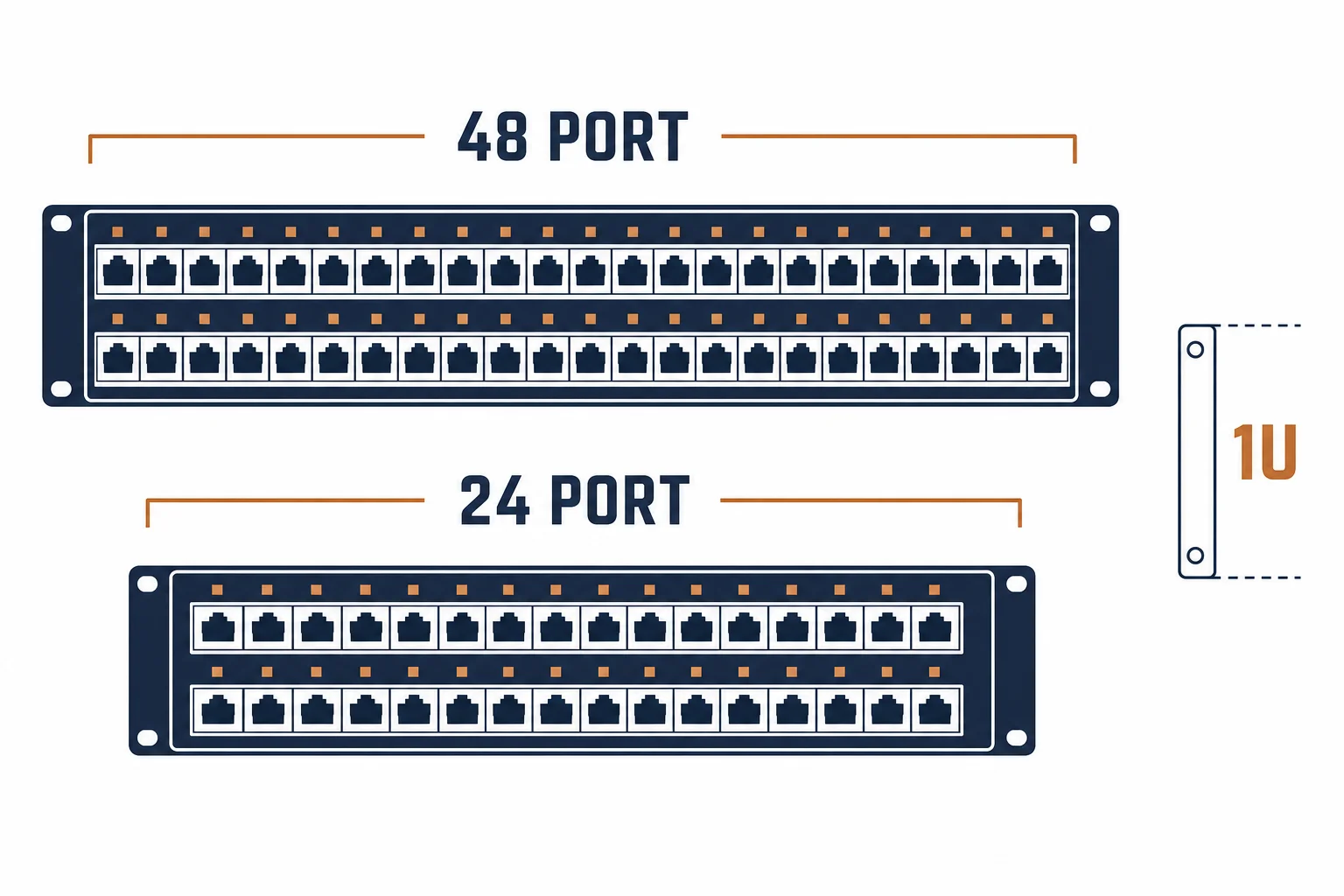
A Cat6a patch panel is the point where a 500 MHz cable either keeps its rating or loses it: the jacks must be Cat6a, the shield must bond if the cable is shielded, and the rear bundle must be managed so the pairs stay where they were terminated.
This is the panel guide: the jack and shield decisions, the density arithmetic, and the test that tells you whether the panel is part of the channel or the reason it fails.
Where a Cat6a Channel Is Lost
| The component | The failure | The result |
|---|---|---|
| Jack | Cat6 or Cat5e jack fitted | Channel capped below 500 MHz |
| Shield | Drain left unbonded | Unpredictable noise and test failure |
| Rear management | Bundle unsupported | Pair distortion at the termination |
| Test | Sampled instead of every port | Faults found by the user, not the installer |
The failures are all installation-side: the panel and jacks are bought correctly far more often than they are installed correctly.
The Specification Lines
- Panel rated Cat6a, with jacks of the same category
- Shielded jacks and a bonding bar if the cable is F/UTP or S/FTP
- 110-style termination or tool-less, matched to the installer's method
- Rear cable manager included, not optional
- Port numbering and a writable label field
The bonding bar is the line most often missing from a purchase order, and it is the one that decides whether the shield does anything.
Density and Rack Space
| The panel | The rack space | The best fit |
|---|---|---|
| 24-port Cat6a | 1U | Shallower racks, frequent changes |
| 48-port Cat6a | 1U | Dense racks, fixed patching |
| Angled 24/48 | 1U | Tight cabinets where cords need clearance |
Standards and Verification
| The reference | The relevance |
|---|---|
| TIA-568.2-D | Category 6A and connecting hardware |
| ISO/IEC 11801-1 | Class EA |
| IEC 60603-7 | The jack interface |
| Field test | Permanent link test, every port |
Per-SKU panel construction is not provided in the knowledge base. The category and bonding requirements are standard; request the panel datasheet and confirm the jack marking on delivery.
Real-World Applications
The 10G data room
Forty-eight Cat6a runs landing on two 24-port panels: shielded jacks, bonding bar to the rack, every port tested at Class EA – the channel holding the category it was bought for.
The unbonded shield
An F/UTP installation with plastic jacks: the shield floating at every port, two links failing intermittently near a drive cabinet. Shielded jacks and a bonding bar retrofitted – the faults disappeared with the bond.
The unsupported bundle
A 48-port panel terminated with no rear manager: the bundle hanging on the terminations, one pair pulling loose. A manager fitted and two ports re-terminated – the mechanical cause found before it became a callout.
Related reading: The category this panel serves? Read the Cat6a cable specification — blogs/news/cat6a-cable-spec
Related reading: The panel density decision in general? Read the patch panel buying guide — blogs/news/cat6-patch-panel-buying
Frequently Asked Questions
Does the patch panel category matter?
Yes – a Cat6 or Cat5e panel caps the channel regardless of the cable installed behind it.
Do I need a shielded Cat6a panel?
If the cable is F/UTP or S/FTP, yes, with a bonding bar. An unshielded panel breaks the shield path.
How many ports per rack unit?
24 or 48 in 1U. Density trades against termination time and access.
How should a Cat6a panel be tested?
Permanent link test on every port at Class EA, not a sample.
Sourcing cables for a project, a store, or a private-label line? Contact our B2B sales team for specifications, certification evidence, and volume terms – FOB and CIF options available. Request a quote or sample.