
Cat6 Wholesale: MOQ, Spools, and Terms
Quick answer / TL;DR: Short answer: Cat6 wholesale tiers run from samples through cartons, pallets, and containers, with per-meter cost falling and MOQ rising at each step. Choose the tier your sell-through supports, confirm the spool format (305 m standard), and lock the Incoterm and payment terms in writing. Over-buying a tier for the price is how stock becomes dead capital.
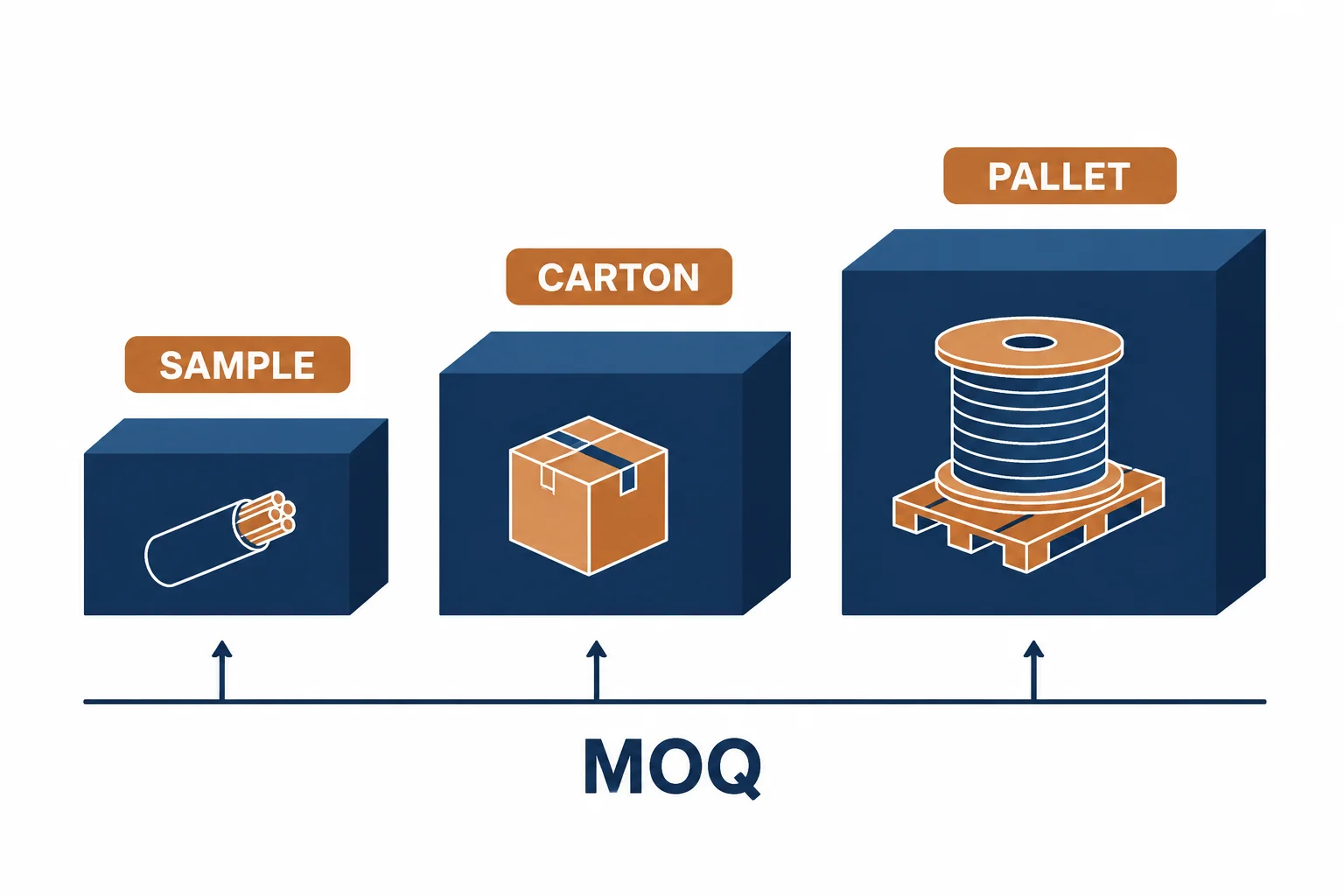
Cat6 wholesale is a ladder: sample, carton, pallet, container – each tier carries a better per-meter cost and a larger commitment. The buying decision is where on the ladder your demand actually lives, and the planning question is whether the stock will move before the next tier's price becomes available.
This is the wholesale guide: the tiers, the terms that travel with them, and the planning arithmetic.
The Tiers
| The tier | The quantity shape | What improves |
|---|---|---|
| Sample | A cut length | Nothing – a test purchase |
| Carton | One or a few boxes | The distributor price |
| Pallet | Multiple cartons | Freight efficiency and terms |
| Container | Full load | Best per-meter cost and payment leverage |
The ladder is a cost structure, not a status symbol: the right tier is the one whose stock turns before the next quote cycle.
The Terms That Travel
- Spool format: 305 m boxes are the standard unit – confirm box dimensions and labeling
- Incoterm: FOB, CIF, or DDP changes who owns freight and risk
- Payment: deposit and balance, or letter of credit at container scale
- Validity: copper-linked quotes carry windows – plan the order date around them
The terms are half the price: two quotes at the same per-meter rate can differ materially on freight ownership and payment timing.
The Planning Arithmetic
| The question | The calculation |
|---|---|
| Monthly sell-through | Units sold per month by category |
| Stock cover | Months of cover the tier creates |
| Working capital | Tier cost divided by months of cover |
| The rule | Choose the tier whose cover matches your cash cycle |
Standards and Verification
| The reference | The relevance |
|---|---|
| TIA-568.2-D | The category the stock must meet |
| Box and spool labeling | The marking that proves category and length |
| Inspection | Pre-shipment check for quantity and marking |
Specific prices, MOQ figures, and freight rates are not provided in the knowledge base. The tier structure is standard; confirm each figure with the supplier in writing.
Real-World Applications
The first pallet
A regional reseller moving from cartons to a pallet: the sell-through checked first – the tier chosen because the stock would turn in two months.
The container mistake
A buyer chasing the container price with six months of demand: the working capital arithmetic run late – the stock aging while the next price cycle arrived.
The sample step
A new supplier qualified through a sample cut: measured, tested, then the carton ordered – the ladder climbed one rung at a time.
Related reading: The factory audit before the order? Read Cat6 factory sourcing — blogs/news/cat6-factory-sourcing
Related reading: The regional distribution route? Read Middle East distributors — blogs/news/cat6-distributors-middle-east
Frequently Asked Questions
What is the MOQ for Cat6 cable wholesale?
It depends on the supplier and the tier – cartons, pallets, and containers each carry their own minimums. Confirm in writing; the knowledge base does not hold current figures.
What is the standard Cat6 spool size?
305 meters (1,000 feet) per box is the common wholesale unit, with other lengths available from some factories.
Is a container always cheaper?
Per meter, usually – but only if the stock turns. Compare the tier's cost against your cash cycle, not against the price list.
Which Incoterm should a first order use?
FOB is common for first factory orders, with the buyer arranging freight; CIF and DDP shift more of the logistics to the seller at a price. Name the term explicitly.
Sourcing Cat6 or Cat6a for a project, a store, or a private-label line? Contact our B2B sales team for datasheets, category test reports, and volume terms – FOB and CIF options available. Request a quote or sample.