
Cat6 for Security Cameras: The Drop Budget
Quick answer / TL;DR: Short answer: run Cat6 with 23 AWG conductors to each camera, keep the channel under 100 m, and size the PoE class against the camera's peak draw including infrared, not its idle figure. Use UV-rated or conduit-protected cable outdoors, seal connectors, and test each drop's negotiated rate and delivered voltage before commissioning.
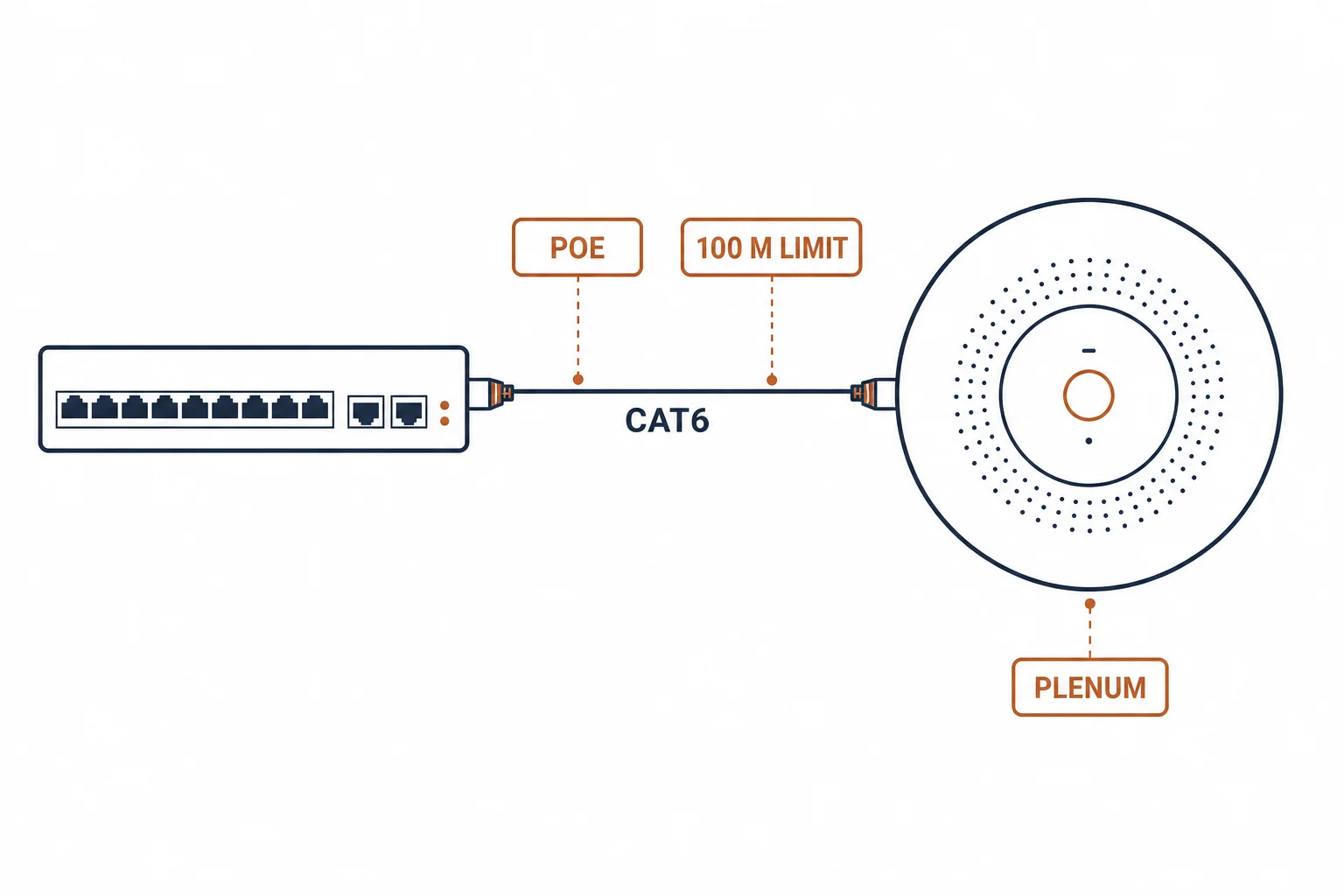
A camera on Cat6 is a powered device at the end of a long run, and that combination sets the design: the PoE class decides the current, the length decides the voltage drop, and the connector decides whether the joint survives weather. Cameras fail at night because infrared draw peaks when the cable is already at its limit.
This is the camera-cabling guide: the drop budget, the construction choices for exterior cameras, and the checks that catch a marginal run before the customer does.
The Drop Budget
| The element | The typical figure | The risk |
|---|---|---|
| PoE class | af 15.4 W, at 30 W | Infrared peak exceeds idle draw |
| Run length | Under 100 m channel | Voltage drop at the far end |
| Conductor | 23 AWG preferred | 24 AWG drops more volts |
| Connector | Sealed outdoors | Corrosion after a season |
The budget is arithmetic: source power minus cable loss must exceed the camera's peak, which is usually at night with the illuminator on.
Construction Choices
- 23 AWG solid copper for longer drops
- UV-rated jacket or conduit for exterior runs
- Gel-filled or sealed connectors at the camera
- Shielded only where interference is real, with bonding at the panel
The construction decisions are about survival, not bandwidth: a camera link needs tens of megabits and a power path that lasts years.
The Checks Before Commissioning
| The check | What it catches |
|---|---|
| Negotiated rate | A marginal pair or bad termination |
| Delivered voltage at the camera | Excessive drop over the run |
| Night test | Infrared current draw |
| Seal inspection | Water ingress risk |
The night test is the one that matters most and is most often skipped: the fault appears when the illuminator switches on.
Standards and Verification
| The reference | The relevance |
|---|---|
| IEEE 802.3af/at/bt | PoE classes and source power |
| TIA-568.2-D | Cable and channel requirements |
| IEC 60529 | Ingress protection at the connector |
| Field test | Channel test plus a power measurement |
Per-camera power figures are not provided in the knowledge base. The class arithmetic is standard; read the camera's peak draw from its datasheet before sizing the run.
Real-World Applications
The car park camera
A camera 85 m from the switch on 24 AWG: fine during the day, rebooting at dusk when infrared engaged. Re-run on 23 AWG, the voltage measured under load – the night fault gone.
The unsealed connector
An exterior camera with a push-fit connector exposed to rain: corrosion after one winter and a link that dropped in wet weather. The joint remade inside a sealed enclosure.
The shielded overreach
Shielded Cat6 specified for every camera in a quiet building: the shield unbonded, no benefit, and a higher cost. Unshielded cable used for the interior drops – the specification matched to the environment.
Related reading: The PoE arithmetic behind the drop — blogs/news/cat6-poe-cable
Related reading: Cabling an access point on the same principle — blogs/news/ethernet-cable-for-access-point
Frequently Asked Questions
What cable do security cameras need?
Cat6 with 23 AWG conductors, within a 100 m channel, with the PoE class sized to the camera's peak draw.
Why do cameras reboot at night?
Infrared illuminators draw more current, and a marginal run cannot deliver it – the voltage drops below the camera's threshold.
Do outdoor cameras need shielded cable?
Only where interference is present. Weather protection at the connector matters more.
How do I test a camera drop?
Check the negotiated rate, measure voltage at the camera, and test at night with infrared active.
Sourcing cables for a project, a store, or a private-label line? Contact our B2B sales team for specifications, certification evidence, and volume terms – FOB and CIF options available. Request a quote or sample.