
Cat6 Cable Size: The Numbers That Decide Fit
Quick answer / TL;DR: Short answer: Cat6 conductors are typically 23 AWG (some 24 AWG), and the cable's outside diameter is roughly 5.5-6.5 mm depending on construction. 23 AWG gives lower loss and better PoE headroom; larger diameters reduce conduit fill. Calculate fill at no more than about 40 percent of the conduit's internal area, and check the bend radius before the pull.
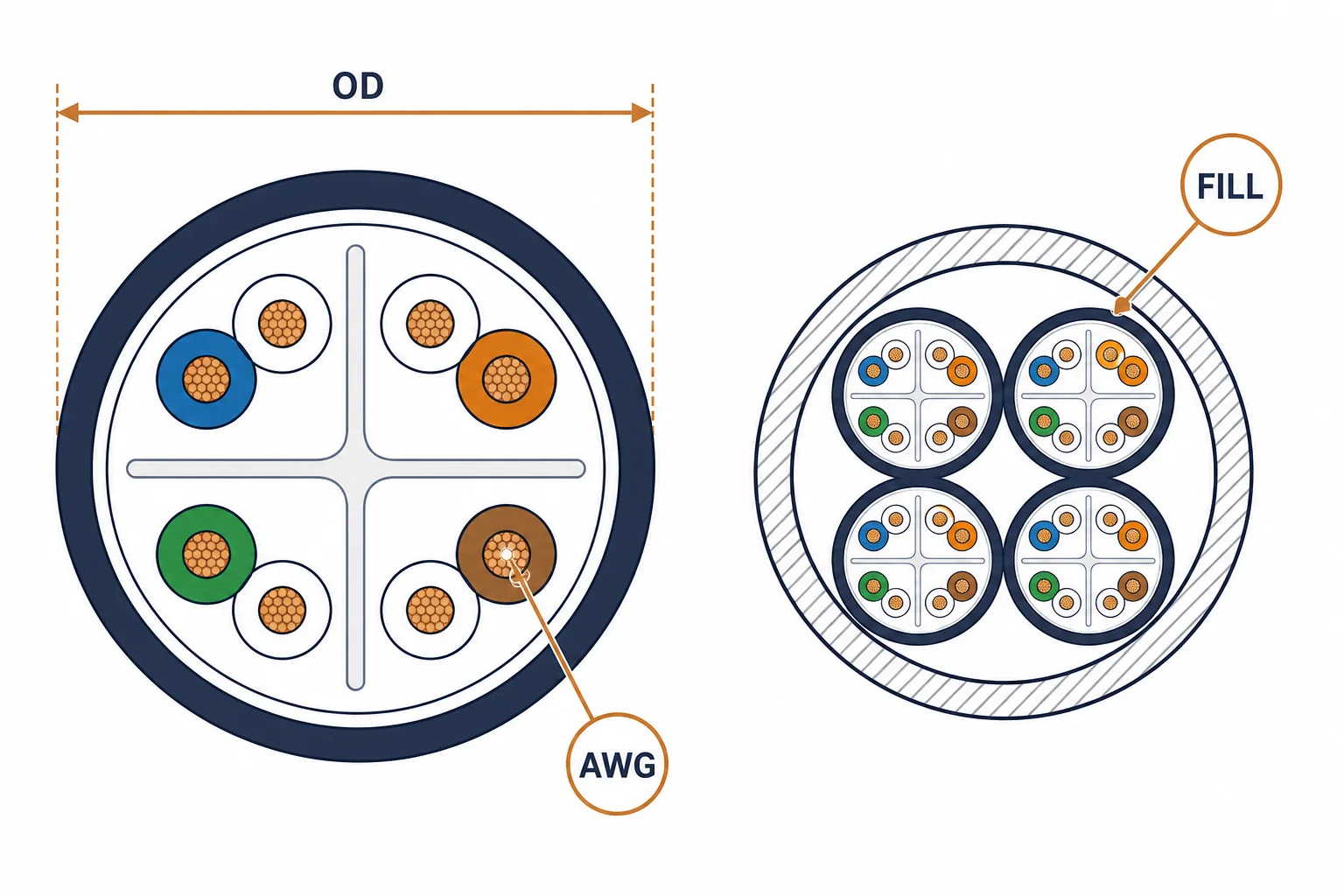
Cat6 cable size is two numbers that are easy to confuse and both matter: the conductor's AWG, which drives attenuation and PoE loss, and the cable's outside diameter, which decides how many fit in a conduit and whether the bend radius suits the route.
This is the dimensional guide: what each number does, the typical figures, and the fill calculation that prevents a cable pull that will not fit.
The Two Numbers
| The number | The typical figure | The effect |
|---|---|---|
| Conductor | 23 AWG (24 AWG on some SKUs) | Attenuation, PoE voltage drop |
| Outside diameter | Approximately 5.5-6.5 mm | Conduit fill and bend radius |
The two numbers trade against each other: a larger conductor lowers loss and raises diameter, which is why high-performance Cat6 is stiffer than the budget SKU.
The Fill Calculation
- Fill ratio: keep cable cross-sectional area to roughly 40 percent of the conduit's internal area
- Count future cables: a spare pair of runs is cheaper than a second conduit
- Bend radius: typically four times the cable diameter for installation, more for tight jackets
- Pull tension: larger bundles need more force – and the jacket has a limit
The calculation is arithmetic, not judgement: measure the conduit's internal diameter, sum the cable areas, compare.
What the Datasheet Should State
| The line | The reason |
|---|---|
| Conductor AWG and material | Loss and copper content |
| Nominal OD | Fill and bend radius |
| Bend radius, installed | Route design |
| Jacket material and rating | Route permission and flexibility |
Standards and Verification
| The reference | The relevance |
|---|---|
| TIA-568.2-D | Cable and installation requirements |
| IEC 61156 | Construction definitions |
| Local electrical code | Conduit fill rules where they apply |
Per-SKU dimensions are not provided in the knowledge base. The ranges are typical market figures; measure the actual cable and conduit before finalizing a pull.
Real-World Applications
The conduit that filled early
A 25 mm conduit planned for twelve runs: the OD measured, the fill above 40 percent – the count reduced and a second conduit added.
The PoE headroom decision
A long PoE run on 24 AWG: voltage drop calculated – the 23 AWG SKU chosen for the remaining distance.
The tight corner
A route with a sharp bend at a wall: the bend radius exceeded, the jacket creased. The route re-drilled, the cable replaced.
Related reading: The conductor forms explained? Read solid versus stranded — blogs/news/solid-vs-stranded-cat6
Related reading: What the generic term hides? Read ethernet cable versus Cat6 — blogs/news/ethernet-cable-vs-cat6
Frequently Asked Questions
What gauge is Cat6 cable?
Most commonly 23 AWG solid bare copper; some SKUs use 24 AWG, which has slightly higher loss.
What is the diameter of Cat6 cable?
Roughly 5.5 to 6.5 mm depending on construction and jacket – measure the actual SKU for fill calculations.
How many Cat6 cables fit in a conduit?
Keep cable area to about 40 percent of the conduit's internal area, and allow for future runs.
Does cable size affect performance?
The conductor gauge does – larger conductors have lower attenuation and less PoE voltage drop. The jacket diameter mainly affects installation.
Sourcing cables for a project, a store, or a private-label line? Contact our B2B sales team for specifications, certification evidence, and volume terms – FOB and CIF options available. Request a quote or sample.