
Cat5e vs Cat6e: One Real Category, One Label
Quick answer / TL;DR: Short answer: Cat5e is a defined category – 100 MHz, 1G to 100 m, unshielded typically. CAT6E is not defined by TIA or ISO, so its column depends entirely on the seller's claims. For a real decision, compare Cat5e against Cat6 (250 MHz, 10G to about 55 m) or Cat6a (500 MHz, 10G to 100 m) using test reports.
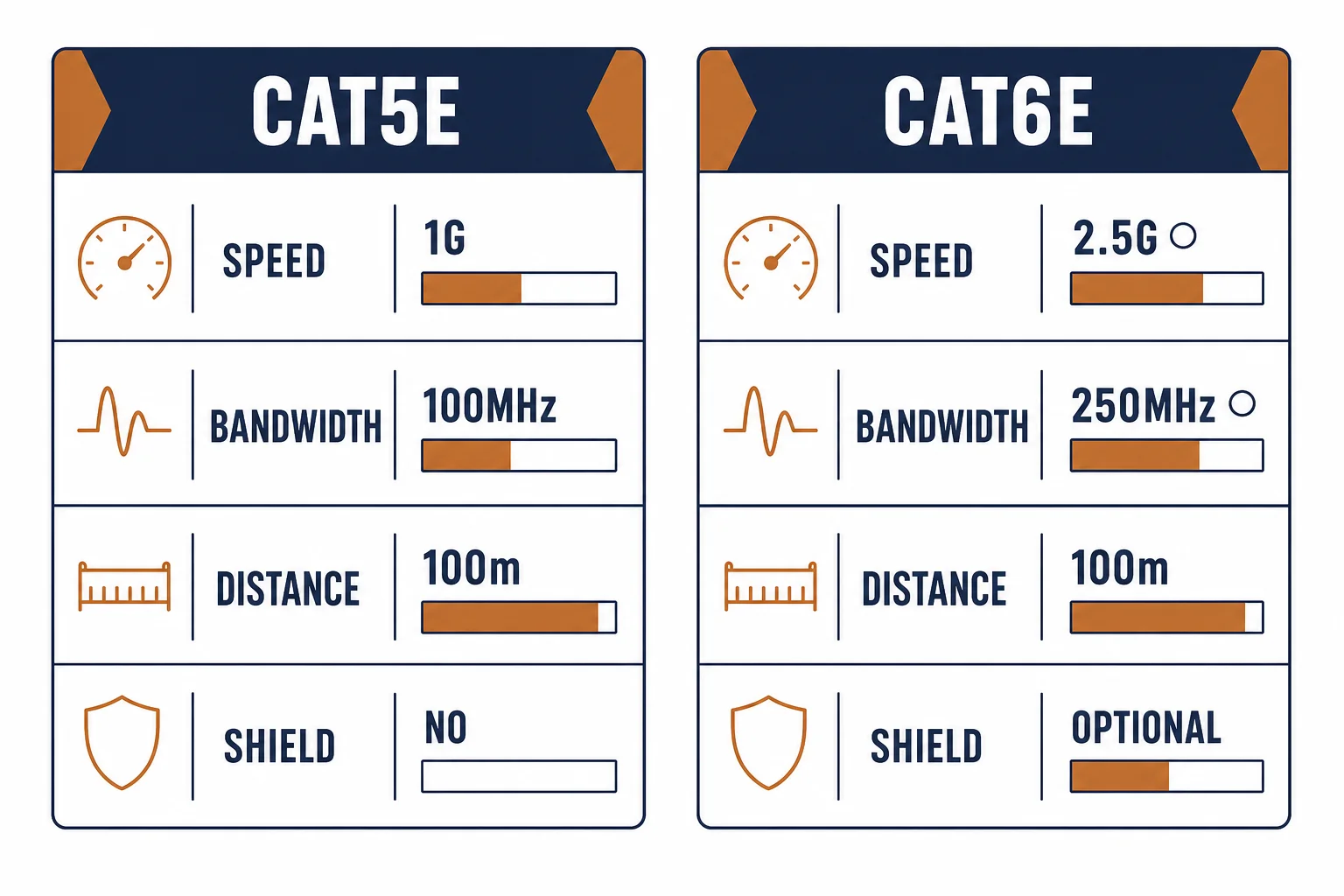
The comparison 'Cat5e vs Cat6e' pairs a defined standard category with a label that has no standard definition – which makes the honest answer unusual: one column can be filled from the standards, the other only from the seller's datasheet. This article does both, and shows the comparison buyers actually need: Cat5e versus Cat6 or Cat6a.
This is the comparison guide: what Cat5e specifies, what the Cat6E label leaves open, and the substitution that makes the decision testable.
The Comparison Table
| The attribute | Cat5e | CAT6E (as labeled) | |||
|---|---|---|---|---|---|
| Standards status | Defined by TIA/ISO | Not defined | |||
| Bandwidth | 100 MHz | Seller's claim – unverifiable | |||
| Typical construction | U/UTP, 24 AWG | Varies by seller | |||
| 10G distance | Not supported at full distance | Claimed variously | Test report | Available against the category | Cannot name a category |
The table's asymmetry is the finding: a defined category produces documents, a label produces adjectives. The purchase decision needs the left column compared with a real alternative.
The Substitution That Works
- Compare Cat5e with Cat6: the next defined step, 250 MHz, 10G to about 55 m
- Compare Cat5e with Cat6a where the run needs 10G at full distance
- Ask sellers of 'CAT6E' which defined category their test report names
- Use the named category for the price comparison – then the quotes align
The substitution turns a marketing comparison into a procurement one: two defined categories, two test reports, one decision.
When Cat5e Still Wins
| The situation | The call |
|---|---|
| 1G network, runs under 100 m | Cat5e is sufficient |
| Existing Cat5e infrastructure in good condition | Keep it – the channel is already tested |
| New install with a 10-year view | Move to Cat6 or Cat6a |
Standards and Verification
| The reference | The relevance |
|---|---|
| TIA-568.2-D | Cat5e and Cat6 definitions and test methods |
| ISO/IEC 11801-1 | The international category table |
| The test report | The document that resolves any label into a category |
Per-SKU performance claims are not verified in the knowledge base. The Cat5e figures are standard; the CAT6E column cannot be standardized because the label has no definition.
Real-World Applications
The small-office refresh
A clinic with 1G switching and 40-meter runs: Cat5e retained where the channel tests clean – the upgrade budget spent where distance demanded it.
The quote comparison
Two quotes, one labeled CAT6E: the sellers asked for the test report's category – one named Cat6, the other could not – and the comparison restarted on defined ground.
The tender rewrite
A specification replacing CAT6E with Cat6a: the bidders now comparable, the evaluation scoring the test report rather than the label.
Related reading: Where the CAT6E label comes from? Read what is CAT6E — blogs/news/cat6e-naming-trap
Related reading: The Cat5e-to-Cat6 upgrade decision? Read the upgrade guide — blogs/news/cat6-vs-cat5e-upgrade
Frequently Asked Questions
What is the difference between Cat5e and CAT6E?
Cat5e is a defined category (100 MHz, 1G to 100 m). CAT6E is not defined by TIA or ISO, so there is no standard difference to state – only seller claims.
Is CAT6E faster than Cat5e?
Unverifiable as labeled. Ask which defined category the product's test report names – that answer can be compared with Cat5e.
Should I buy Cat5e or Cat6?
Cat5e for 1G runs under 100 m; Cat6 for new installs with a longer view or 10G on short runs. The defined categories make the choice testable.
Can Cat5e and Cat6 coexist?
Yes – the channel runs at the lower category's capability. Document the runs so future upgrades target the right segments.
Sourcing Cat6 or Cat6a for a project, a store, or a private-label line? Contact our B2B sales team for datasheets, category test reports, and volume terms – FOB and CIF options available. Request a quote or sample.