
Cat5e Patch Cable: The Workhorse
Quick answer / TL;DR: Short answer: a Cat5e patch cable is a stranded-conductor assembly with moulded plugs, rated to 100 MHz and gigabit. Specify four lines – category (Cat5e), conductor (stranded), boot (snagless or standard), and length – and buy in consistent colours for legibility. It is not a substitute for permanent cabling.
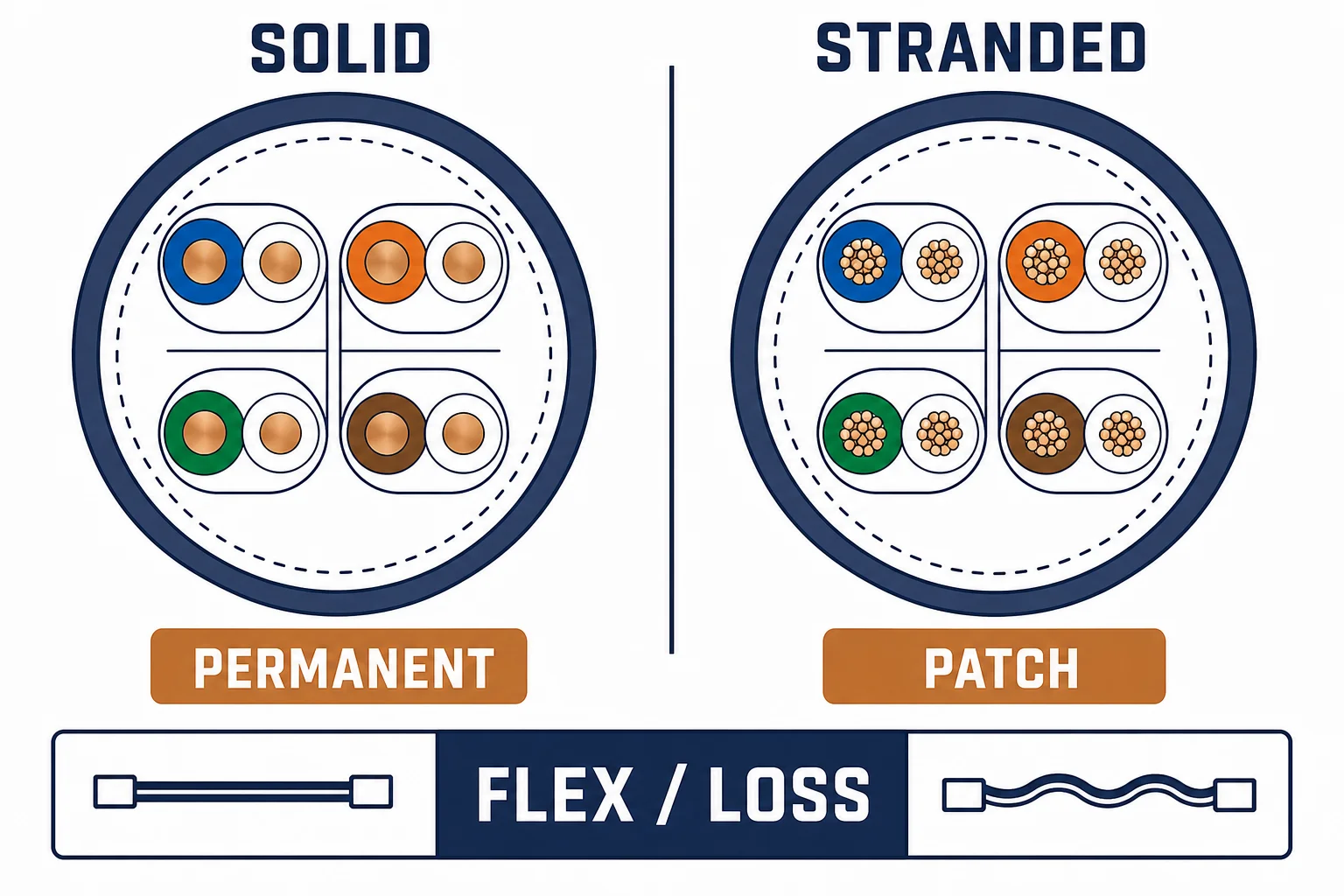
Cat5e patch cables outnumber every other network product in service: they connect the desks, the TVs, the consoles and the printers, and they are replaced more often than any cable in the building. Buying them well is less about bandwidth than about construction and consistency.
This is the patch cable guide: the four SKU lines, the boot and length decisions, and the checks that keep a box of cords from becoming a box of faults.
The Four SKU Lines
| The line | The options | The effect |
|---|---|---|
| Category | Cat5e | 100 MHz, gigabit |
| Conductor | Stranded | Flex life at the plug |
| Boot | Snagless, standard, slim | Latch survival in dense racks |
| Length | 0.5 m to 5 m | Tidiness and signal margin |
The four lines are the whole specification: everything else on the packaging is marketing or colour.
Why Stranded Matters
- Flex life: stranded conductors survive repeated bending at the plug
- Solid cores crack: the failure appears months after installation
- Termination: moulded plugs suit stranded; punch-down suits solid
- The exception: long fixed runs should be solid cable to outlets
The conductor form is the difference between a cord that lasts years and one that fails at the strain relief.
Colour and Legibility
| The practice | The benefit |
|---|---|
| One colour per function | Faster fault-finding |
| Consistent lengths per position | A tidier cabinet |
| Labelled at both ends | Shorter outages |
Standards and Verification
| The reference | The relevance |
|---|---|
| TIA-568.2-D | Cord requirements |
| ISO/IEC 11801-1 | Class D |
| Field test | Channel test with cords installed |
Per-SKU conductor counts are not provided in the knowledge base. The construction rules are standard; confirm category and stranded construction on the packaging.
Real-World Applications
The classroom refresh
Thirty classrooms re-cabled with 3 m Cat5e cords: three colours by device type – the support calls shorter because the patching is readable.
The spare box
A stock of 1 m and 3 m Cat5e snagless cords: two lengths covering most requests – the drawer no longer full of unknown cords.
The solid-cord failure
Cords made on the bench from solid cable: three failed at the plug within a year. Replaced with moulded stranded cords – the construction rule applied late.
Related reading: The cable the cords join? Read the Cat5e network cable guide — blogs/news/cat5e-network-cable-line
Related reading: The terminology behind the names? Read the patch leads guide — blogs/news/ethernet-patch-leads
Frequently Asked Questions
What is a Cat5e patch cable?
A short stranded-conductor cord with moulded plugs, rated to 100 MHz and gigabit, used to connect devices to outlets or panels.
Are all Cat5e patch cables the same?
No – conductor form, boot style, plug quality and length vary. Those decide how long the cord survives.
Can Cat5e patch cables be used in walls?
No – cords are not rated for in-wall installation. Use solid cable and terminate at outlets.
Does length affect performance?
Only at the extremes; within a few metres the difference is negligible. Length mainly affects tidiness and channel margin.
Sourcing cables for a project, a store, or a private-label line? Contact our B2B sales team for specifications, certification evidence, and volume terms – FOB and CIF options available. Request a quote or sample.