
Cat5e Network Cable: The Budget Line
Quick answer / TL;DR: Short answer: Cat5e carries 1 GbE to 100 m and is the cheapest way to wire a home or a small office. It is rated to 100 MHz, so it is not a 10G cable at any distance, and it has less headroom for long PoE runs. Buy it for gigabit access layers and patch cords, not for backbones or 10G links.
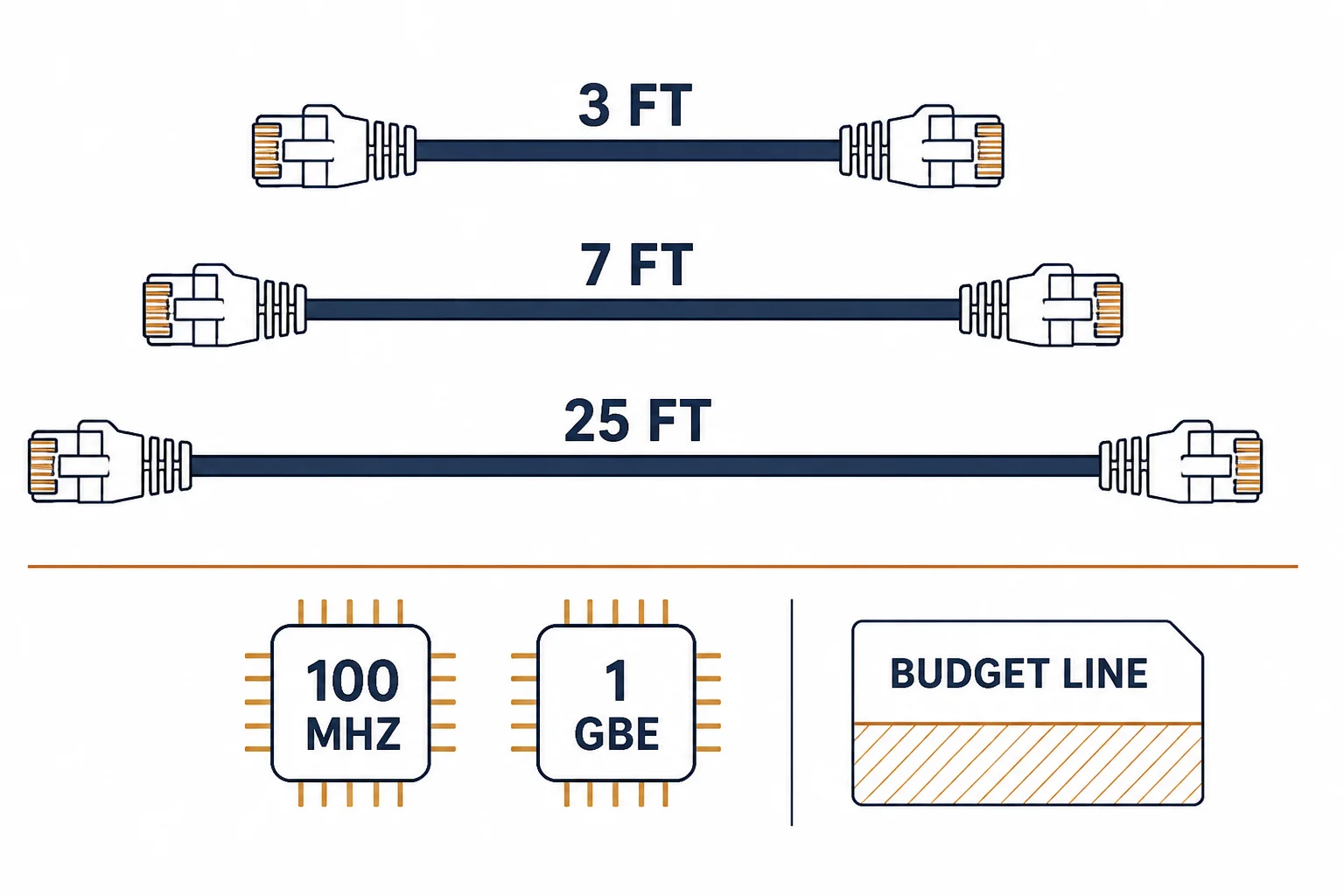
Cat5e network cable is the tier below Cat6 in price and above it in availability: every distributor stocks it, every installer can terminate it, and it still carries gigabit to 100 metres. The question is not whether it works – it is where the 100 MHz ceiling starts to cost more than the upgrade.
This is the budget-line guide: what Cat5e does well, the three situations where it stops being enough, and the order lines that keep it in the catalogue.
What Cat5e Still Does Well
| The use | Cat5e verdict | The note |
|---|---|---|
| Home and small office gigabit | Excellent | 100 m, well within rating |
| Patch cords | Excellent | Cheap, stocked, easy to replace |
| Voice and low-speed links | Overkill | Cat3 would do, but one stock simplifies |
| PoE to 30 W | Fine at short lengths | Gauge limits long runs |
The verdicts share a pattern: Cat5e excels where the requirement is gigabit and the run is ordinary. It fails only when either condition changes.
Where the Ceiling Bites
- 10G links: Cat5e is rated to 100 MHz – 10GBASE-T needs far more headroom
- Long PoE runs: 24 AWG conductors drop more voltage than 23 AWG
- Dense bundles: heat builds and the derating margin is thinner
- Future-proofing: a 2.5G or 5G upgrade may not negotiate on marginal cable
The ceiling is a frequency rating, not a quality judgement: a well-made Cat5e is simply built for a lower band.
The Order Lines
| The need | The line |
|---|---|
| Desk drops in an office | Cat5e U/UTP, solid 24 AWG, CMR |
| Patch cords | Cat5e stranded, assorted lengths |
| Riser to a floor | Cat5e CMR, or step to Cat6 |
| Any 10G plan | Do not specify Cat5e |
Standards and Verification
| The reference | The relevance |
|---|---|
| TIA-568.2-D | Category 5e requirements |
| ISO/IEC 11801-1 | Class D equivalent |
| IEEE 802.3ab | 1000BASE-T over twisted pair |
| Field test | The channel result after installation |
Per-SKU conductor and test data are not provided in the knowledge base. The 100 MHz rating is standard; confirm the channel test at the installed category.
Real-World Applications
The starter office
A ten-person office on gigabit: Cat5e throughout – the cheapest route to a working network, tested after installation.
The patch-cord drawer
A maintenance stock of Cat5e cords in four lengths: one category covering every desk swap – the simplicity worth more than the spec.
The 10G retrofit that stalled
A lab upgrading to 10G on existing Cat5e: the links refusing to negotiate. Cat6a pulled for the affected runs – the ceiling finally priced.
Related reading: What Cat5 actually delivers in speed? Read the Cat5 speed guide — blogs/news/cat5-cable-speed
Related reading: The step up in category? Read the Cat5e versus Cat6a comparison — blogs/news/cat5e-vs-cat6a
Frequently Asked Questions
Is Cat5e still worth buying?
For gigabit access layers, homes and patch cords, yes – it is the cheapest cable that does the job. Not for 10G or long PoE runs.
How fast is Cat5e?
1 GbE to 100 m, with a 100 MHz rating. It is not a 10GBASE-T cable.
Cat5e or Cat6 for a new office?
Cat6 costs little more and adds headroom for 2.5G and 5G. Cat5e remains valid where the requirement is fixed at gigabit.
Does Cat5e support PoE?
Yes, within its thermal and length limits. Longer or higher-power runs favor 23 AWG Cat6.
Sourcing cables for a project, a store, or a private-label line? Contact our B2B sales team for specifications, certification evidence, and volume terms – FOB and CIF options available. Request a quote or sample.