
Cat5e 50ft: The Budget SKU Decision
Quick answer / TL;DR: Short answer: a 50 ft Cat5e cord carries gigabit comfortably, since the 100 m channel limit leaves a large margin at 15 m. Buy it where the requirement is fixed at gigabit and the cable stays a patch cord. Step up to Cat6 if the run may see 2.5G/5G, long PoE, or permanent in-wall installation.
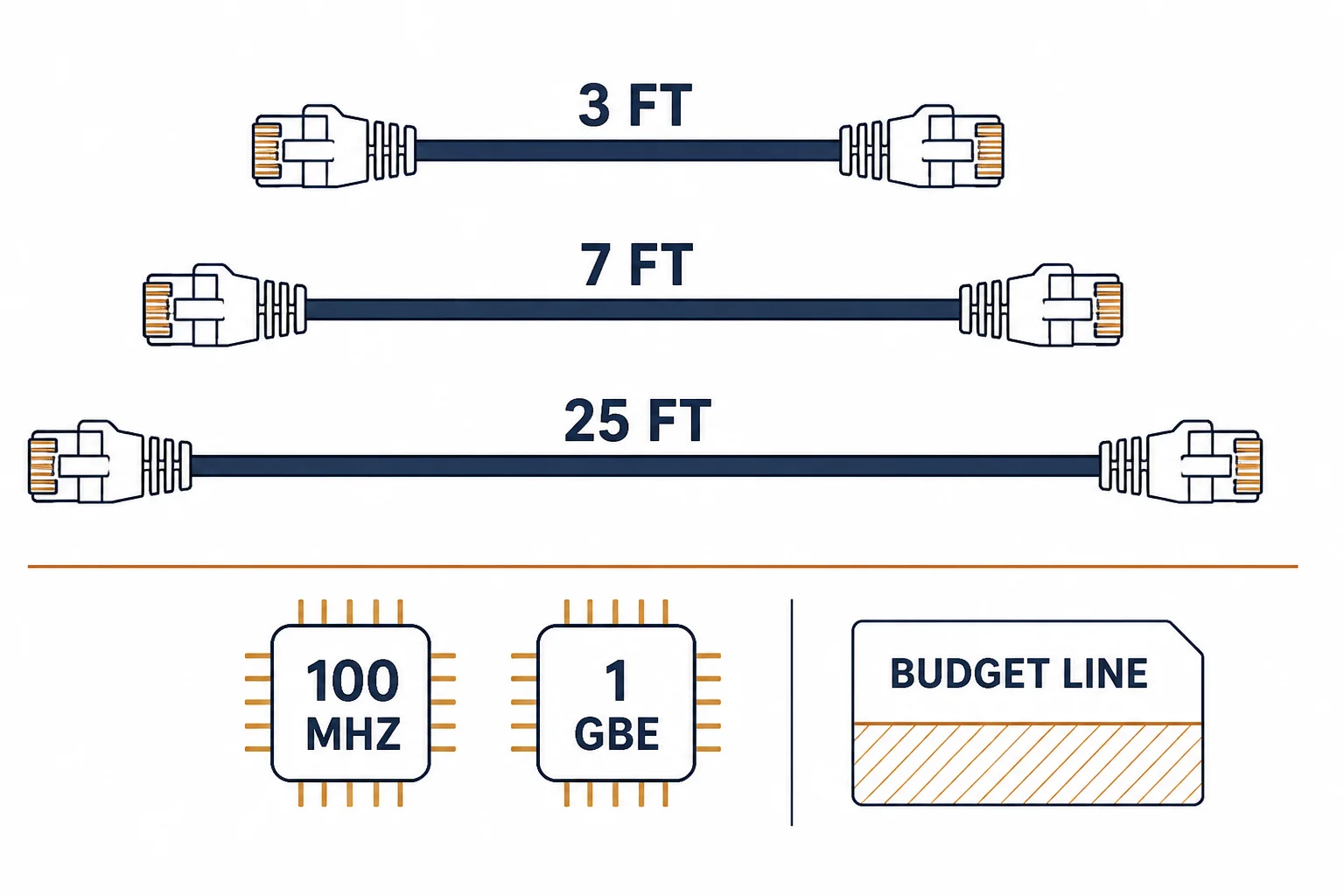
A 50-foot Cat5e cable is the cheapest way to move a gigabit link across a room, and at that length the category is not the constraint – the devices at each end are. The decision is about price against headroom, and about whether the run stays a patch or becomes part of the building.
This is the value-tier guide: what Cat5e does at 50 ft, where the saving is real, and the two situations that make it a false economy.
What Cat5e Does at This Length
| The requirement | Cat5e at 50 ft | The verdict |
|---|---|---|
| Gigabit | Well inside rating | Fine |
| 100 Mbps | Overkill | Fine |
| 2.5G/5G | Outside the rating | Step up |
| PoE to 30 W | Works, with thinner gauge | Watch long runs |
The table is short because the answer is: at 15 metres, Cat5e's 100 MHz rating is not the limiting factor for gigabit.
Where the Saving Is Real
- Patch cords for desks, TVs and consoles
- Temporary layouts and rental spaces
- Stock items where a single cheap SKU simplifies inventory
- Runs that will never see more than gigabit
The saving is real wherever the requirement is settled. It becomes false economy where the requirement is likely to change.
Where It Stops Working
| The situation | The problem |
|---|---|
| In-wall permanent run | Cord jacket not rated for the space |
| 2.5G or 5G upgrade | Category below the rate |
| Long PoE drops | 24 AWG voltage drop over distance |
Standards and Verification
| The reference | The relevance |
|---|---|
| TIA-568.2-D | Category 5e requirements |
| ISO/IEC 11801-1 | Class D |
| IEEE 802.3ab | 1000BASE-T |
| Field test | Channel result for permanent runs |
Per-SKU gauge and jacket data are not provided in the knowledge base. The category ratings are standard; confirm the print for 24 AWG and the jacket type.
Real-World Applications
The console and TV
Two 50 ft Cat5e cords for a console and a TV: gigabit links, the cheapest sensible purchase – the bandwidth need measured in tens of megabits.
The office drawer
A stock of 50 ft Cat5e cords for desk moves: one SKU covering most requests – the simplicity worth the small headroom given up.
The in-wall substitution
A 50 ft Cat5e cord stapled through a stud wall: no jacket rating, no support. Replaced with Cat6 CMR on a proper run – the saving reversed.
Related reading: The budget line in full? Read the Cat5e network cable guide — blogs/news/cat5e-network-cable-line
Related reading: What the next category adds? Read Cat5e versus Cat6a — blogs/news/cat5e-vs-cat6a
Frequently Asked Questions
Is a 50 ft Cat5e cable fast enough?
For gigabit, yes – comfortably. Cat5e is rated to 1 GbE over 100 m, and 50 ft is a fraction of that.
Can Cat5e 50ft do 2.5G?
Not within its rating. Use Cat6 for 2.5G and Cat6a for 10G.
Is a Cat5e patch cord okay in a wall?
No – patch cords are not rated for in-wall use. Use a rated cable and terminate at outlets.
Why is Cat5e cheaper?
Smaller conductors, no shield and a lower band – less copper and less testing, not lower quality within its rating.
Sourcing cables for a project, a store, or a private-label line? Contact our B2B sales team for specifications, certification evidence, and volume terms – FOB and CIF options available. Request a quote or sample.