
Cat5e Cable Price: The Deferred Cost
Quick answer / TL;DR: Short answer: Cat5e is cheaper because it uses 24 AWG copper and no shield. Buy it where the requirement is fixed at gigabit and the route is accessible. Where 2.5G is plausible or the cable will be buried in a wall for a decade, the price difference to Cat6 is small compared with the cost of a re-pull – compare installed life cost, not price per box.
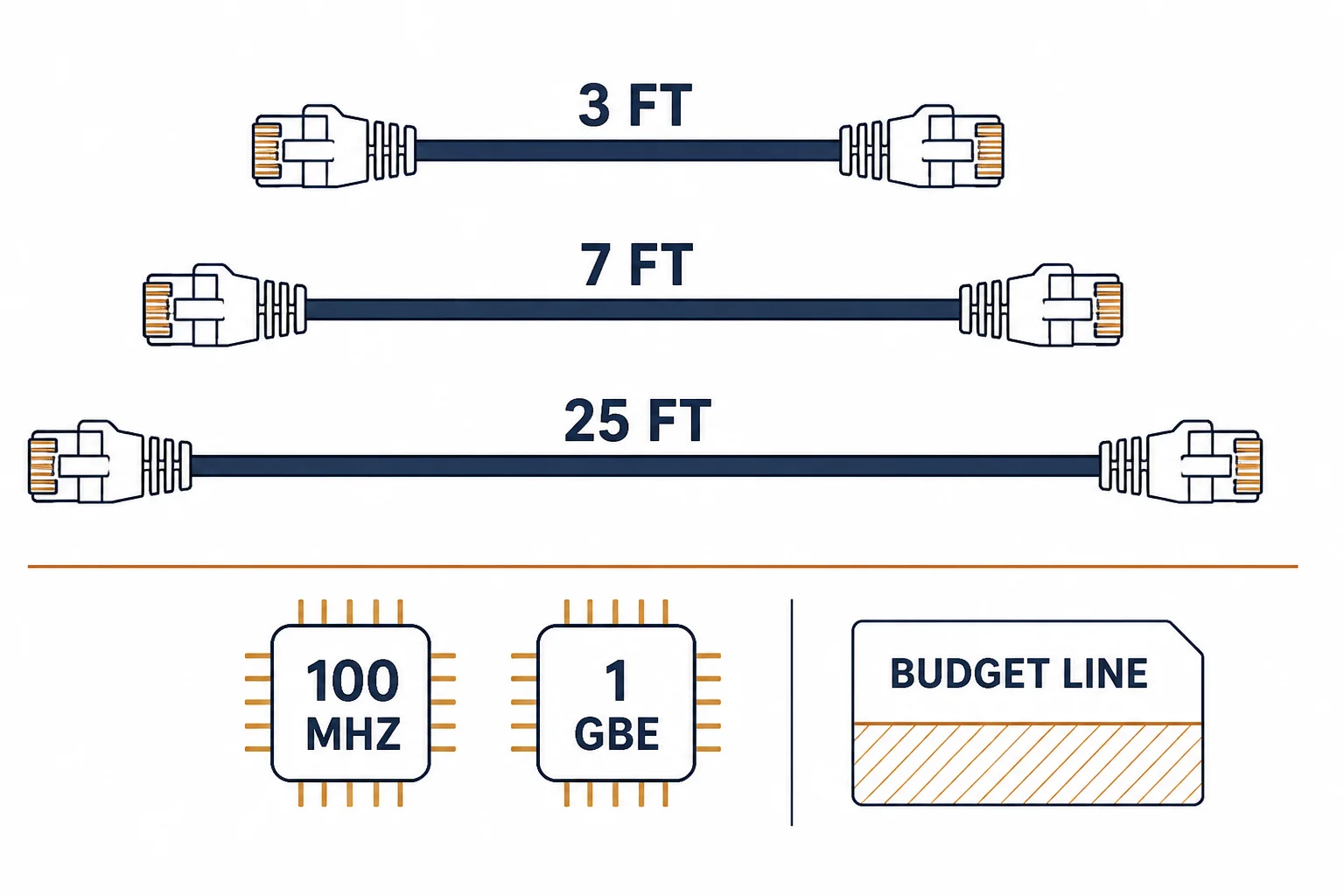
Cat5e cable price is the lowest in the twisted-pair family, and the number is honest: less copper, no shield, a lower band, and less testing. What the price does not show is the cost of the upgrade it defers – a re-pull in two years costs more than the difference between categories today.
This is the price guide: what sets the number, where the saving is genuine, and the arithmetic that compares Cat5e against Cat6 over a realistic life.
What Sets the Price
| The factor | Cat5e | Cat6 |
|---|---|---|
| Conductor | 24 AWG typical | 23 AWG |
| Shield | None | Optional |
| Band | 100 MHz | 250 MHz |
| Testing | Category 5e | Category 6 |
The first two lines are most of the difference: less copper and no screening.
Where the Saving Is Genuine
- Fixed gigabit access layers
- Patch cords and temporary routes
- Maintenance stock where one category suffices
- Accessible routes where a future re-pull is cheap
The saving is genuine when the future is known and the route can be changed without demolition.
The Deferred Cost
| The scenario | The cost |
|---|---|
| 2.5G upgrade in two years | New cable plus labour |
| Cable buried in a wall | Demolition and repair |
| PoE expansion | 24 AWG voltage drop |
| Mixed categories on site | Spares lose interchangeability |
The arithmetic is simple: the price gap between Cat5e and Cat6 is small against the labour of replacing either.
Standards and Verification
| The reference | The relevance |
|---|---|
| TIA-568.2-D | Category 5e and 6 requirements |
| ISO/IEC 11801-1 | Class D and E |
| UL 444 | Jacket ratings |
| Field test | Channel test at the installed category |
Per-SKU pricing is not provided in the knowledge base. The cost structure is standard; compare installed cost per port rather than price per box.
Real-World Applications
The accessible retrofit
An office with ceiling tiles and open trays: Cat5e installed for a fixed gigabit requirement, with the route left accessible – the upgrade path cheap when it is needed.
The buried decision
Cat5e specified for a walled-in refurbishment to save on cable: the 2.5G upgrade two years later required opening walls. Cat6 would have cost a fraction of the difference.
The PoE surprise
Cameras added to a Cat5e installation: two long drops failing under load. Replaced with 23 AWG – the gauge, not the price, was the deciding factor.
Practical Notes
Copper-clad aluminium appears in cheap Cat5e more often than in higher categories, because the price pressure is greatest there. A cut test on a sample is the cheapest quality control available.
Per-SKU conductor material is not provided in the knowledge base. The cut test is definitive and takes seconds; make it part of goods-in for any low-price purchase.
The cheap pallet
A Cat5e pallet well below market: the cut test showing CCA. Returned and the order re-placed with bare copper specified – the price had been the signal.
The honest budget job
A charity office wired on Cat5e with copper conductors: gigabit to every desk within budget, and the specification documented so a future upgrade knows what is in the walls.
The mixed-site risk
A site with Cat5e in one wing and Cat6 in another: spares no longer interchangeable. The next phase standardised on Cat6 – the drift stopped before it reached the backbone.
Related reading: The budget line in service — blogs/news/cat5e-network-cable-line
Related reading: The Cat6a cost structure for comparison — blogs/news/cat6a-cable-cost
Frequently Asked Questions
Why is Cat5e cheaper than Cat6?
Smaller conductors (24 versus 23 AWG), no shield, lower band and less testing.
Is Cat5e still worth buying?
For fixed gigabit links and accessible routes, yes. Otherwise the upgrade cost outweighs the saving.
How much more does Cat6 cost?
The gap is small relative to installation labour – compare installed cost, not box price.
How do I avoid CCA in cheap cable?
Cut a conductor and look: a silver core means aluminium under copper plating.
Sourcing cables for a project, a store, or a private-label line? Contact our B2B sales team for specifications, certification evidence, and volume terms – FOB and CIF options available. Request a quote or sample.