
Cat3 vs Cat5: The Retirement Question
Quick answer / TL;DR: Short answer: Cat3 is a 16 MHz, typically two-pair cable built for telephony – it is not a network cable and will not carry gigabit. Cat5 is 100 MHz, four-pair, and supports 100 Mbps to 100 m. In a retrofit, either pull new Cat5e/Cat6 or accept that the Cat3 stays voice-only; do not plan a data network on it.
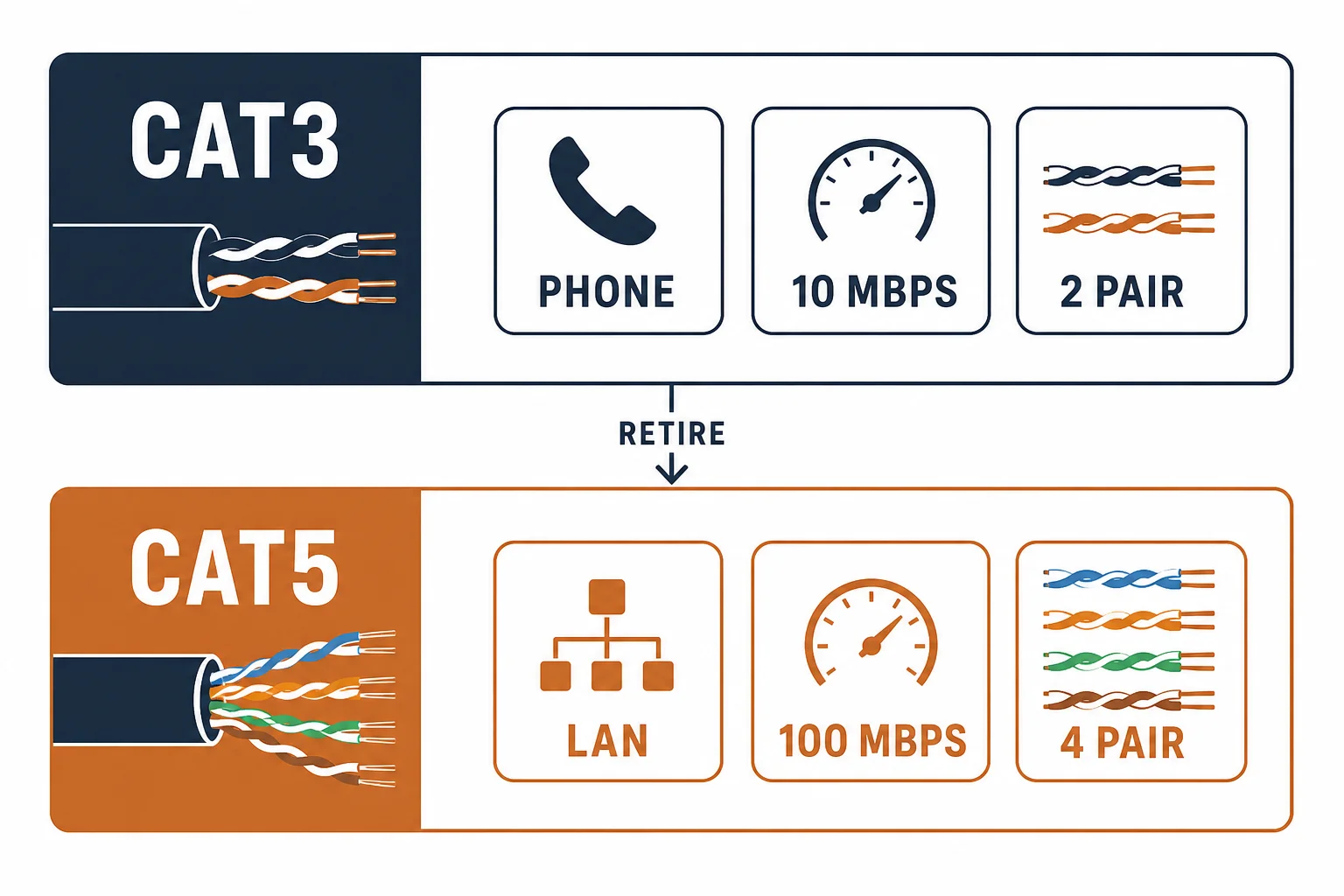
Cat3 and Cat5 differ in ways that decide what a building can do with its existing wiring: pair count, twist rate and bandwidth. Cat3 was designed for voice and survives there; asking it to carry a modern network is where retrofits go wrong.
This is the legacy guide: what Cat3 can still do, why it fails as network cable, and the two legitimate paths for a building full of it.
The Differences
| The dimension | Cat3 | Cat5 |
|---|---|---|
| Band | 16 MHz | 100 MHz |
| Pairs | Typically 2 | 4 |
| Typical use | Voice, low-speed signalling | 100 Mbps data |
| Twist | Looser | Tighter, controlled |
The pair count is the practical barrier: a two-pair cable cannot carry a four-pair data link regardless of its condition.
Why It Fails as Data Cable
- Two pairs: gigabit needs all four
- Bandwidth: 16 MHz is far below what any modern rate requires
- Terminations: often daisy-chained for phones, which is wrong for data
- Condition: decades-old jacket and insulation, with unknown damage
The failures are structural, not marginal – no amount of testing turns a two-pair voice cable into a data link.
The Two Legitimate Paths
| The path | The work | The result |
|---|---|---|
| Replace | Pull Cat5e or Cat6 to the outlets | A network-ready building |
| Reuse for voice | Keep Cat3 for telephony | A clean separation of duties |
Standards and Verification
| The reference | The relevance |
|---|---|
| TIA-568.2-D | Category 3 and 5 definitions |
| ISO/IEC 11801-1 | Class A-C equivalents |
| Field test | What the existing cable actually passes |
Per-building wiring condition is not provided in the knowledge base. The category limits are standard; test a sample before planning any reuse.
Real-World Applications
The office refit
A 1990s office with Cat3 to every desk: the cable tested, two pairs confirmed. New Cat6 pulled alongside – the old cable left for voice.
The phone system upgrade
A VoIP migration on existing Cat3: the handsets working on 100 Mbps links at short runs – the limits documented per desk.
The reuse that failed
A data network planned on existing Cat3: the links refusing to negotiate above 100 Mbps on two pairs. New cable pulled – the retrofit re-planned around the pair count.
Related reading: The current budget tier? Read the Cat5e network cable guide — blogs/news/cat5e-network-cable-line
Related reading: The legacy shielded question? Read is Cat5e shielded — blogs/news/is-cat5e-shielded
Frequently Asked Questions
Can Cat3 carry ethernet?
Marginally at low speeds over short runs, and not with two pairs. It is a voice cable, not a network cable.
What is the difference between Cat3 and Cat5?
Band (16 versus 100 MHz), pairs (two versus four), and twist control. Cat5 supports 100 Mbps to 100 m; Cat3 does not.
Should I replace Cat3?
For any data requirement, yes. For voice, it remains serviceable.
Can Cat3 be reused for PoE?
Not for standard PoE – the pair count and gauge do not support it. Plan new cable for powered devices.
Sourcing cables for a project, a store, or a private-label line? Contact our B2B sales team for specifications, certification evidence, and volume terms – FOB and CIF options available. Request a quote or sample.