
Cat 8.2 Cable: Class II Explained
Quick answer / TL;DR: Short answer: Cat 8.2 (Class II) targets 40GBASE-T over 30 m at 2000 MHz; Cat 8.1 (Class I) targets 25GBASE-T over the same distance. Both need shielded connectors, and 8.2's interface is not the same as 8.1's. Specify the class explicitly, confirm the switch port supports the rate, and test the channel – a mixed installation satisfies neither.
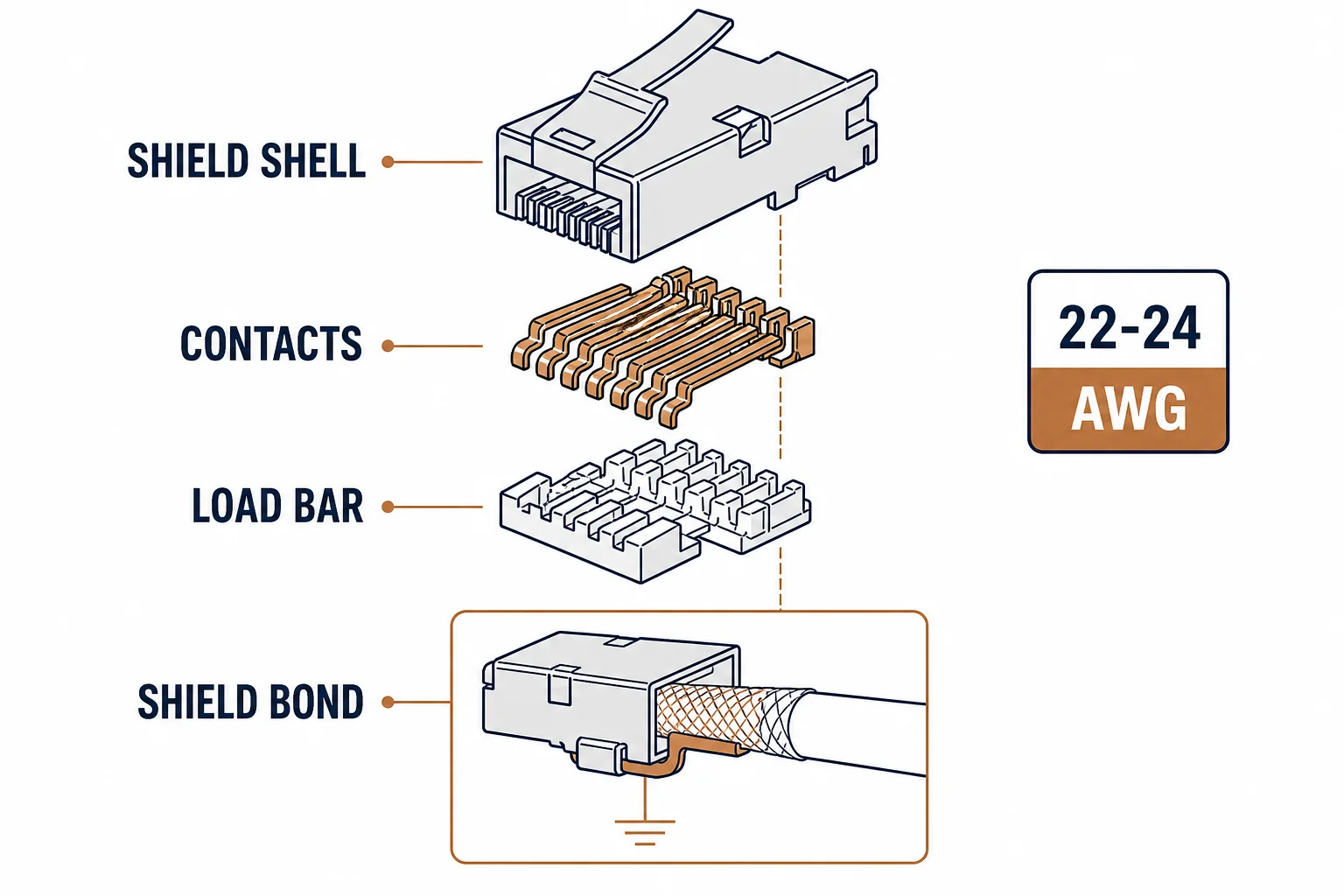
Cat 8.2 is the Class II tier of the Cat8 family: 2000 MHz, 30 metres, targeting 40GBASE-T. It is not a better version of Cat8.1 – the two differ in connector interface and target rate, which is why a project must specify which one it wants.
This is the Cat 8.2 guide: the class definitions, the connector question, and the conditions under which the rating means anything at all.
The Two Classes
| The class | The target | The band |
|---|---|---|
| Cat 8.1 (Class I) | 25GBASE-T | 2000 MHz |
| Cat 8.2 (Class II) | 40GBASE-T | 2000 MHz |
| Distance | 30 m for both | Not a general-purpose cable |
Both share the band and the distance; the difference is the target rate and the connector interface that supports it.
The Connector Question
- Class I uses the RJ45 family with shielded construction
- Class II specifies a different interface for the higher rate
- Mixing classes in one channel produces the lower performance
- Cords, jacks and panels must match the class
The interface is the reason 8.2 is a separate product rather than an upgrade: the familiar plug does not carry the full claim.
When It Means Anything
| The condition | The requirement |
|---|---|
| Distance | 30 m or less |
| Switch ports | 40GBASE-T capable |
| Connectors | Class II throughout |
| Test | Channel test at the class |
All four conditions must hold; three out of four gives a channel that tests below the label.
Standards and Verification
| The reference | The relevance |
|---|---|
| ISO/IEC 11801-1 | Class I and Class II definitions |
| TIA-568.2-D | Cat8 requirements |
| IEEE 802.3bq | 25G and 40GBASE-T |
| Field test | Channel test at the installed class |
Per-SKU class claims are not provided in the knowledge base. The definitions are standard; verify the connector interface and the test certificate rather than the product name.
Practical Notes
In practice most installations stop at Cat6a because 40GBASE-T ports are rare outside dense compute rows, and the cable is stiff and expensive. Ask whether the switch can deliver the rate before buying cable that can.
Real-World Applications
The compute row
A storage row moving to 40G: Cat 8.2 within the rack, Class II connectors and panels, every channel tested – the only configuration where the class is real.
The mislabelled upgrade
Cat 8.1 cable bought as 8.2 to save cost: the channel tested at Class I. The order corrected – the two classes are different products, not price tiers.
The office overspec
Cat 8.2 quoted for office drops: the 30 m limit and the port requirement explained. Cat6a used instead – the specification matched to the actual rates.
Related reading: The Cat8 deployment limits — blogs/news/cat8-deployment-limits
Related reading: The shielded plug assembly — blogs/news/cat8-rj45-connector
Frequently Asked Questions
What is Cat 8.2?
The Class II tier of Cat8: 2000 MHz, 30 m, targeting 40GBASE-T.
Is 8.2 better than 8.1?
It targets a higher rate, with a different connector interface. It is not simply an improved 8.1.
Do I need Cat 8.2 for 25G?
No – Cat 8.1 targets 25GBASE-T; 8.2 targets 40G.
How far does it run?
30 metres, like all Cat8 classes.
Sourcing cables for a project, a store, or a private-label line? Contact our B2B sales team for specifications, certification evidence, and volume terms – FOB and CIF options available. Request a quote or sample.