
Box of Cat6 Cable: The Standard Bulk Unit
Quick answer / TL;DR: Short answer: a standard box is 305 m (1000 ft); half boxes suit small jobs. Order from a measured route plus verticals, a metre per end for loops and five to ten percent margin. Pull the longest runs first, read the footage marker as you go, and never lift cable off the side of the box – it twists the pairs.
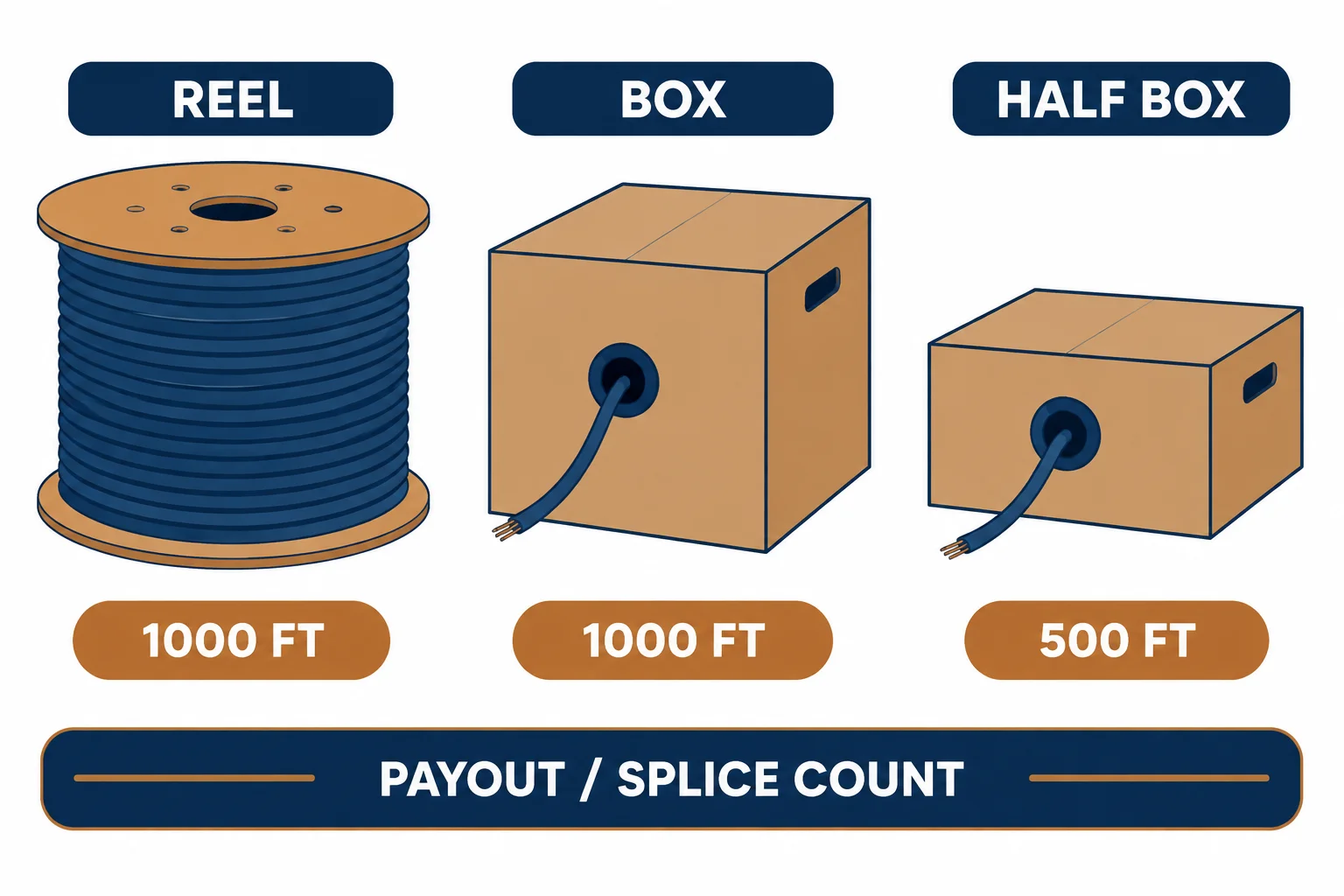
A box of Cat6 is the unit most installations are planned in: 305 metres of solid cable, one continuous length, paid for once. The box is also where projects go wrong, because the quantity decision is made from a floor plan rather than a measured route.
This is the Cat6 box guide: the sizes available, the measurement that decides how many, and the payout discipline that keeps the cable usable to the last metre.
The Sizes
| The box | The use | The risk |
|---|---|---|
| 305 m (1000 ft) | A floor or a stock | Capital tied up if unused |
| 152 m (500 ft) | A few rooms | Runs out on long layouts |
| Reel | Repeated long pulls | Needs a stand |
The size choice is about the layout: a box either covers the job with margin, or it becomes a joint.
The Measurement
- Measure the route, including every vertical
- Add a metre per end for service loops
- Add five to ten percent for mistakes
- Pull the longest runs first
- Note the footage used at each pull
The measurement is the whole discipline: most shortfalls come from unmeasured verticals rather than from waste.
Payout Discipline
| The practice | The reason |
|---|---|
| Pull through the payout hole | Lifting off the side twists pairs |
| Keep the box upright | Prevents collapse and snagging |
| No sharp edges | Jacket damage |
| Cut after the loop is formed | No short runs |
The payout rules protect pair geometry, which is the part of the cable no test can repair.
Standards and Verification
| The reference | The relevance |
|---|---|
| TIA-568.2-D | Cable and installation practice |
| UL 444 | Jacket ratings |
| IEC 61156 | Cable construction |
| Field test | Channel test per run |
Per-SKU box lengths are not provided in the knowledge base. Standard boxes apply; confirm the footage marker and jacket print on delivery.
Practical Notes
A part-used box is not waste if it is stored properly: coiled at a large radius, out of sunlight, with the remaining length written on the side. Stored badly, it becomes cable that fails at the first bend.
Real-World Applications
The single floor
Twenty-eight drops on one floor: one 305 m box, the footage marker tracked at each pull, the longest runs first – three metres left at the end and no joints.
The vertical omission
A job measured from the floor plan: two drops short because the riser height was not counted. A second box ordered mid-project – the measurement lesson learned at cost.
The stored remainder
Half a box kept against a sunny window: the jacket stiff a year later and unusable for a client job. Stored in its box in a cupboard afterwards – the remainder stayed serviceable.
Related reading: The bulk order arithmetic — blogs/news/bulk-ethernet-cable-box
Related reading: The standard 1000 ft format — blogs/news/1000-ft-ethernet-cable
Frequently Asked Questions
How much cable is in a box of Cat6?
A standard box is 305 metres, or 1000 feet.
How many drops will one box cover?
Roughly 25-30 typical drops, depending on route, verticals and loops.
Why pull the longest runs first?
So the remainder can serve the short runs without a joint.
How should a part-used box be stored?
Coiled at a large radius, out of sunlight, with the remaining length marked.
Sourcing cables for a project, a store, or a private-label line? Contact our B2B sales team for specifications, certification evidence, and volume terms – FOB and CIF options available. Request a quote or sample.