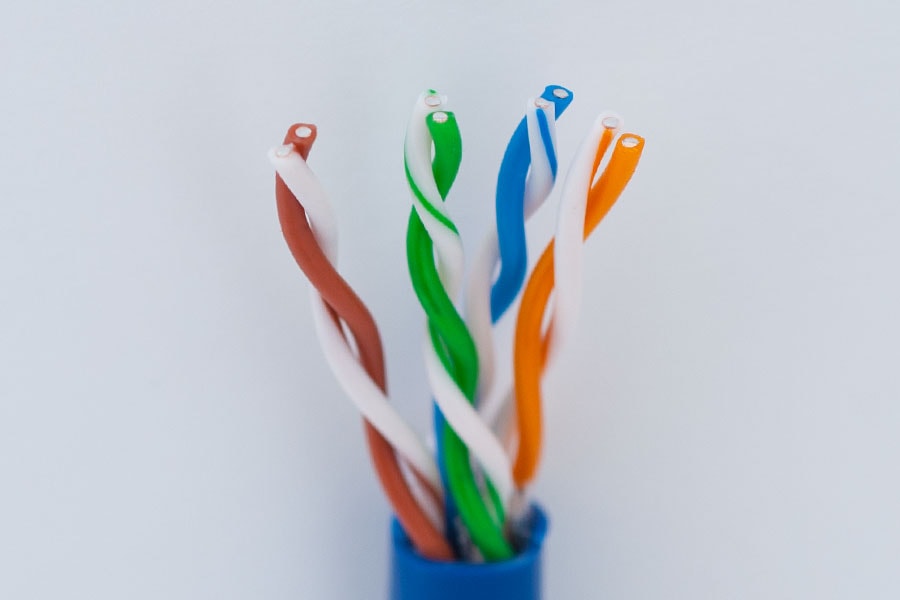
Quick answer: Bare wire is still reliable when three things are right: enough strands twisted in one direction, a twist tight enough to bundle every strand, and a stripped length short enough that no copper crosses between the two posts. Strip around twelve millimetres, twist the bundle with the lay of the strands, and inspect it from the side before you tighten anything.
The cheapest termination also causes the most dead channels. A single strand escapes the twist, curls back along the insulation, and touches the neighbouring post. The amplifier sees a short, protection trips, and the fault looks like a failed channel instead of a wire end. Bare wire speaker cable rewards two slow minutes at each terminal.

What the clamp actually grips
Every spring clip and binding post squeezes a bundle of strands into a block. Contact happens only where metal meets metal, so a bundle that spreads under pressure holds better than one that stays round and springs back when the screw is released.
Strand count at a given gauge
Two cables of the same gauge can hold very different strand counts, one coarse with a few thick wires, one fine with dozens of thin ones. Fine stranding bends around a corner and fills a clamp; coarse stranding resists nicking but leaves gaps in the same clamp.
Twist direction and tightness
Twist one way only, following the lay of the strands, until the bundle holds its own shape. Over twisting work hardens the copper and snaps the outer strands next to the insulation, and those broken ends are the ones that stray.
The short at the post
The gap between two posts is a few millimetres wide. A strand outside the twist has exactly that gap to cross, and it does not need to be long to bridge it.
How a stray strand shows up
Protection circuitry usually trips on the first loud note and resets a minute later, so the fault reads as a thermal problem. On amplifiers without protection the channel distorts and the output stage runs hot instead.
Inspection before power
Look along the wire from the side rather than from above. A stray strand lies flat against the insulation and hides under the terminal nut. A light pull on the bundle lifts any loose end into view.
Stripping length and the sizes that work
Strip too little and the clamp bites insulation; strip too much and bare copper sits outside the terminal where it can sag toward the other post. The useful length leaves about a millimetre of copper past the clamp and no more.
| Size | What the clamp sees | Relative resistance | Where bare wire fits |
|---|
| 18 AWG | Thin bundle, needs a full twist | Highest of the four | Short runs to small satellites |
| 16 AWG | Fills a spring clip well | Moderate | Shelf systems and in room runs |
| 14 AWG | Tight in a small clip | Low | Longer runs and four ohm loads |
| 12 AWG | Often too fat for a clip hole | Lowest of the four | Binding posts and long runs |
Re dressing an end that has been used before
Copper that sat in a clamp for a year keeps the shape of that clamp and carries a dark oxide film where air reached it. Cut back to bright metal instead of adding length, because the film sits exactly at the joint that carries the current. Screw terminals also want one re check after a week of use, since copper creeps under pressure and the joint goes loose.
Where bare wire stops being sensible
Gear that is patched often
Every insertion frays the bundle a little, and after a season of weekly changes the end is mostly broken strands. Equipment that moves between rooms is better served by a plug.
Runs inside a wall
A concealed joint cannot be inspected, and the cable in that space has to carry a jacket rated for it. A bare end behind a wall plate belongs on a proper connector, not on a terminal screw.
Practical scenarios
- Bookshelf rebuild: sixteen gauge, ten millimetres of strip, one clean twist, then a side view to confirm no strand crosses the gap.
- Subwoofer in a corner: twelve gauge into binding posts, with the strip length set by how deep the post hole runs.
- Amp with spring clips: stay at eighteen or sixteen gauge, because a thicker bundle will not enter the clip and half the strands end up outside it.
- Chasing a dead channel: swap the two wires at the amplifier first, then look for the stray strand that started the fault.
FAQ
Should I tin bare wire before clamping?
Usually not. Solder wicks up the strands, hardens the bundle and lets it creep under clamp pressure, so the joint loosens over months. Tinned ends suit screw terminals that are checked often, not spring clips.
How tight should the twist be?
Tight enough that the bundle holds shape when you let go, loose enough that no strand kinks at the insulation. If the copper necks down near the jacket, you have gone too far.
Can the bare end touch the cabinet back?
It should not. A cabinet panel can be conductive if it is metal, and even a painted panel holds moisture. Keep the stripped section inside the terminal body.
Next step
Match the size to the run before you cut anything: the gauge selection guide converts length and load into a size. For long runs to four ohm speakers, compare 12 gauge speaker cable with 14 AWG speaker cable and pick the one that fits your terminals.
See the matching cables and adapters