
Audio Cable Manufacturing: The Four Lines
Quick answer / TL;DR: Short answer: source audio cable by line – XLR (balanced, star-quad common), TRS (balanced or stereo), RCA (unbalanced shielded coax), speaker (unshielded two-core, heavy gauge). Qualify the factory on the lines you actually need, and ask for the specific construction (conductor, shield, capacitance) per line.
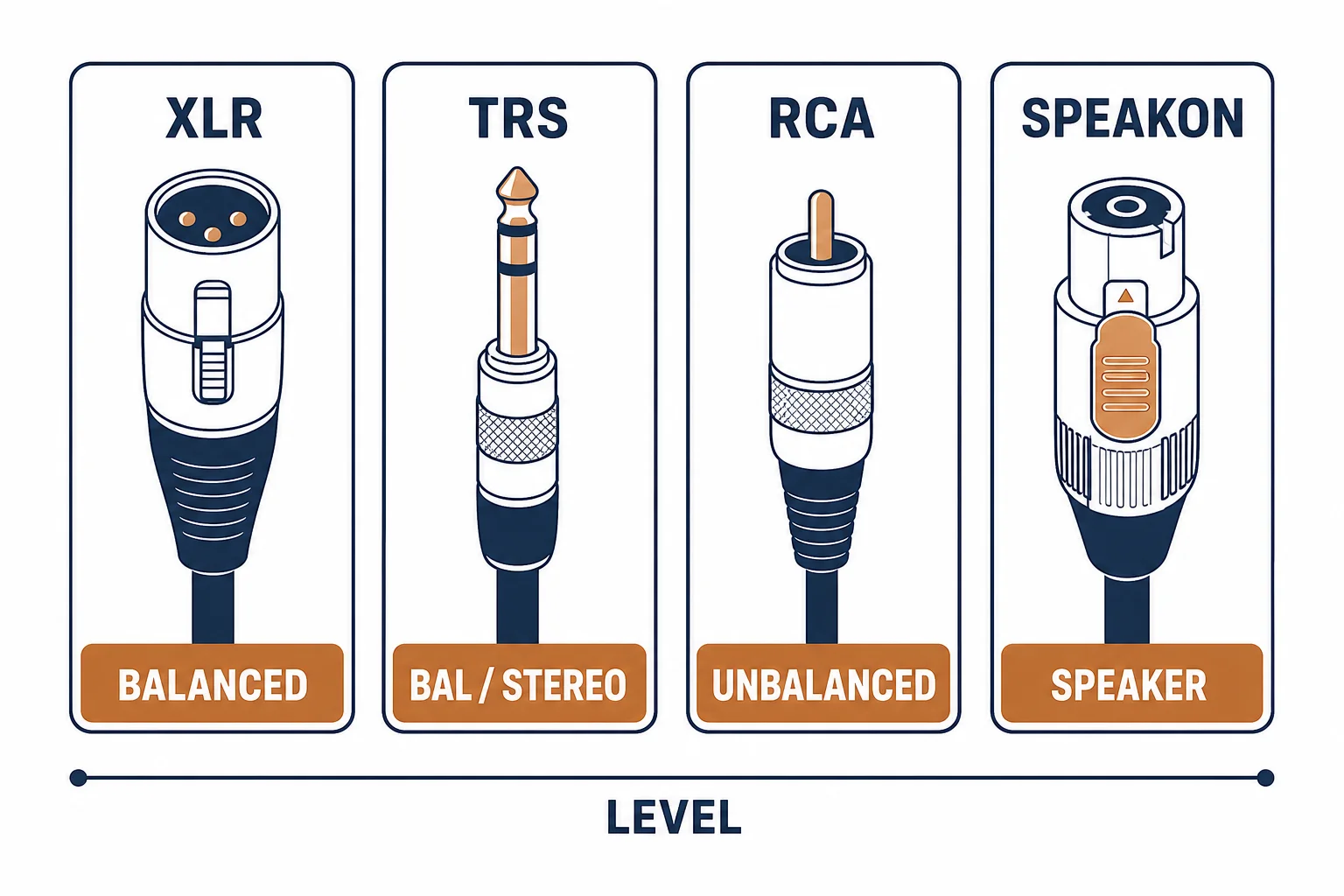
Audio cable manufacturing splits into four lines with different electrical rules: balanced XLR, TRS (balanced or stereo), unbalanced RCA, and speaker cable. A factory that builds one well may not build the others – the shielding, conductor and termination practices differ. This guide is the sourcing map.
This is the manufacturer guide: the four lines, the specification each demands, and the qualification that covers them.
The Four Lines
| The line | The signal | The construction focus |
|---|---|---|
| XLR | Balanced mono | Star-quad or twisted pair, braided shield |
| TRS | Balanced or stereo | Two or three conductors, foil/braid shield |
| RCA | Unbalanced line | Coax with high shield coverage |
| Speaker | Power-level | Two-core, gauge by length |
The construction focus column is the sourcing question: each line's quality lives in a different parameter.
What to Ask the Factory
- XLR: star-quad or standard pair, shield type, connector specifications
- TRS: conductor count, shield coverage, plug strain relief
- RCA: coax construction, shield percentage, connector plating
- Speaker: gauge, strand count, jacket flexibility
The questions are construction-level because the lines differ there – a factory that answers in generalities is assembling, not manufacturing.
The Qualification
| The step | The evidence |
|---|---|
| Line capability | Which lines are made in-house |
| Sample test | Continuity, shield coverage, capacitance where stated |
| Connector quality | Pull test and plating spec |
| Batch consistency | Two samples from different runs compared |
Standards and Verification
| The reference | The relevance |
|---|---|
| AES/EBU practice | Balanced audio interconnection |
| IEC 60268 | Audio system equipment practice |
| RoHS / REACH | Material compliance for connectors and jackets |
Per-SKU capacitance and shield figures are not provided in the knowledge base. The line structure is standard; request construction data per line from the factory.
Real-World Applications
The studio package
A studio ordering XLR and TRS lines together: two constructions specified separately – the same factory, the different rules respected.
The install line
A venue's RCA and speaker runs: coax for the unbalanced feeds, heavy two-core for the speakers – the lines distinguished at the order.
The batch that drifted
Two samples from different production runs compared: shield coverage down on the second – the batch-consistency check catching a supplier change.
Related reading: The coax family these lines borrow from? Read the coaxial wholesalers guide — blogs/news/coaxial-cable-wholesalers
Related reading: The A/V family map? Read the A/V cables guide — blogs/news/a-v-cables-buying
Frequently Asked Questions
What are the main audio cable types?
XLR (balanced), TRS (balanced/stereo), RCA (unbalanced line), and speaker cable (power-level two-core).
Can one factory make all audio cable lines?
Some can, but capability varies – qualify the factory on the specific lines you need and compare samples across runs.
What matters most in XLR cable?
The balanced construction and shield: star-quad or twisted pair with a braided shield, and connectors with real strain relief.
Is expensive audio cable worth it?
At the construction level yes – shielding, conductor and connectors. Beyond the specification, returns are small.
Sourcing cables for a project, a store, or a private-label line? Contact our B2B sales team for specifications, certification evidence, and volume terms – FOB and CIF options available. Request a quote or sample.