
Active HDMI Cable: Powered Inside
Quick answer / TL;DR: Short answer: active HDMI cables equalise or convert the signal, extending reach. They are directional – source end to source – and draw small power from the HDMI port. Use them beyond about 5-10 m at 4K, or where passive cable proves marginal. Fiber HDMI is a type of active cable with the longest reach.
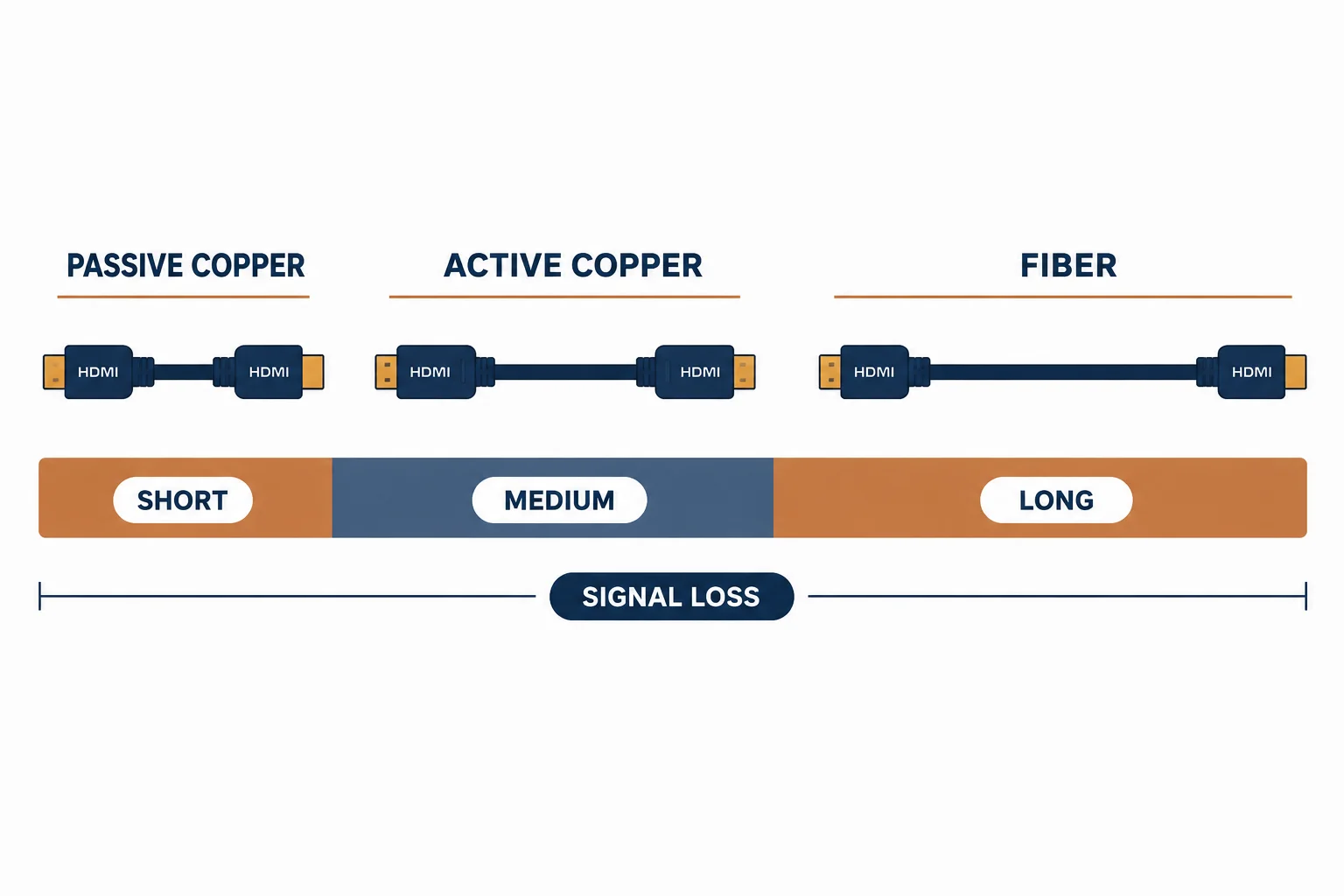
An active HDMI cable contains electronics that equalise or convert the signal, which is how it carries high-bandwidth video further than passive copper. The electronics are also why the cable is directional, why it draws a little power from the port, and why it costs more.
This is the active cable guide: what the chip does, the direction and power rules, and the length where the change from passive is no longer optional.
What the Electronics Do
| The type | The mechanism | The reach |
|---|---|---|
| Passive | Copper only | Short |
| Active copper | Equaliser in the plug | Medium |
| Fiber (AOC) | Electrical to optical | Long |
The mechanism explains the cost and the reach: something has to compensate for what the copper loses.
The Rules
- Direction: marked source and display, not interchangeable
- Power: drawn from the HDMI port, not from a separate supply
- Compatibility: some splitters and switches cannot supply it
- Handling: active plugs are larger and less tolerant of bending
The rules are mechanical and electrical, and every one of them produces a fault that looks like a broken cable.
When Passive Stops Working
| The length | 4K 60 Hz | The verdict |
|---|---|---|
| Up to 5 m | Works | Passive |
| 5-10 m | Usually | Passive, good quality |
| 10-20 m | Marginal | Active |
| Over 20 m | Fails | Fiber |
The crossover depends on the cable's gauge and quality, which is why 'it worked at 8 m' is not a specification.
Standards and Verification
| The reference | The relevance |
|---|---|
| HDMI specification | Signal and cable categories |
| HDCP | Protection through the active electronics |
| Field test | The display's reported mode |
Per-SKU active reach is not provided in the knowledge base. The mechanism is standard; test at the target mode rather than trusting the datasheet distance.
Practical Notes
Active cables fail differently from passive ones: a passive cable degrades gradually, while an active cable can stop working entirely when its power is marginal. A cable that works on one source and not another is often a power-supply symptom.
Real-World Applications
The 15 m projector run
A ceiling projector 15 m from the rack: an active copper cable at 4K 60 Hz – stable where passive had produced sparkle.
The splitter problem
An active cable behind a cheap splitter: no picture. The splitter could not supply the cable's power – the cable moved to a direct port.
The reversed active
An active cable installed backwards in a wall: no signal. Reversed after the marking was found – the direction rule, not the cable, was the issue.
Related reading: The fiber alternative — blogs/news/fiber-optic-hdmi-cable
Related reading: When length outruns copper — blogs/news/25-ft-hdmi-cable
Frequently Asked Questions
What is an active HDMI cable?
One with electronics in the plug that equalise or convert the signal to reach further.
Is it directional?
Yes – the source end must go to the source.
Does it need external power?
No – it draws from the HDMI port, which some devices cannot supply.
When should I use one?
Beyond about 5-10 m at 4K, or where passive cable is marginal.
Sourcing cables for a project, a store, or a private-label line? Contact our B2B sales team for specifications, certification evidence, and volume terms – FOB and CIF options available. Request a quote or sample.